Knowledge How are lab-grown diamonds created? Discover the HPHT and CVD Manufacturing Process
Author avatar

Tech Team · Kintek Solution

Updated 1 week ago

How are lab-grown diamonds created? Discover the HPHT and CVD Manufacturing Process


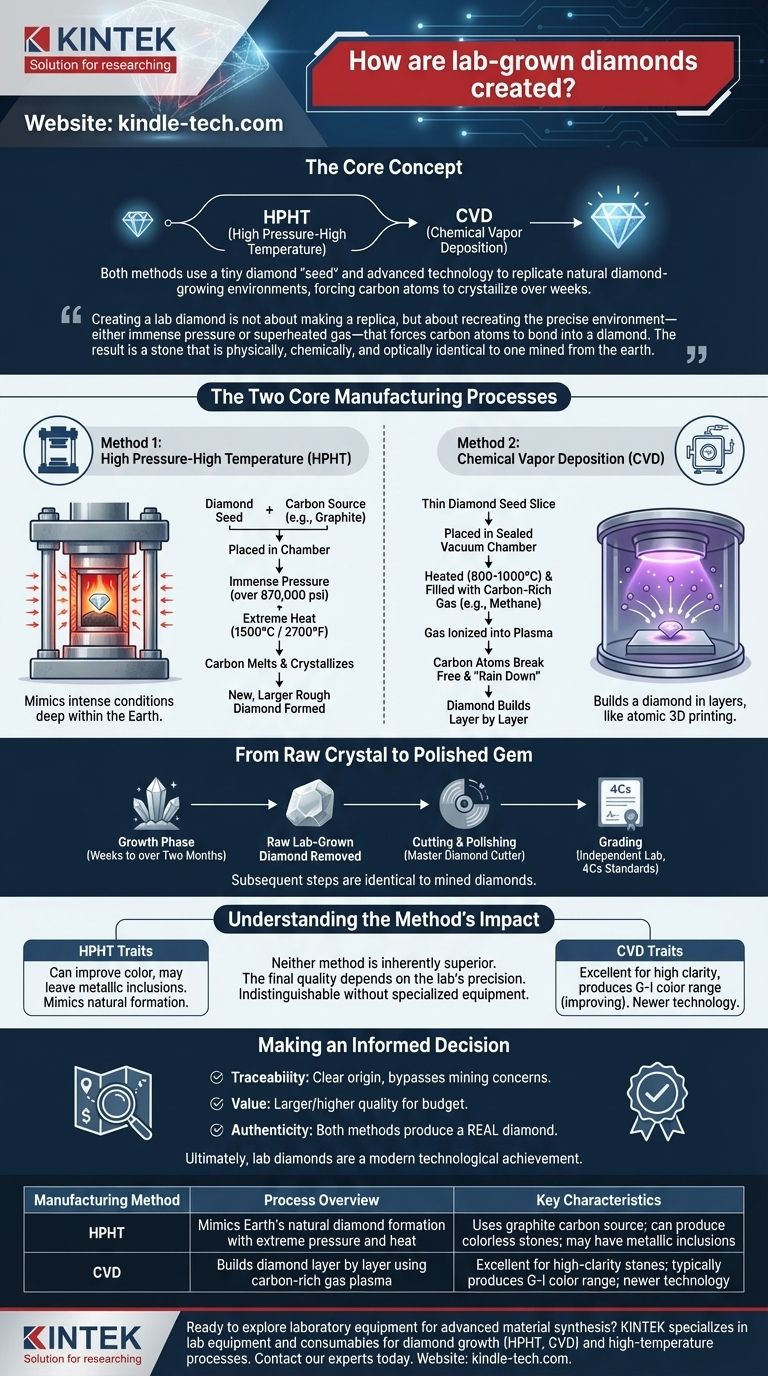
Lab-grown diamonds are created using two primary manufacturing methods: High Pressure-High Temperature (HPHT) and Chemical Vapor Deposition (CVD). Both processes start with a tiny diamond "seed" and use advanced technology to replicate the natural diamond-growing environment, forcing carbon atoms to crystallize into a diamond structure over a matter of weeks.

At its core, creating a lab diamond is not about making a replica, but about recreating the precise environment—either immense pressure or superheated gas—that forces carbon atoms to bond into a diamond. The result is a stone that is physically, chemically, and optically identical to one mined from the earth.
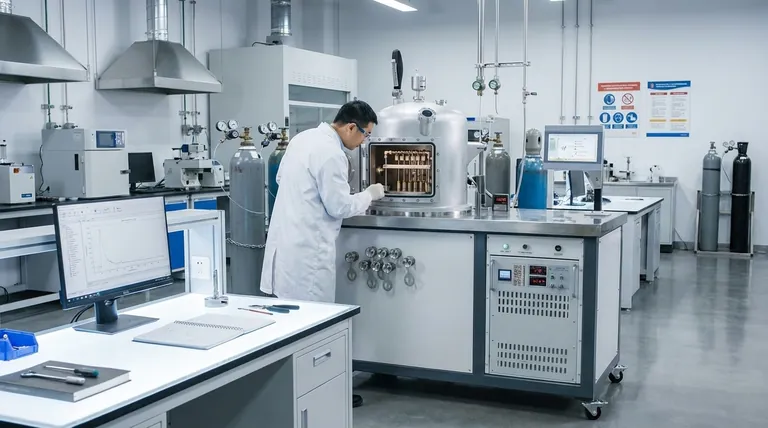
How are lab-grown diamonds created? Discover the HPHT and CVD Manufacturing Process

The Two Core Manufacturing Processes

While a natural diamond takes millions of years to form deep within the Earth's mantle, technology has allowed us to accelerate this process dramatically. The two dominant methods achieve this in different ways.

Method 1: High Pressure-High Temperature (HPHT)

The HPHT method directly mimics the intense conditions found deep within the earth.

A small diamond seed is placed into a chamber along with a pure, solid carbon source, such as graphite.

This chamber is then subjected to immense pressures (over 870,000 pounds per square inch) and extreme heat (around 1500°C / 2700°F).

Under these conditions, the solid carbon source melts and crystallizes around the diamond seed, forming a new, larger rough diamond.

Method 2: Chemical Vapor Deposition (CVD)

The CVD method builds a diamond in layers, almost like atomic 3D printing. It is a newer technique compared to HPHT.

A thin slice of a diamond seed is placed inside a sealed vacuum chamber.

The chamber is heated to a high temperature (around 800-1000°C) and filled with a mixture of carbon-rich gases, like methane.

This high heat ionizes the gases into a plasma, which causes carbon atoms to break free. These carbon atoms then "rain down" and deposit onto the diamond seed, building the diamond layer by layer.

From Raw Crystal to Polished Gem

The creation process does not end when the crystal stops growing. The subsequent steps are identical to those for a mined diamond, demonstrating that the final product is the same material.

The Growth Phase

Depending on the desired size and quality, the growth process for a single gem-quality diamond can take anywhere from several weeks to over two months.

This controlled, steady growth is critical for achieving the high clarity and desired color characteristics of a beautiful gemstone.

Cutting, Polishing, and Grading

Once the rough lab-grown diamond is formed, it is removed from the growth chamber. It is then sent to a master diamond cutter who plans, cuts, and polishes the stone to maximize its brilliance and beauty.

After polishing, the diamond is sent to an independent gemological laboratory to be graded on the exact same standards as natural diamonds—the 4Cs of Cut, Color, Clarity, and Carat.

Understanding the Method's Impact

While both HPHT and CVD produce real diamonds, the different growth environments can leave subtle microscopic clues and influence the final characteristics of the rough stone.

Inherent Traits of Each Method

CVD diamonds historically tended to be produced in the warmer G-I color range, though technology is constantly improving this. The process is excellent for producing very high-clarity stones.

HPHT can be used to improve the color of some diamonds (both lab-grown and natural) after they are grown, turning brownish stones into colorless ones. However, the process can sometimes leave trace metallic inclusions from the growth cell.

Why the Method Doesn't Affect Authenticity

Neither method is inherently superior; they are simply different paths to the same result. The final quality of the diamond depends on the precision of the specific lab's process and the skill of the diamond cutter.

Without highly specialized gemological equipment, it is impossible to distinguish a lab-grown diamond from a natural one, let alone tell which method was used to create it.

Making an Informed Decision

Understanding the manufacturing process demystifies the product, allowing you to focus on what matters most for your specific goals.

  • If your primary focus is traceability: A lab-grown diamond provides a clear, documented origin, bypassing the environmental and ethical concerns associated with mining.
  • If your primary focus is value: The efficiency of the lab process means you can typically acquire a larger or higher-quality diamond for a given budget compared to a natural stone.
  • If your primary focus is authenticity: Rest assured that both HPHT and CVD produce a real diamond. The choice of growth method does not change the fact that the final product is a genuine carbon crystal.

Ultimately, understanding how lab diamonds are made empowers you to see them not as an alternative, but as a modern technological achievement.

Summary Table:

Manufacturing Method Process Overview Key Characteristics
High Pressure-High Temperature (HPHT) Mimics Earth's natural diamond formation with extreme pressure and heat Uses graphite carbon source; can produce colorless stones; may have metallic inclusions
Chemical Vapor Deposition (CVD) Builds diamond layer by layer using carbon-rich gas plasma Excellent for high-clarity stones; typically produces G-I color range; newer technology

Ready to explore laboratory equipment for advanced material synthesis? KINTEK specializes in lab equipment and consumables, serving researchers and manufacturers who need reliable solutions for diamond growth and other high-temperature processes. Whether you're developing CVD systems or HPHT technology, our expertise can help you achieve precise, repeatable results. Contact our experts today to discuss how we can support your laboratory's specific needs in materials science and gemstone synthesis.

Visual Guide
How are lab-grown diamonds created? Discover the HPHT and CVD Manufacturing Process Visual Guide

Related Products

People Also Ask

Related Products

HFCVD Machine System Equipment for Drawing Die Nano-Diamond Coating

HFCVD Machine System Equipment for Drawing Die Nano-Diamond Coating

The nano-diamond composite coating drawing die uses cemented carbide (WC-Co) as the substrate, and uses the chemical vapor phase method ( CVD method for short ) to coat the conventional diamond and nano-diamond composite coating on the surface of the inner hole of the mold.

915MHz MPCVD Diamond Machine Microwave Plasma Chemical Vapor Deposition System Reactor

915MHz MPCVD Diamond Machine Microwave Plasma Chemical Vapor Deposition System Reactor

915MHz MPCVD Diamond Machine and its multi-crystal effective growth, the maximum area can reach 8 inches, the maximum effective growth area of single crystal can reach 5 inches. This equipment is mainly used for the production of large-size polycrystalline diamond films, the growth of long single crystal diamonds, the low-temperature growth of high-quality graphene, and other materials that require energy provided by microwave plasma for growth.

CVD Diamond Domes for Industrial and Scientific Applications

CVD Diamond Domes for Industrial and Scientific Applications

Discover CVD diamond domes, the ultimate solution for high-performance loudspeakers. Made with DC Arc Plasma Jet technology, these domes deliver exceptional sound quality, durability, and power handling.

CVD Diamond Cutting Tool Blanks for Precision Machining

CVD Diamond Cutting Tool Blanks for Precision Machining

CVD Diamond Cutting Tools: Superior Wear Resistance, Low Friction, High Thermal Conductivity for Non-Ferrous Materials, Ceramics, Composites Machining

Laboratory CVD Boron Doped Diamond Materials

Laboratory CVD Boron Doped Diamond Materials

CVD boron-doped diamond: A versatile material enabling tailored electrical conductivity, optical transparency, and exceptional thermal properties for applications in electronics, optics, sensing, and quantum technologies.

Vacuum Hot Press Furnace Machine for Lamination and Heating

Vacuum Hot Press Furnace Machine for Lamination and Heating

Experience clean and precise lamination with Vacuum Lamination Press. Perfect for wafer bonding, thin-film transformations, and LCP lamination. Order now!

Small Vacuum Heat Treat and Tungsten Wire Sintering Furnace

Small Vacuum Heat Treat and Tungsten Wire Sintering Furnace

The small vacuum tungsten wire sintering furnace is a compact experimental vacuum furnace specially designed for universities and scientific research institutes. The furnace features a CNC welded shell and vacuum piping to ensure leak-free operation. Quick-connect electrical connections facilitate relocation and debugging, and the standard electrical control cabinet is safe and convenient to operate.

Vacuum Dental Porcelain Sintering Furnace

Vacuum Dental Porcelain Sintering Furnace

Get precise and reliable results with KinTek's Vacuum Porcelain Furnace. Suitable for all porcelain powders, it features hyperbolic ceramic furnace function, voice prompt, and automatic temperature calibration.

Lab Scale Rotary Single Punch Tablet Press Machine TDP Tablet Punching Machine

Lab Scale Rotary Single Punch Tablet Press Machine TDP Tablet Punching Machine

This machine is a single-pressure automatic rotating, continuous tableting machine that compresses granular raw materials into various tablets. It is mainly used for tablet production in the pharmaceutical industry, and is also suitable for chemical, food, electronics and other industrial sectors.

Ring Press Mold for Lab Applications

Ring Press Mold for Lab Applications

Ring Press Dies, also known as Circular Pellet Press Die Sets, are integral components in various industrial and laboratory processes.

High Energy Vibratory Laboratory Ball Mill Grinding Mill Single Tank Type

High Energy Vibratory Laboratory Ball Mill Grinding Mill Single Tank Type

High-energy vibration ball mill is a small desktop laboratory grinding instrument.It can be ball-milled or mixed with different particle sizes and materials by dry and wet methods.

Anti-Cracking Press Mold for Lab Use

Anti-Cracking Press Mold for Lab Use

The anti-cracking press mold is a specialized equipment designed for molding various shapes and sizes of film using high pressure and electric heating.

Laboratory Test Sieves and Sieving Machines

Laboratory Test Sieves and Sieving Machines

Precision lab test sieves & sieving machines for accurate particle analysis. Stainless steel, ISO-compliant, 20μm-125mm range. Request specs now!

High Energy Planetary Ball Mill Milling Machine for Laboratory

High Energy Planetary Ball Mill Milling Machine for Laboratory

The biggest feature is that the high energy planetary ball mill can not only perform fast and effective grinding, but also has good crushing ability

High-Energy Omnidirectional Planetary Ball Mill Milling Machine for Laboratory

High-Energy Omnidirectional Planetary Ball Mill Milling Machine for Laboratory

The KT-P4000E is a new product derived from the vertical high-energy planetary ball mill with a 360° swivel function. Experience faster, uniform, and smaller sample output results with 4 ≤1000ml ball mill jars.

High-Energy Omnidirectional Planetary Ball Mill Machine for Laboratory

High-Energy Omnidirectional Planetary Ball Mill Machine for Laboratory

The KT-P2000E is a new product derived from the vertical high-energy planetary ball mill with a 360°rotation function. The product not only has the characteristics of the vertical high-energy ball mill, but also has a unique 360°rotation function for the planetary body.

High Energy Planetary Ball Mill Milling Machine for Laboratory

High Energy Planetary Ball Mill Milling Machine for Laboratory

Experience fast and effective sample processing with the F-P2000 high-energy planetary ball mill. This versatile equipment offers precise control and excellent grinding capabilities. Perfect for laboratories, it features multiple grinding bowls for simultaneous testing and high output. Achieve optimal results with its ergonomic design, compact structure, and advanced features. Ideal for a wide range of materials, it ensures consistent particle size reduction and low maintenance.

High Energy Planetary Ball Mill Machine for Laboratory Horizontal Tank Type

High Energy Planetary Ball Mill Machine for Laboratory Horizontal Tank Type

The KT-P2000H uses a unique Y-axis planetary trajectory, and utilizes the collision, friction and gravity between the sample and the grinding ball.

Laboratory Sterilizer Lab Autoclave Pulse Vacuum Lifting Sterilizer

Laboratory Sterilizer Lab Autoclave Pulse Vacuum Lifting Sterilizer

The pulse vacuum lifting sterilizer is a state-of-the-art equipment for efficient and precise sterilization. It uses pulsating vacuum technology, customizable cycles, and a user-friendly design for easy operation and safety.

Laboratory Sterilizer Lab Autoclave Vertical Pressure Steam Sterilizer for Liquid Crystal Display Automatic Type

Laboratory Sterilizer Lab Autoclave Vertical Pressure Steam Sterilizer for Liquid Crystal Display Automatic Type

Liquid crystal display automatic vertical sterilizer is a safe, reliable and automatic control sterilization equipment, which is composed of heating system, microcomputer control system and overheating and overvoltage protection system.


Leave Your Message