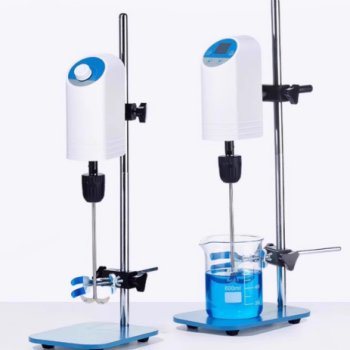
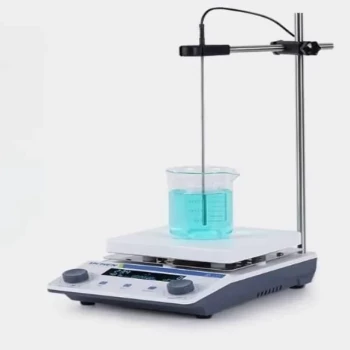
Constant temperature shakers and stirred reactors serve as critical drivers of mechanical intensification during alkaline pretreatment. Rather than allowing the biomass to passively soak, these devices actively force the chemical interaction, ensuring that sodium hydroxide is uniformly distributed throughout the perennial grass slurry for maximum efficacy.
The Core Insight Chemical concentration alone is insufficient for effective lignin removal; it requires physical dynamics to succeed. Mechanical agitation ensures deep chemical penetration and uniform heat transfer, transforming the biomass from a resistant solid into a porous, swollen structure ready for downstream processing.
The Mechanisms of Lignin Removal
Achieving Uniform Distribution
In a static environment, chemical reactions can create localized "dead zones" where the concentration of sodium hydroxide drops, stalling the process.
Stirred reactors prevent this by maintaining a homogenous mixture. This ensures that every particle of grass is exposed to consistent chemical concentrations and temperatures, eliminating gradients that lead to uneven pretreatment.
Facilitating Deep Penetration
Perennial grasses possess a recalcitrant structure designed to resist chemical attack.
Mechanical agitation provides the force necessary to drive alkaline solutions beyond the surface. It facilitates deep penetration into the intricate plant cell walls, ensuring the reactant reaches the internal lignin structure.
Breaking the Chemical Bonds
Once the solution penetrates the cell wall, the active physical mixing supports the chemical attack on the biomass architecture.
The environment created by the reactor promotes the cleavage of ester bonds. This chemical scission is the fundamental step required to dissolve lignin and detach it from the cellulose and hemicellulose matrix.
Inducing Structural Swelling
The process does not just remove material; it physically alters the remaining solids.
The interaction of mechanical force and alkalinity induces chemical swelling of the biomass. This swelling expands the fiber structure, significantly increasing porosity and surface area, which makes the cellulose more accessible for subsequent hydrolysis or fermentation steps.
The Pitfall of Static Processing
The Risk of Surface-Only Treatment
A common error in pretreatment strategy is relying solely on the aggressive pH of sodium hydroxide to break down biomass.
Without the continuous mechanical intensification provided by shakers or reactors, the alkaline solution may only react with the outer surface of the grass particles. This leaves the internal structure intact and the lignin undissolved, resulting in low conversion yields and inefficient use of chemicals.
Making the Right Choice for Your Goal
How to Apply This to Your Project
To maximize the efficiency of your alkaline pretreatment, you must view agitation as a core process variable, not just a mixing step.
- If your primary focus is Maximum Delignification: Prioritize high-agitation reactors that ensure deep penetration of the alkali into the cell wall matrix to cleave ester bonds.
- If your primary focus is Process Consistency: Use constant temperature shakers to eliminate heat and concentration gradients, ensuring every batch yields uniform fiber porosity.
True pretreatment efficiency is achieved only when chemical potential is unlocked by mechanical force.
Summary Table:
| Feature | Mechanical Impact | Pretreatment Outcome |
|---|---|---|
| Agitation | Eliminates chemical gradients | Uniform NaOH distribution & penetration |
| Temp. Control | Maintains kinetic stability | Consistent cleavage of lignin ester bonds |
| Structural Shift | Induces chemical swelling | Increased fiber porosity and surface area |
| Efficiency | Reduces "dead zones" | Higher delignification & conversion yields |
Unlock the Full Potential of Your Biomass Research
Maximize delignification efficiency and ensure process consistency with KINTEK’s advanced laboratory solutions. Whether you are optimizing alkaline pretreatment or scaling up chemical synthesis, our precision shakers, stirred reactors, and high-pressure autoclaves provide the mechanical intensification and thermal stability required for superior results.
From high-performance homogenizers to durable PTFE and ceramic consumables, KINTEK empowers researchers with a comprehensive range of equipment, including:
- High-Temperature Reactors & Autoclaves for deep chemical penetration.
- Constant Temperature Shakers for uniform heat and concentration.
- Crushing, Milling, and Sieving Systems for biomass preparation.
Ready to transform your laboratory yields? Contact our technical experts today to find the perfect equipment for your perennial grass and lignin research.
References
- Lovisa Panduleni Johannes, Tran Dang Xuan. Comparative Analysis of Acidic and Alkaline Pretreatment Techniques for Bioethanol Production from Perennial Grasses. DOI: 10.3390/en17051048
This article is also based on technical information from Kintek Solution Knowledge Base .
Related Products
- High Performance Laboratory Stirrers for Diverse Applications
- Laboratory Small Constant Temperature Heated Magnetic Stirrer Heater and Stirrer
- Customizable Laboratory High Temperature High Pressure Reactors for Diverse Scientific Applications
- Mini SS High Pressure Autoclave Reactor for Laboratory Use
- High Pressure Laboratory Autoclave Reactor for Hydrothermal Synthesis
People Also Ask
- How does a laboratory stirrer influence MOF product quality? Master Precision in Non-Solvothermal Synthesis
- What critical role does a Laboratory Stirrer play during leaching? Enhance Titanium-Magnesium Waste Recovery
- What is the primary function of laboratory stirring equipment in the preparation of compost leachate? Optimize Extraction
- What is a laboratory mixer? A Guide to Achieving Perfect Sample Homogeneity
- What is a laboratory mixer used for? Choose the Right Tool for Liquids or Solids