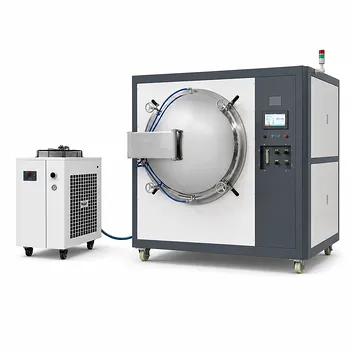
Increasing the applied pressure in a hot-press furnace is the primary driver for achieving high density in boron carbide ceramics. As pressure parameters increase, the contact between ceramic particles becomes significantly tighter, which mechanically forces the elimination of residual porosity. This process converts open pores into closed pores or removes them entirely, directly resulting in higher relative density and improved flexural strength.
The Core Insight Boron carbide possesses strong covalent bonds that naturally resist densification, making standard sintering inefficient. The mechanical pressure in a hot-press furnace acts as an external driving force, overcoming this resistance to achieve near-theoretical density at significantly lower temperatures than would be possible with heat alone.
The Mechanics of Densification
Forcing Particle Rearrangement
The application of axial mechanical pressure—typically ranging from 20 to 100 MPa depending on the specific setup—physically forces ceramic particles closer together. This initial rearrangement is critical for reducing the volume of void spaces between particles before thermal fusion fully takes over.
The Transition from Open to Closed Porosity
As pressure increases, the nature of the material's porosity changes. The mechanical force collapses "open" porosity (interconnected pores that reach the surface). These are either converted into isolated "closed" pores or eliminated completely, which is the defining factor in achieving high relative density.
Inducing Plastic Flow
Under high pressure and temperature, boron carbide particles undergo plastic flow. This means the solid material begins to deform and flow into remaining voids. This mechanism is essential for filling the microscopic gaps that standard diffusion (movement of atoms due to heat) cannot resolve on its own.
Why Boron Carbide Specifically Needs Pressure
Overcoming Covalent Bonding
Boron carbide is characterized by a high percentage of covalent bonds (approx. 94%) and low diffusion coefficients. These properties make the material extremely resistant to sintering; atoms do not want to move or bond across particles easily.
The Failure of Pressureless Sintering
Without the assistance of mechanical pressure, sintering boron carbide is inefficient. Conventional pressureless methods often require extreme temperatures (2250–2300°C) yet still fail to achieve full density, typically capping out at 80–87% relative density.
Achieving Near-Theoretical Density
By introducing pressure, hot-press furnaces can push the material to relative densities exceeding 90%, and often close to the material's theoretical physical limit. This high density is directly correlated with superior mechanical performance and hardness.
Understanding the Trade-offs
Temperature vs. Pressure Balance
One of the most significant advantages of applying pressure is the ability to reduce thermal stress. High pressure increases the sintering driving force, allowing you to lower the required sintering temperature by 100–200°C.
Controlling Grain Coarsening
There is a critical trade-off between densification and microstructure. High temperatures in pressureless sintering often lead to rapid "grain growth" (coarsening), which weakens the ceramic. By using high pressure to sinter at lower temperatures (e.g., 1850°C instead of 2300°C), you inhibit grain growth, resulting in a fine-grained microstructure that is significantly stronger.
Geometry Limitations
While hot pressing is superior for density, the application of uniaxial mechanical pressure imposes geometric constraints. The process is most effective for simple shapes (plates, disks) where pressure can be applied evenly. Complex geometries may suffer from density gradients if the pressure cannot be distributed uniformly.
Making the Right Choice for Your Goal
When configuring your sintering parameters for boron carbide, consider your primary performance metric:
- If your primary focus is Maximum Density: Maximize the applied pressure (up to 100 MPa) to mechanically eliminate all open porosity and force plastic flow into voids.
- If your primary focus is Mechanical Strength: Prioritize a balance of high pressure and reduced temperature to achieve full density while maintaining a fine grain size (preventing coarsening).
- If your primary focus is Process Efficiency: Utilize higher pressure to lower the required sintering temperature and shorten the overall densification time.
By substituting thermal energy with mechanical force, you can bypass the natural limitations of boron carbide to create a denser, stronger, and more reliable ceramic.
Summary Table:
| Parameter Influence | Effect on Boron Carbide | Impact on Microstructure |
|---|---|---|
| Increased Pressure | Reduces porosity & increases density | Forces particle rearrangement & plastic flow |
| High Axial Force | Converts open pores to closed pores | Achieves near-theoretical density (>90%) |
| Lower Temperature | Reduces thermal stress & prevents coarsening | Maintains fine-grained, high-strength structure |
| Uniaxial Pressing | Improves densification efficiency | Best suited for simple shapes (plates, disks) |
Maximize Your Material Performance with KINTEK
Achieving the perfect balance between density and grain size requires precision equipment designed for extreme environments. KINTEK provides industry-leading hot-press furnaces and hydraulic presses specifically engineered to overcome the covalent bonding challenges of boron carbide and other advanced ceramics.
Beyond sintering, our comprehensive portfolio includes high-temperature high-pressure reactors, vacuum furnaces, and crushing systems to support every stage of your lab's workflow. Partner with KINTEK to leverage our technical expertise and high-performance consumables for superior research results.
Ready to optimize your ceramic densification?
Contact Our Technical Experts Today
Related Products
- 600T Vacuum Induction Hot Press Furnace for Heat Treat and Sintering
- Vacuum Heat Treat and Pressure Sintering Furnace for High Temperature Applications
- Vacuum Heat Treat and Sintering Furnace with 9MPa Air Pressure
- Vacuum Hot Press Furnace Heated Vacuum Press Machine Tube Furnace
- Vacuum Hot Press Furnace Machine Heated Vacuum Press
People Also Ask
- What role does an induction vacuum hot pressing furnace play in sintering? Achieve 98% Density in Carbide Blocks
- What advantages does a vacuum hot press furnace provide for LSLBO ceramic electrolytes? Achieve 94% Relative Density
- What role does a Vacuum Hot Press (VHP) furnace play in the densification of austenitic stainless steel 316 composites?
- What are the advantages of a vacuum hot press furnace for W-50%Cu? Achieve 99.6% Density at Lower Temperatures
- What role does mechanical pressure play during the vacuum diffusion bonding of tungsten and copper? Keys to Solid Bonding