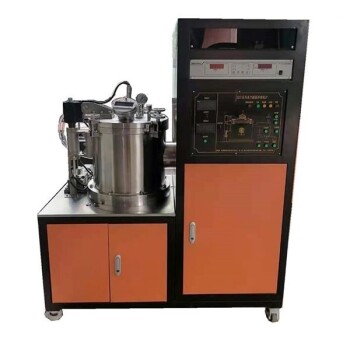
Vacuum furnaces paired with flexible diaphragm systems ensure the quality of diffusion bonding by creating a strictly controlled environment that combines high-temperature vacuum conditions with precise argon gas pressure. This dual approach protects reactive titanium-aluminum alloys from oxidation while mechanically forcing atomic layers together, resulting in a solid-state bond where the original interfaces become chemically and structurally indistinguishable.
The synergy between the vacuum environment and the flexible pressure diaphragm is the key to eliminating interfacial pores. It facilitates atomic migration across layer boundaries, transforming a stack of distinct sheets into a single, high-strength composite with isotropic mechanical properties.
The Role of the Vacuum Environment
Prevention of Oxidation
Titanium and aluminum alloys are highly reactive to oxygen at elevated temperatures. The vacuum furnace creates an oxygen-free atmosphere that prevents the formation of brittle oxide layers on the surface of the sheets.
Surface Activation
By maintaining a high vacuum, the system ensures that the metallic surfaces remain chemically active. This purity is a prerequisite for atoms to migrate successfully between layers without contaminants blocking the diffusion path.
The Mechanics of the Flexible Diaphragm
Application of Uniform Pressure
Inside the furnace, a flexible diaphragm (often a membrane) is used to apply pressure to the laminate stack. Unlike rigid mechanical presses, this diaphragm utilizes argon gas to exert isostatic-like force.
Ensuring Intimate Contact
The flexible nature of the diaphragm ensures that pressure is distributed evenly across the entire surface area of the laminate. This forces the stacked layers into intimate contact, closing microscopic gaps and overcoming surface irregularities that could lead to voids.
Achieving Atomic-Level Fusion
Solid-State Diffusion
The process occurs in a solid state, meaning the metal never melts. Instead, the combination of high heat and the pressure from the diaphragm excites the atoms, causing them to migrate across the boundary lines of the stacked sheets.
Elimination of Interfacial Pores
As atoms diffuse across the contact points, interfacial pores are effectively filled and eliminated. This healing process is so complete that the original interfaces often become invisible under microstructural examination.
Creation of Isotropic Properties
The result of this uniform diffusion is a material structure that behaves consistently in all directions (isotropic). The laminated material gains a unified microstructure, balancing high strength with significant impact toughness.
Critical Process Constraints
Sensitivity to Pressure Variations
The success of the bond relies entirely on the precision of the pressure applied via the diaphragm. If the argon pressure is insufficient or uneven, "kissing bonds" (weak partial bonds) may form, retaining microscopic voids that compromise structural integrity.
Strict Atmospheric Control
The vacuum integrity is non-negotiable. Even minor leaks or insufficient vacuum levels can introduce oxygen, leading to embrittlement of the titanium alloy. This compromises the ductility and toughness of the final composite, negating the benefits of the lamination process.
Making the Right Choice for Your Goal
To maximize the effectiveness of this manufacturing process, consider your specific performance requirements:
- If your primary focus is Impact Toughness: Prioritize the precision of the flexible diaphragm pressure to ensure all interfacial pores are eliminated, as voids act as crack initiation sites.
- If your primary focus is Microstructural Uniformity: Focus on the vacuum integrity and temperature cycling to prevent oxidation and ensure the grain structure remains consistent across the bond lines.
By integrating precise atmospheric control with uniform mechanical pressure, you transform multi-layered laminates into high-performance structural components.
Summary Table:
| Feature | Role in Diffusion Bonding | Benefit to Ti-Al Laminates |
|---|---|---|
| High Vacuum | Prevents oxidation and activates surfaces | Ensures ductile, contaminant-free bonds |
| Flexible Diaphragm | Applies uniform argon gas pressure | Eliminates voids and interfacial pores |
| Solid-State Diffusion | Facilitates atomic migration | Creates isotropic, high-strength structures |
| Thermal Control | Regulates temperature cycling | Maintains microstructural uniformity |
Elevate Your Material Integrity with KINTEK Advanced Solutions
Precise diffusion bonding requires uncompromising atmospheric control and uniform pressure distribution. KINTEK specializes in high-performance laboratory equipment designed to meet these rigorous standards. From our state-of-the-art high-temperature vacuum furnaces and isostatic presses to specialized high-temperature high-pressure reactors, we provide the tools necessary to eliminate interfacial pores and achieve superior isotropic properties in your composites.
Whether you are developing titanium-aluminum laminates or conducting advanced battery research, our comprehensive portfolio—including muffle furnaces, crushing systems, and cooling solutions—ensures your lab operates at peak efficiency.
Ready to optimize your bonding process? Contact KINTEK today to discover how our expert-grade equipment can transform your research and manufacturing outcomes.
References
- Edyta Słupek, Jacek Gębicki. New generation of green sorbents for desulfurization of biogas streams. DOI: 10.21175/rad.abstr.book.2023.17.3
This article is also based on technical information from Kintek Solution Knowledge Base .
Related Products
- Vacuum Hot Press Furnace Machine for Lamination and Heating
- Vacuum Arc Induction Melting Furnace
- High Temperature Muffle Oven Furnace for Laboratory Debinding and Pre Sintering
- Vacuum Heat Treat and Pressure Sintering Furnace for High Temperature Applications
- Vacuum Heat Treat and Molybdenum Wire Sintering Furnace for Vacuum Sintering
People Also Ask
- What advantages does a vacuum hot press furnace provide for LSLBO ceramic electrolytes? Achieve 94% Relative Density
- Why is it necessary to maintain a high-vacuum environment within a vacuum hot press furnace? Optimize Cu-SiC Sintering
- What are the advantages of using a vacuum hot press furnace for sintering CNT/Cu composites? Superior Density & Bonding
- What are the advantages of a vacuum hot press furnace for W-50%Cu? Achieve 99.6% Density at Lower Temperatures
- What role does mechanical pressure play during the vacuum diffusion bonding of tungsten and copper? Keys to Solid Bonding