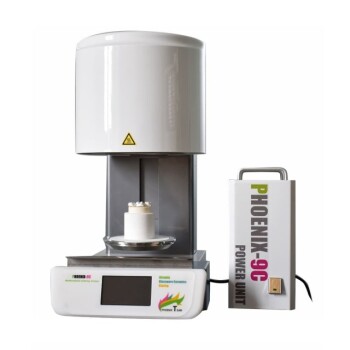
Vacuum and atmosphere furnaces enable near-net-shape forming by maintaining precise high-temperature environments that facilitate the infiltration of molten silicon into a porous green body without altering its external dimensions. Unlike traditional sintering which relies on shrinkage to densify a part, this process uses an in-situ chemical reaction to fill internal voids, ensuring the final Silicon Carbide product retains the exact geometry of the initial mold.
The defining characteristic of reaction sintering is the virtual elimination of macroscopic shrinkage. By creating a new ceramic phase within the material's pores rather than compressing the material itself, these furnaces allow for the production of complex components with exceptional dimensional precision.
The Mechanics of Dimensional Stability
The Role of Thermal Precision
Reaction sintering furnaces are engineered to operate strictly between 1450°C and 1700°C.
This specific temperature window is critical for melting silicon while maintaining the structural integrity of the Silicon Carbide green body.
If the temperature deviates significantly, the viscosity of the silicon or the stability of the green body could be compromised, threatening the shape of the part.
Infiltration via Capillary Action
Once the target temperature is reached, molten silicon is introduced to the "green body," which consists of Silicon Carbide and carbon powder.
The furnace environment allows the molten silicon to penetrate the material through capillary action.
This natural wicking force draws the liquid into the microscopic pores of the solid structure without requiring external mechanical pressure that could distort the shape.
The In-Situ Reaction
As the silicon infiltrates the porous structure, it reacts chemically with the carbon powder present in the green body.
This reaction generates a new phase of Silicon Carbide that grows to fill the internal voids.
Because this new material is created inside the existing pore network, the density of the part increases significantly while the outer boundaries remain static.
Critical Process Considerations
Managing Material Composition
While the furnace provides the environment, the success of near-net-shape forming relies heavily on the initial composition of the green body.
The ratio of carbon powder to pore volume must be calculated precisely to ensure the reaction fills the voids completely.
The Trade-off of Infiltration
Reliance on capillary action means the process is sensitive to the pore size and distribution within the green body.
If the pores are too small or unconnected, the molten silicon cannot infiltrate effectively, leading to weak spots or inconsistent density.
Conversely, this method is generally limited to materials that can withstand the aggressive reaction between silicon and carbon without degrading.
Leveraging Near-Net-Shape Manufacturing
If your primary focus is Complex Geometry:
- Utilize reaction sintering for parts with intricate internal channels or thin walls, as the lack of shrinkage prevents warping that typically occurs in standard firing.
If your primary focus is Tight Tolerances:
- Choose this process to eliminate the need for expensive post-sintering machining, as the final part will virtually match the dimensions of the green body.
By mastering the reaction sintering process, you transform the challenge of ceramic shrinkage into an opportunity for unparalleled manufacturing precision.
Summary Table:
| Feature | Reaction Sintering Mechanism | Benefit for Near-Net-Shape |
|---|---|---|
| Shrinkage | Virtual elimination (0% macroscopic shrinkage) | Dimensions match the initial green body exactly |
| Densification | In-situ reaction fills internal pores with new SiC | Maintains structural integrity without compression |
| Mechanism | Capillary action infiltration of molten silicon | No external pressure required; prevents part distortion |
| Temp. Range | Precise control between 1450°C and 1700°C | Ensures stable silicon viscosity and body stability |
| Geometry | Chemical bonding within the existing pore network | Enables complex designs and tight tolerances |
Elevate Your Material Precision with KINTEK Solutions
Are you struggling with shrinkage and dimensional inaccuracies in your ceramic manufacturing? KINTEK specializes in advanced laboratory and industrial thermal systems designed for the most demanding applications. Our high-performance vacuum and atmosphere furnaces provide the thermal precision and atmosphere control necessary to master reaction sintering for Silicon Carbide and other complex ceramics.
By partnering with KINTEK, you gain access to a comprehensive portfolio of high-temperature solutions, including:
- Advanced Furnaces: Muffle, tube, vacuum, and atmosphere furnaces for exact sintering profiles.
- Processing Equipment: High-pressure reactors, hydraulic presses (isostatic and hot), and crushing/milling systems.
- Specialized Consumables: High-purity ceramics, crucibles, and PTFE products to ensure zero contamination.
Transform your production with near-net-shape accuracy and eliminate costly post-processing. Contact KINTEK today to discuss your specific laboratory or production requirements!
References
- Hidehiko Tanaka. Silicon carbide powder and sintered materials. DOI: 10.2109/jcersj2.119.218
This article is also based on technical information from Kintek Solution Knowledge Base .
Related Products
- Spark Plasma Sintering Furnace SPS Furnace
- Vacuum Heat Treat and Sintering Furnace with 9MPa Air Pressure
- Vacuum Heat Treat and Pressure Sintering Furnace for High Temperature Applications
- Vacuum Heat Treat and Molybdenum Wire Sintering Furnace for Vacuum Sintering
- 600T Vacuum Induction Hot Press Furnace for Heat Treat and Sintering
People Also Ask
- What is SPS sintering method? A Guide to High-Speed, High-Performance Material Fabrication
- Why are Spark Plasma Sintering (SPS) furnaces or hot presses utilized in the preparation of Li3PS4 solid electrolytes?
- What is the difference between spark plasma sintering and flash sintering? A Guide to Advanced Sintering Methods
- What technical advantages does a Spark Plasma Sintering (SPS) furnace offer for LZP ceramics? Enhance Ionic Conductivity
- What is the theory of spark plasma sintering? A Guide to Rapid, Low-Temperature Densification