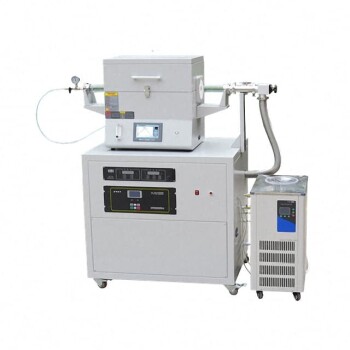
A Chemical Vapor Deposition (CVD) reaction system operates by creating a highly controlled environment where gaseous reactants are introduced and mixed, often at elevated temperatures. When this gas mixture contacts the heated surface of a substrate, a chemical reaction occurs that deposits a high-purity, consistent thin film directly onto the packaging base.
By leveraging controlled chemical reactions at the molecular level, CVD systems significantly enhance the functionality of bio-based packaging, specifically improving barrier properties and moisture resistance.
The Mechanics of Deposition
Controlled Reaction Environment
The core of the CVD process involves a specialized reaction chamber. Here, gaseous reactants are mixed under precise conditions, ranging from room temperature to specific elevated temperatures, to ensure optimal chemical interaction.
Surface Interaction
The transformation happens at the point of contact. As the gas mixture meets the heated substrate surface, the thermal energy triggers a chemical reaction.
Thin Film Formation
This reaction results in the deposition of a solid material. The outcome is a thin film that adheres thoroughly to the packaging base material.
Enhancing Material Performance
Strengthening Barrier Properties
One of the primary goals of applying CVD to packaging is the enhancement of barrier capabilities. The deposited film acts as a shield, reinforcing the base material against external factors.
Increasing Hydrophobicity
For bio-based packaging materials, moisture sensitivity is a common challenge. CVD modifies the surface to significantly increase hydrophobicity, making the packaging more resistant to water absorption.
Precision and Quality Control
High-Purity Consistency
Unlike simple coating methods, CVD produces films of exceptional purity. The process ensures that the coating is highly consistent across the entire surface of the substrate.
Thickness Regulation
The nature of the CVD system allows for exacting control over the film's physical parameters. As demonstrated in advanced applications like nanocrystalline diamond growth, this method permits precise regulation of film thickness (e.g., down to the nanometer scale) and grain size.
Understanding the Trade-offs
Thermal Constraints
The process relies on a heated substrate to trigger the necessary chemical reaction. This requirement can limit the types of packaging materials used, as the substrate must withstand the specific elevated temperatures required for deposition without degrading.
Process Complexity
CVD is not a simple dip-or-spray application; it requires a controlled reaction chamber and precise gas management. This implies a higher level of operational complexity and equipment infrastructure compared to basic coating techniques.
Making the Right Choice for Your Goal
To determine if a CVD system is the right solution for your packaging development, consider your specific performance targets.
- If your primary focus is Durability and Protection: Use CVD to enhance the barrier properties and hydrophobicity of bio-based materials that might otherwise degrade in moist environments.
- If your primary focus is Quality Assurance: Rely on CVD for applications requiring high-purity, uniform thin films where consistency across the packaging surface is non-negotiable.
Leveraging the precision of Chemical Vapor Deposition allows you to elevate standard packaging materials into high-performance, resistant products.
Summary Table:
| Feature | Impact on Packaging Films | Benefits for Nanomaterials |
|---|---|---|
| Barrier Properties | Creates a molecular-level shield | Enhances durability and protection |
| Surface Hydrophobicity | Modifies surface chemistry | Increases resistance to water and moisture |
| Film Purity | Ensures high-purity solid deposition | Provides consistent, high-performance coatings |
| Thickness Control | Regulates film at nanometer scale | Allows for precise functional customization |
| Material Adhesion | Direct chemical reaction on substrate | Ensures long-lasting, robust film bonding |
Elevate Your Packaging Performance with KINTEK
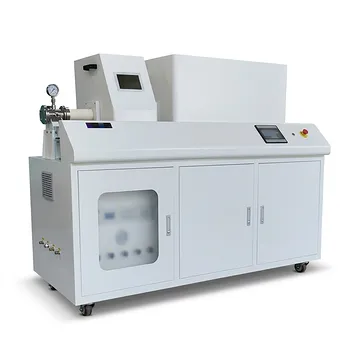
Are you looking to revolutionize your material science with precision coating technology? KINTEK specializes in cutting-edge laboratory equipment, including advanced CVD and PECVD systems designed to transform standard packaging into high-performance, resistant materials.
Whether you are refining nanomaterials or developing bio-based films, our expertise in high-temperature furnaces, vacuum systems, and crushing and milling solutions ensures you achieve the exact purity and thickness your research demands. From high-pressure reactors to essential PTFE and ceramic consumables, KINTEK provides the tools needed to overcome thermal constraints and achieve superior quality assurance.
Ready to enhance your lab’s capabilities? Contact us today to find the perfect CVD solution for your needs!
References
- Pallavi Chaudhary, Ankur Kumar. Relevance of Nanomaterials in Food Packaging and its Advanced Future Prospects. DOI: 10.1007/s10904-020-01674-8
This article is also based on technical information from Kintek Solution Knowledge Base .
Related Products
- Chemical Vapor Deposition CVD Equipment System Chamber Slide PECVD Tube Furnace with Liquid Gasifier PECVD Machine
- Customer Made Versatile CVD Tube Furnace Chemical Vapor Deposition Chamber System Equipment
- HFCVD Machine System Equipment for Drawing Die Nano-Diamond Coating
- Split Chamber CVD Tube Furnace with Vacuum Station Chemical Vapor Deposition System Equipment Machine
- Multi Heating Zones CVD Tube Furnace Machine Chemical Vapor Deposition Chamber System Equipment
People Also Ask
- What are the advantages of chemical vapor deposition? Achieve Superior Thin Films for Your Lab
- What types of substrates are used in CVD to facilitate graphene films? Optimize Graphene Growth with the Right Catalyst
- What is the chemical vapor deposition growth process? Build Superior Thin Films from the Atom Up
- How expensive is chemical vapor deposition? Understanding the True Cost of High-Performance Coating
- Why is Chemical Vapor Deposition (CVD) equipment uniquely suited for constructing hierarchical superhydrophobic structures?