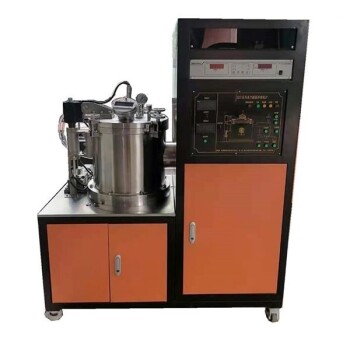
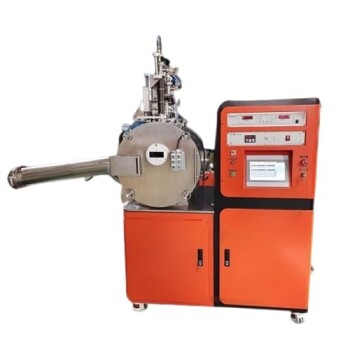
A high vacuum induction melting furnace optimizes FATT50 performance primarily by eliminating impurities at the source. During the material preparation phase, the furnace creates a pure vacuum environment that significantly reduces the concentration of gaseous impurities like oxygen and nitrogen, as well as harmful trace elements like sulfur and phosphorus. This purification minimizes the formation of brittle inclusions at the grain boundaries, directly improving low-temperature toughness and shifting the Fracture Appearance Transition Temperature (FATT50) lower.
Core Takeaway: The quality of a metal’s fracture resistance is determined before solid heat treatment begins. By removing oxidation and contaminants during the liquid phase, high vacuum induction melting ensures the material's microstructure is free of the brittle "weak points" that raise FATT50 scores.
The Role of Purity in Fracture Mechanics
To understand how the furnace impacts FATT50 (the temperature at which a material creates a 50% brittle fracture surface), you must look at the chemistry of the melt.
Elimination of Gaseous Impurities
Standard melting exposes molten metal to atmospheric gases. A high vacuum induction furnace operates in a controlled, gas-free environment.
This prevents the absorption of oxygen and nitrogen, which are detrimental to ductility.
Reduction of Harmful Trace Elements
Beyond gases, the process actively reduces the concentration of sulfur and phosphorus.
These elements are notorious for causing embrittlement. If left in the material, they degrade the metal's ability to absorb energy during impact.
Impact on Microstructure and Grain Boundaries
The physical environment created by the furnace directly dictates the structural integrity of the solidified metal.
Preventing Brittle Inclusions
When impurities like oxygen react with the metal, they form oxides and inclusions.
These inclusions act as stress concentrators within the material. Under load, cracks initiate at these points, leading to premature failure.
Cleaning the Grain Boundaries
Inclusions and impurities tend to segregate (collect) at the grain boundaries of the metal.
By minimizing these inclusions via vacuum melting, the grain boundaries remain "clean" and strong. This cohesion is vital for preventing intergranular fracture, thereby lowering the FATT50 temperature.
Understanding the Trade-offs
While high vacuum induction melting provides superior mechanical properties, it is essential to consider the operational implications.
Complexity and Throughput
Vacuum processing is inherently more complex than open-air melting.
It requires rigorous maintenance of vacuum seals and pumps to ensure a total lack of oxidation and contamination. This can limit the speed of production compared to standard furnaces.
Capacity Limitations
As noted in equipment evaluations, these units are often designed to be compact.
While this makes them energy-efficient and ideal for precision work (like research institutes or precision casting), they may not be suitable for massive, high-tonnage industrial outputs without significant scaling.
Making the Right Choice for Your Goal
The decision to utilize high vacuum induction melting should be based on the specific performance targets of your material.
- If your primary focus is Extreme Toughness: Prioritize high vacuum melting to minimize O, N, S, and P content, ensuring the lowest possible FATT50 for safety-critical applications.
- If your primary focus is Cost and Speed: Evaluate if standard induction melting meets your baseline requirements, as vacuum processing introduces higher operational costs and cycle times.
- If your primary focus is Precision Alloys: Use vacuum melting for materials like platinum, gold, or high-grade steel, where even minor oxidation constitutes a failure.
Ultimately, a high vacuum induction melting furnace is not just a heating tool; it is a purification system that sets the chemical ceiling for your material's toughness.
Summary Table:
| Feature | Impact on FATT50 | Benefit for Metallic Materials |
|---|---|---|
| Vacuum Environment | Reduces Oxygen & Nitrogen | Prevents gas-induced embrittlement |
| Impurity Removal | Lowers Sulfur & Phosphorus | Minimizes brittle grain boundary inclusions |
| Microstructure Control | Eliminates Stress Concentrators | Enhances energy absorption and impact strength |
| Refining Process | Cleans Grain Boundaries | Lowers transition temperature for safety-critical parts |
Elevate Your Material Performance with KINTEK Precision
Don't let impurities compromise your material's fracture resistance. KINTEK specializes in advanced laboratory solutions, including high-performance induction melting furnaces and vacuum systems designed to optimize FATT50 and ensure peak structural integrity.
Whether you are refining precision alloys or conducting critical battery research, our comprehensive portfolio—from high-temperature furnaces and isostatic presses to PTFE consumables and cooling solutions—provides the purity and control your lab demands.
Ready to achieve superior metal toughness? Contact our technical experts today to find the perfect furnace for your research and production needs.
References
- Jijiang Liu, Jun Tan. Research Progress on the Ductile-to-Brittle Transition of Metal Materials: The Impact of FATT50. DOI: 10.57237/j.mater.2023.06.001
This article is also based on technical information from Kintek Solution Knowledge Base .
Related Products
- Vacuum Heat Treat Furnace and Levitation Induction Melting Furnace
- Lab-Scale Vacuum Induction Melting Furnace
- Vacuum Arc Induction Melting Furnace
- Vacuum Induction Melting Spinning System Arc Melting Furnace
- 600T Vacuum Induction Hot Press Furnace for Heat Treat and Sintering
People Also Ask
- What are the advantages of a vacuum induction melting furnace? Achieve High-Purity Alloys with Precision VIM
- What is the function of a vacuum induction melting furnace? Essential Guide for High-Purity FeCrAl Alloy Production
- What are the key components inside the vacuum chamber of a vacuum induction melting furnace? A Guide to the Core Melting Assembly
- Why use VIM for rare earth steel? Essential Precision for Melting Reactive Lanthanum and Cerium
- What is the primary function of a vacuum induction melting furnace in Ni-Mo-Cr-Fe master alloy prep? Ensure High Purity