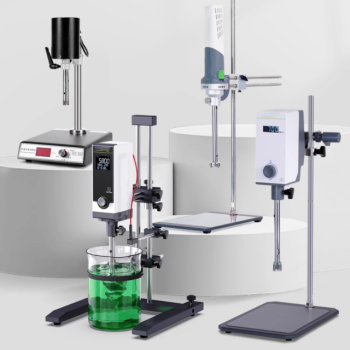
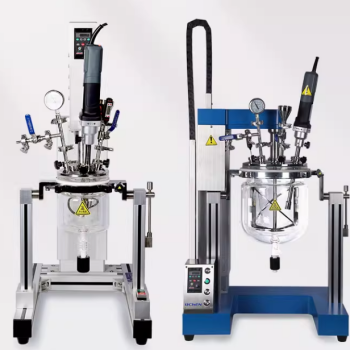
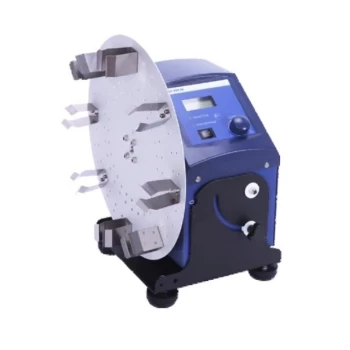
The primary function of a homogenizer is to ensure absolute uniformity in the electrode slurry. It utilizes high-shear mixing forces to thoroughly disperse active materials, conductive agents, and binders within a solvent. By actively breaking down agglomerates of nanopowders, the homogenizer creates a stable, consistent suspension that is essential for manufacturing high-quality lithium-ion batteries.
Core Takeaway The homogenizer acts as the critical quality gatekeeper before coating begins. By eliminating particle clumps and creating a perfectly uniform suspension, it directly enables defect-free electrode surfaces and ensures consistent internal resistance in the final battery cell.
The Mechanism of Dispersion
Applying High-Shear Force
To create an effective slurry, simple stirring is often insufficient. Industrial-grade homogenizers apply intense shear force to the mixture.
This energy is required to blend distinct components—such as active materials (like graphite or metal oxides) and conductive binders—into a single, cohesive suspension.
Breaking Down Agglomerates
Nanopowders and active materials have a natural tendency to clump together, forming agglomerates. These clumps are detrimental to battery performance.
The homogenizer mechanically breaks these structures down. This ensures that active particles are highly dispersed and fully integrated into the solvent rather than remaining as isolated clusters.
Impact on Electrode Quality
Achieving Slurry Stability
A slurry must remain consistent over time to be useful in manufacturing. High levels of uniformity prevent the heavier particles from settling out of the solution too quickly.
This stability is a prerequisite for the coating process. It ensures that the material properties remain constant from the beginning of the batch to the end.
Facilitating Defect-Free Coating
The physical quality of the electrode sheet is determined during the mixing stage. If the slurry contains unbroken agglomerates, the final coating will be rough or uneven.
Proper homogenization guarantees the smoothness of the electrode surface. This allows for a precise, even application of the slurry onto the current collector foil without streaks or lumps.
Ensuring Electrical Consistency
Beyond physical appearance, the homogenizer impacts the electrochemical performance of the battery. Uniform distribution of conductive agents is vital for electron flow.
By creating a uniform suspension, the process ensures the consistency of internal resistance. This prevents "hot spots" or weak points within the battery cell.
The Risks of Inadequate Mixing
Surface Defects
If the homogenization process is incomplete, the immediate result is physical defects on the electrode sheet.
Undispersed particles create irregularities in the coating thickness. These defects can compromise the structural integrity of the electrode and lead to manufacturing waste.
Performance Variability
Inconsistent mixing leads to inconsistent battery performance. If the binder and active materials are not evenly distributed, the battery will lack uniformity.
This results in unpredictable internal resistance. Ultimately, this variability reduces the reliability and cycle life of the lithium-ion battery.
Making the Right Choice for Your Process
The homogenizer is not merely a mixer; it is a tool for precision engineering. Depending on your specific manufacturing targets, your focus on homogenization may vary slightly.
- If your primary focus is Surface Quality: Prioritize high-shear capabilities to fully eliminate agglomerates, ensuring a perfectly smooth and defect-free electrode coating.
- If your primary focus is Battery Consistency: Focus on the uniformity of dispersion to guarantee stable internal resistance and reliable electrical performance across all cells.
Effective homogenization is the foundational step that dictates whether a battery will perform reliably or fail prematurely.
Summary Table:
| Process Factor | Impact on Slurry & Electrode | Key Benefit |
|---|---|---|
| High-Shear Force | Breaks down nanopowder agglomerates | Uniform active material dispersion |
| Dispersion Level | Eliminates lumps and streaks in coating | Smooth, defect-free electrode surface |
| Slurry Stability | Prevents particle sedimentation | Consistent material properties during coating |
| Conductive Uniformity | Even distribution of conductive agents | Lower and more consistent internal resistance |
Elevate Your Battery Research with KINTEK Precision Homogenizers
Don't let poor slurry quality compromise your lithium-ion battery performance. KINTEK specializes in advanced homogenizers and shakers designed to deliver the high-shear force necessary for absolute electrode uniformity. Whether you are working with nanopowders or complex binders, our equipment ensures a stable, defect-free suspension that is critical for high-quality coating and consistent internal resistance.
From high-temperature furnaces and vacuum systems to battery research tools, consumables, and hydraulic presses, KINTEK provides the comprehensive laboratory solutions needed to drive innovation in energy storage.
Ready to optimize your electrode preparation process? Contact KINTEK today to find the perfect homogenization solution for your lab!
Related Products
- High Shear Homogenizer for Pharmaceutical and Cosmetic Applications
- High Performance Lab Homogenizer for Pharma Cosmetics and Food R&D
- Lab Sterile Slapping Type Homogenizer for Tissue Mashing and Dispersing
- Laboratory Disc Rotary Mixer for Efficient Sample Mixing and Homogenization
- Laboratory High Throughput Tissue Grinding Mill Grinder
People Also Ask
- Why Use a High Shear Homogenizer for Cathode Slurries? Optimize Double-Layer Solid-State Battery Production
- What is the function of high-shear dispersion equipment in corona-resistant nanocomposites? Elevate Your Insulation
- What is the necessity of using an industrial-grade high-shear homogenizer for biomass washing? Ensure Process Efficiency
- What are the advantages of using a high-shear homogenizer for BED/GMA coatings? Achieve Superior Nano-Dispersion
- What role does a high-shear homogenizer play in ODC catalyst suspensions? Unlock Superior Electrochemical Efficiency