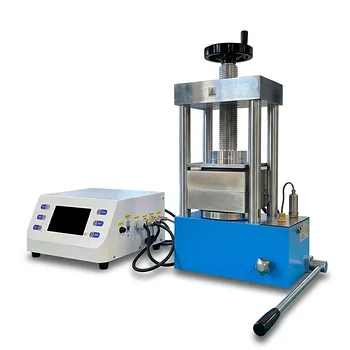
The hydraulic press facilitates silicone rubber curing by providing the simultaneous application of high-precision thermal energy and mechanical pressure. This environment triggers the cross-linking of molecular chains while forcing the material to conform to a specific mold geometry. By maintaining these conditions for a set duration, the machine eliminates internal microbubbles and ensures the composite reaches its maximum structural density and stability.
Core Takeaway: A platen vulcanizing machine serves as the critical catalyst for silicone rubber composites by using controlled heat to drive chemical cross-linking and high pressure to eliminate physical voids, resulting in a dense, uniform, and structurally sound finished product.
Thermal Activation and Molecular Cross-Linking
Initiating the Chemical Reaction
The primary role of the heating system is to provide the activation energy required for vulcanization. As the silicone rubber compound reaches a specific temperature—often ranging from 80°C to 180°C depending on the formulation—the molecular chains begin to form permanent chemical bonds.
Ensuring Degree of Cure Consistency
Precise temperature control is essential to ensure a consistent degree of cure across the entire specimen. Fluctuations in heat can lead to "under-curing," where the material remains tacky, or "over-curing," which can make the composite brittle and prone to failure.
Melting and Matrix Formation
In composites involving binders or polymers, the heat from the platens melts the binding matrix. This allows the material to flow into the gaps between reinforcements, such as fibers or recycled particles, creating a structurally stable bond once the material cools and solidifies.
Mechanical Compaction and Structural Integrity
Elimination of Internal Microbubbles
During the mixing and pouring stages, air is often trapped within the silicone compound. The hydraulic press applies axial pressure (frequently 10 MPa or higher) to expel these air pockets and residual moisture, preventing the formation of internal voids that would otherwise weaken the material.
Increasing Material Bulk Density
High-pressure compaction significantly increases the bulk density of the composite. By forcing the particles into closer proximity, the press reduces interfacial gaps, which directly improves the material’s flexural strength and reduces its water absorption rate.
Geometric Standardization
The use of high-precision molds within the press ensures that the cured specimens have uniform thickness and standardized dimensions. This level of precision is vital for creating test sheets that can perform reliably during subsequent heat flow or mechanical stress testing.
Understanding the Trade-offs and Limitations
Risk of Material Flash and Waste
Applying excessive pressure can cause "flash," where the molten rubber is forced out of the mold cavities into the gaps between the plates. This not only wastes material but can also lead to non-uniform part thickness if the mold does not close perfectly.
Thermal Gradients and Internal Stress
If the platens do not heat evenly, the exterior of the composite may cure faster than the core. This thermal gradient can trap internal stresses within the material, potentially causing warping or cracking once the pressure is released and the part cools.
Cycle Time vs. Material Degradation
While higher temperatures can accelerate the curing process to increase production speed, they also increase the risk of thermal degradation. Finding the balance between rapid cycle times and maintaining the chemical integrity of the silicone chains is a primary challenge in process optimization.
How to Apply This to Your Project
Making the Right Choice for Your Goal
- If your primary focus is mechanical strength: Prioritize high-pressure compaction (10 MPa+) to maximize bulk density and eliminate structural voids that lead to crack propagation.
- If your primary focus is thermal stability: Focus on precise temperature calibration and soak times to ensure a complete and uniform cross-linking reaction throughout the entire thickness of the part.
- If your primary focus is electrical or dielectric performance: Use the press to minimize interfacial gaps between fillers and the silicone matrix, as air voids significantly degrade dielectric constants.
By mastering the intersection of thermal energy and mechanical force, you transform a raw compound into a high-performance engineering material.
Summary Table:
| Mechanism | Function in Curing | Impact on Composite Quality |
|---|---|---|
| Thermal Activation | Initiates molecular cross-linking (80°C–180°C) | Ensures chemical stability and consistent matrix formation |
| Mechanical Pressure | Expels air pockets and internal microbubbles | Increases bulk density and enhances flexural strength |
| Precision Molds | Standardizes thickness and dimensions | Guarantees reliable data for subsequent mechanical testing |
| Cycle Control | Balances heat-up and soak times | Minimizes thermal degradation and internal stresses |
Elevate Your Material Research with KINTEK Precision
Are you looking to optimize the structural integrity of your silicone rubber composites? KINTEK specializes in advanced laboratory equipment designed to deliver the precise thermal and mechanical control your research demands. Our comprehensive range of hydraulic presses (pellet, hot, and isostatic) ensures uniform compaction and void-free curing for every specimen.
Beyond vulcanization, KINTEK offers a full suite of high-performance laboratory solutions, including:
- High-Temperature Furnaces: Muffle, vacuum, CVD, and atmosphere furnaces for expert heat treatment.
- Material Preparation: Crushing, milling, and sieving systems for consistent sample preparation.
- Advanced Reactors: High-temperature high-pressure reactors and autoclaves for complex chemical synthesis.
- Specialized Lab Tools: Electrolytic cells, battery research consumables, and high-purity ceramics or crucibles.
Don't let inconsistent curing compromise your results. Partner with KINTEK for reliable, high-performance tools that guarantee precision in every press.
Contact KINTEK Today for a Custom Solution!
References
- Hao Zhang, Huawei Zou. Improving the Ablation Properties of Liquid Silicone Rubber Composites by Incorporating Hexaphenoxycyclotriphosphonitrile. DOI: 10.3390/nano13030563
This article is also based on technical information from Kintek Solution Knowledge Base .
Related Products
- Heated Hydraulic Press Machine with Integrated Manual Heated Plates for Lab Use
- Automatic High Temperature Heated Hydraulic Press Machine with Heated Plates for Lab
- Automatic Heated Hydraulic Press Machine with Heated Plates for Laboratory Hot Press 25T 30T 50T
- 24T 30T 60T Heated Hydraulic Press Machine with Heated Plates for Laboratory Hot Press
- Heated Hydraulic Press Machine with Heated Plates for Vacuum Box Laboratory Hot Press
People Also Ask
- Why is a heated laboratory hydraulic press necessary for composite laminates? Achieve Void-Free Structural Integrity
- Why is the heating function of a laboratory hydraulic press essential for MEA assembly in DEFC? Optimize Cell Bonding
- What is the core function of a laboratory heated hydraulic press in CSP? Revolutionize Low-Temp Ceramic Sintering
- What role does a heated hydraulic press play in Cold Sintering (CSP)? Enhancing LATP-Halide Densification
- What are heated hydraulic presses used for? Molding Composites, Vulcanizing Rubber, and More