
In simple terms, a hydraulic press works by using an incompressible fluid, like oil, to multiply force. A small amount of force is applied to a small piston, which creates pressure in the fluid. This pressure is then transmitted to a much larger piston, which generates a significantly larger output force capable of shaping, crushing, or forging materials.
The core principle is not about creating energy, but about trading distance for force. By applying a constant pressure over two different-sized areas, a hydraulic press multiplies a small input effort into an immensely powerful output, governed by a fundamental law of physics.
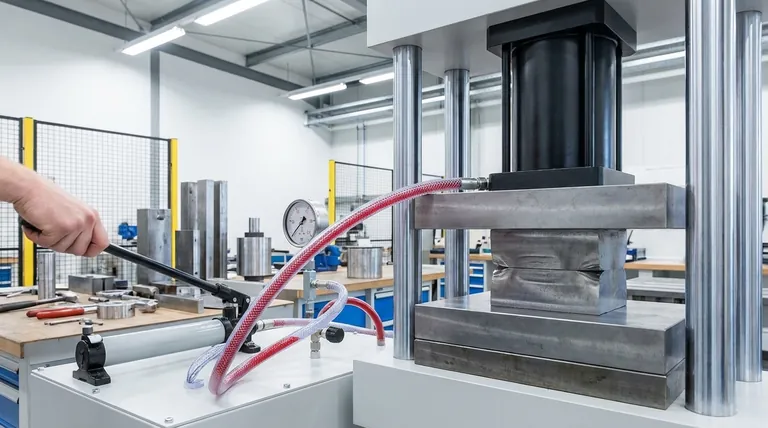
The Core Principle: Pascal's Law Explained
A hydraulic press is a direct application of one of the most fundamental principles in fluid mechanics: Pascal's Law. Understanding this concept is key to understanding the entire system.
What is Pascal's Law?
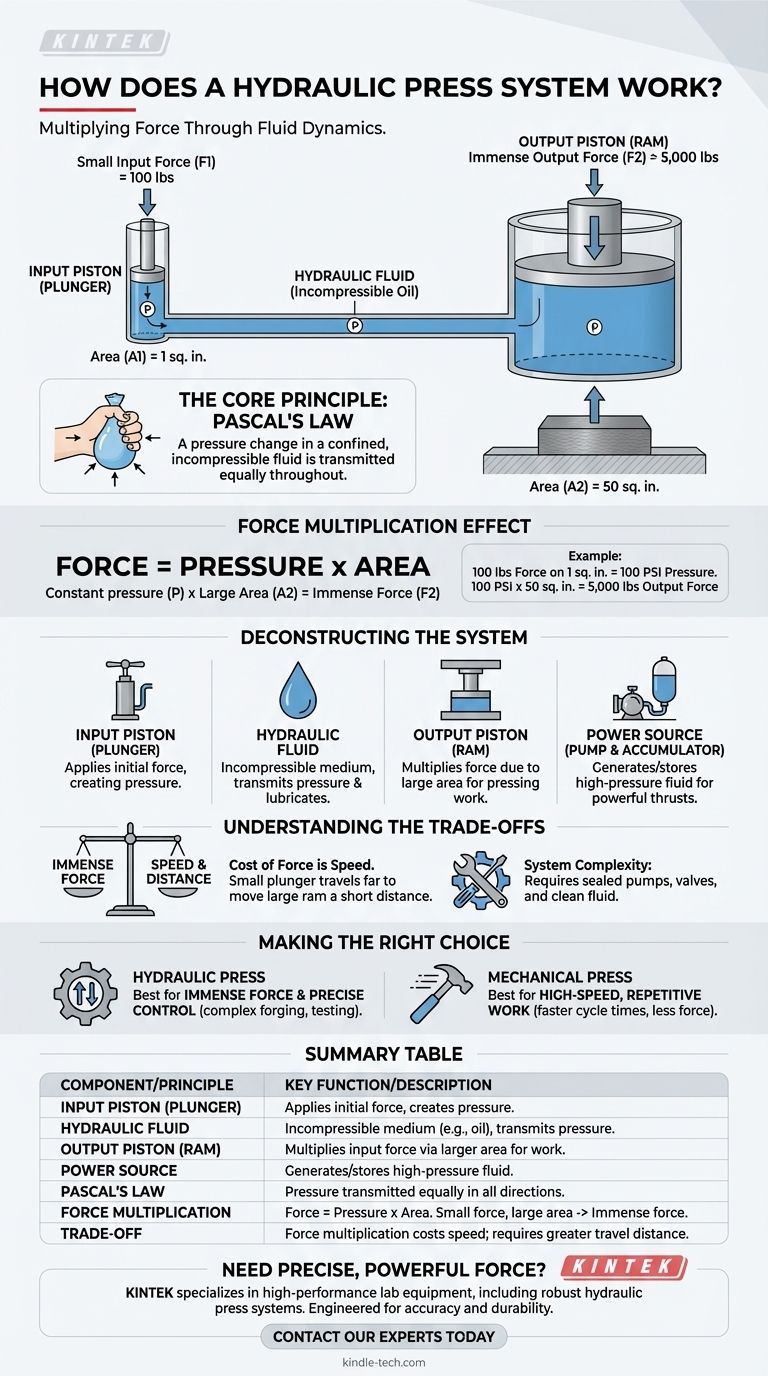
Pascal's Law states that a pressure change at any point in a confined, incompressible fluid is transmitted equally throughout the fluid in all directions.
Think of it like squeezing a sealed water balloon. The pressure you apply with your fingers is felt equally on every other part of the balloon's inner surface.
In a hydraulic press, the "balloon" is a sealed system of cylinders and pipes filled with hydraulic oil.
The Force Multiplication Effect
This is where the true power of the system is unlocked. The formula that matters is Force = Pressure x Area.
Since Pascal's Law guarantees the pressure is constant throughout the fluid, we can use two pistons with different areas to multiply force.
Imagine applying 100 pounds of force to a small input piston (a plunger) with an area of 1 square inch. This generates 100 pounds per square inch (PSI) of pressure in the fluid.
That same 100 PSI of pressure then pushes against a large output piston (a ram) with an area of 50 square inches. The resulting output force is 100 PSI x 50 sq. inches, which equals 5,000 pounds of force.
Deconstructing the Hydraulic Press System
While the principle is simple, a functional press relies on several key components working together to generate and control this immense force.
The Input Piston (Plunger)
This is the smaller piston where the initial force is applied. In many systems, this force is generated by a hydraulic pump, which continuously pushes fluid into the system to build pressure.
The Hydraulic Fluid (The Medium)
Oil is the most common fluid used. It is chosen because it is practically incompressible, meaning it won't squash under pressure and efficiently transfers energy from one piston to the other. It also lubricates the system's moving parts.
The Output Piston (Ram)
This is the larger piston that receives the transmitted pressure from the fluid. Because of its large surface area, it multiplies the initial force and performs the actual work of pressing, forging, or crushing the object placed beneath it.
The Power Source (Pump & Accumulator)
A high-pressure pump is the heart of the system, supplying the pressurized liquid. Sometimes, this is paired with a hydraulic accumulator, a device that stores this high-pressure fluid.
The accumulator acts like a capacitor in an electrical circuit, allowing the system to release a massive amount of stored energy very quickly when a strong, sudden thrust is needed.
Understanding the Trade-offs
The immense force generated by a hydraulic press is not without its compromises. It is crucial to understand the inherent limitations of the design.
The Cost of Force is Speed
There is no free lunch in physics. The trade-off for multiplying force is the distance the pistons must travel.
To move the large ram by just one inch, the small plunger must travel a significantly greater distance. This is why hydraulic presses are incredibly powerful but often much slower than their mechanical counterparts.
System Complexity and Maintenance
Hydraulic systems involve high-pressure pumps, reinforced hoses, precision valves, and critical seals to contain the fluid.
Any leak in the system can lead to a loss of pressure and performance. The hydraulic fluid must also be kept clean and replaced periodically to prevent damage to the components.
Unmatched Control and Precision
Despite their relative slowness, a key advantage of hydraulic systems is their exceptional control.
Operators can precisely manage the force, speed, and position of the ram throughout the entire pressing process. This makes them ideal for complex forging operations where specific geometries and material properties are required.
Making the Right Choice for Your Application
Understanding the principles of a hydraulic press allows you to recognize when its unique characteristics are the ideal solution for a specific task.
- If your primary focus is generating immense force: The force multiplication principle makes hydraulics the go-to choice for applications requiring massive tonnage in a relatively compact machine.
- If your primary focus is precise control over the work: The ability to finely tune pressure and speed makes a hydraulic press ideal for delicate or complex forging, molding, and assembly tasks.
- If your primary focus is high-speed, repetitive work: A mechanical press is often a better choice, as it sacrifices force control for much faster cycle times.
By mastering the relationship between pressure, area, and fluid, the hydraulic press transforms a small input into a force capable of shaping the modern world.
Summary Table:
| Component | Key Function |
|---|---|
| Input Piston (Plunger) | Applies initial force, often via a pump, to create system pressure. |
| Hydraulic Fluid | Incompressible medium (like oil) that transmits pressure throughout the system. |
| Output Piston (Ram) | Multiplies the input force due to its larger area to perform the pressing work. |
| Power Source (Pump/Accumulator) | Generates and can store high-pressure fluid for powerful, controlled thrusts. |
| Key Principle | Pascal's Law: Pressure applied to a confined fluid is transmitted equally in all directions. |
| Force Multiplication | Force = Pressure × Area. A small force on a small area creates pressure, which acts on a large area to generate immense force. |
| Trade-off | Force multiplication comes at the cost of speed; the input piston must travel a greater distance. |
Need precise, powerful force for your lab or production line?
KINTEK specializes in high-performance lab equipment, including robust hydraulic press systems. Whether your application requires immense tonnage for material testing, precise control for sample preparation, or reliable forging capabilities, our solutions are engineered for accuracy and durability.
Let us help you harness the power of hydraulics. Contact our experts today to find the perfect press for your specific laboratory or industrial needs!
Visual Guide
Related Products
- Heated Hydraulic Press Machine with Heated Plates for Vacuum Box Laboratory Hot Press
- Automatic High Temperature Heated Hydraulic Press Machine with Heated Plates for Lab
- Manual High Temperature Heated Hydraulic Press Machine with Heated Plates for Lab
- Heated Hydraulic Press Machine with Integrated Manual Heated Plates for Lab Use
- 24T 30T 60T Heated Hydraulic Press Machine with Heated Plates for Laboratory Hot Press
People Also Ask
- Why is a heated laboratory hydraulic press necessary for composite laminates? Achieve Void-Free Structural Integrity
- What are heated hydraulic presses used for? Molding Composites, Vulcanizing Rubber, and More
- Why is a heated hydraulic press used for warm pressing NASICON green tapes? Optimize Your Solid Electrolyte Density
- How is a heated hydraulic press used for Li-LLZO batteries? Optimize Interfacial Bonding with Thermal-Pressure
- What is the core function of a laboratory heated hydraulic press in CSP? Revolutionize Low-Temp Ceramic Sintering



















