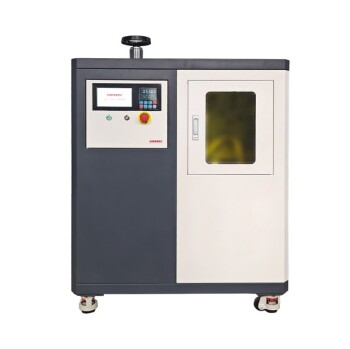
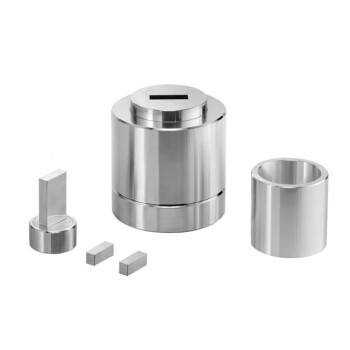
The laboratory hydraulic press functions as the primary densification engine in the creation of non-sintered LLZTO (Lithium Lanthanum Zirconium Tantalum Oxide) electrolytes. By applying high-tonnage force—typically around 8 tons—it cold-presses polymer-coated powder into solid pellets, forcing particles into the intimate physical contact required for ionic conductivity without the use of high-temperature firing.
The press replaces thermal energy with mechanical force to eliminate porosity. Its primary function is to compress polymer-coated particles until the coating fills inter-particle voids, creating a continuous, low-resistance network for ion transport.
The Mechanics of Non-Sintered Densification
The challenge with non-sintered electrolytes is achieving density without melting or fusing the ceramic particles. The hydraulic press solves this through sheer mechanical compaction.
Eliminating Particle Voids
In a loose powder state, air gaps exist between LLZTO particles. These gaps are insulators that block the flow of lithium ions.
The hydraulic press applies uniaxial pressure to collapse these voids. By forcing the particles closer together, the press maximizes the volume fraction of the active ceramic material within the pellet.
Activating the Polymer Coating
Unlike pure ceramic sintering, this specific process relies on a polymer coating on the LLZTO powder.
Under the high pressure of the press (often 8 tons or upwards of 300+ MPa in similar applications), this polymer layer creates a cohesive bond. The force causes the polymer to deform and fill the remaining interstitial spaces between the rigid ceramic particles.
Establishing the Ion Transport Network
The ultimate goal of this pressure application is connectivity.
By ensuring tight contact between the polymer and the ceramic, the press establishes a continuous ion transport network. This microstructural arrangement is essential; without sufficient pressure, the pathway for ions is broken, resulting in high internal resistance and poor battery performance.
Critical Trade-offs in Pressure Application
While pressure is the tool for densification, it must be applied with precision to avoid structural defects.
Density vs. Particle Integrity
Applying higher pressure generally reduces porosity and grain boundary resistance. However, excessive pressure can crush the brittle LLZTO ceramic particles rather than just compacting them.
If the ceramic structure fractures, it creates new resistive interfaces that the polymer coating may not be able to bridge, degrading ionic conductivity.
Pressure Uniformity and Gradients
Uniaxial hydraulic presses apply force from one direction. This can sometimes create density gradients, where the top of the pellet is denser than the bottom.
If the pressure distribution is uneven, the resulting pellet may have weak spots or warp, leading to poor contact with the battery anode or cathode later in assembly.
Optimizing for Performance Goals
The specific pressure settings and dwell times you choose should depend on the specific requirements of your solid-state cell.
- If your primary focus is Ionic Conductivity: Prioritize higher pressures (within particle limits) to minimize porosity and ensure the polymer coating fully bridges all inter-particle gaps.
- If your primary focus is Mechanical Integrity: optimize for a pressure that yields a robust, handleable pellet without inducing micro-cracks or density gradients that lead to delamination.
The hydraulic press is not just a shaping tool; it is the architect of the electrolyte's internal connectivity.
Summary Table:
| Parameter | Role in LLZTO Formation | Impact on Electrolyte Performance |
|---|---|---|
| Applied Force | Collapses air voids & densifies powder | Increases volume fraction of active material |
| Mechanical Compaction | Replaces thermal sintering energy | Eliminates porosity without high-temperature firing |
| Polymer Activation | Deforms coating to fill interstitial spaces | Establishes a continuous ion transport network |
| Pressure Precision | Balances density vs. particle integrity | Prevents micro-cracks while maximizing conductivity |
Elevate Your Solid-State Battery Research with KINTEK
Precision densification is the cornerstone of high-performance LLZTO electrolytes. KINTEK specializes in advanced laboratory solutions, offering a comprehensive range of manual, electric, and isostatic hydraulic presses designed to deliver the consistent, high-tonnage force required for your pelletizing needs.
Whether you are developing next-generation energy storage or researching advanced ceramics, our expertise extends from pellet, hot, and isostatic presses to high-temperature furnaces and specialized consumables like PTFE products and crucibles.
Ready to optimize your electrolyte conductivity and structural integrity? Contact KINTEK today to find the perfect equipment for your laboratory and accelerate your path to discovery.
Related Products
- Automatic Laboratory Hydraulic Pellet Press Machine for Lab Use
- Laboratory Hydraulic Press Split Electric Lab Pellet Press
- Laboratory Hydraulic Pellet Press for XRF KBR FTIR Lab Applications
- Laboratory Manual Hydraulic Pellet Press for Lab Use
- Laboratory Hydraulic Press Lab Pellet Press Machine for Glove Box
People Also Ask
- What is the role of a laboratory hydraulic pellet press and stainless steel molds in the fabrication of RuO2/NbC anodes?
- What role does a laboratory pellet press play in the enhancement of biomass energy products? Optimize Fuel Efficiency
- What is the purpose of using a laboratory pellet press when evaluating the electronic conductivity of carbon powders? Guide
- How does a laboratory hydraulic pellet press contribute to SiCw/2024 aluminum composite preforms? Optimize Densification
- What is the significance of applying 200 MPa of pressure with a laboratory hydraulic pellet press for composite ceramics?