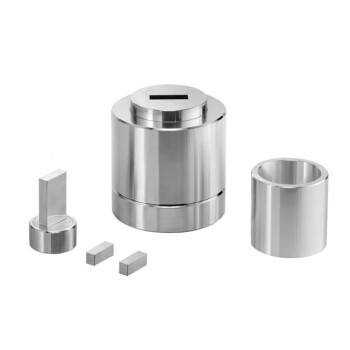
The laboratory hydraulic press is the critical bridge between loose precursor powders and the structural integrity required for superconductivity.
It functions by applying precise axial pressure to mixed powders within a mold to create "green bodies"—dense, shaped pellets typically 13 mm in diameter. This mechanical compression maximizes the contact area between powder particles and increases filling density, which are the essential prerequisites for the diffusion kinetics and phase connectivity needed during high-temperature sintering.
The press transforms loose material into a dense physical prototype, facilitating the solid-state reactions necessary for the Tl-1212 superconducting phase to form. By eliminating air voids and maximizing particle contact, it ensures high green density and mechanical stability for the sintering stage.
Optimizing the Microstructure for Phase Formation
Enhancing Diffusion Kinetics
The press reduces the microscopic distance between precursor particles, creating an intimate contact area across the entire sample. This proximity is vital for solid-state diffusion, allowing elements to migrate and react efficiently when the material is later heated.
Increasing Filling Density
By applying significant axial pressure, the press eliminates internal air voids and forces the rearrangement of powder particles. A high filling density ensures the material does not undergo excessive shrinkage or structural failure during the subsequent 1000°C calcination processes.
Establishing Geometric and Mechanical Stability
Precise Geometric Shaping
The use of precision molds allows the press to create pellets with exact dimensions and uniform thickness. This uniformity is essential for maintaining consistent heat distribution during sintering, which directly impacts the homogeneity of the Tl-1212 phase.
Mechanical Interlocking and Handling Strength
High-pressure compaction causes particles to interlock and, depending on the material ductility, undergo slight deformation. This results in a green body with sufficient preliminary mechanical strength to be handled and loaded into a furnace without the need for additional chemical binders.
Understanding the Trade-offs and Technical Limits
The Risk of Over-Compaction
While high pressure is necessary for density, excessive force can introduce internal stresses that lead to delamination or "capping." This occurs when the pellet cracks or layers peel apart immediately upon release from the mold, rendering the sample useless for sintering.
Dependency on Powder Homogeneity
A hydraulic press cannot correct a poorly mixed precursor; it effectively "locks in" the current distribution of elements. If the powders are not uniformly mixed prior to pressing, the resulting green body will suffer from localized impurities and inconsistent superconducting properties.
Optimizing Your Compaction Strategy
To achieve the best superconducting performance in Tl-1212 synthesis, the pressing stage must be calibrated to the specific characteristics of your precursor mix.
- If your primary focus is maximizing phase purity: Prioritize high filling density to ensure that all chemical precursors are in constant contact, facilitating complete solid-state reactions.
- If your primary focus is preventing structural defects: Use controlled, incremental pressure increases and ensure the mold is perfectly aligned to avoid internal shear stresses and cracking.
Mastering the compaction process is the foundational step in transforming raw chemical precursors into high-performance superconducting ceramics.
Summary Table:
| Key Press Function | Impact on Green Body | Benefit for Superconductor Sintering |
|---|---|---|
| Axial Compression | Maximizes particle contact area | Accelerates solid-state diffusion kinetics |
| Void Elimination | Increases filling density | Prevents shrinkage and structural failure |
| Geometric Shaping | Ensures uniform pellet dimensions | Promotes homogeneous heat distribution |
| Mechanical Interlocking | Provides preliminary strength | Allows binder-free handling and loading |
Elevate Your Superconductor Research with KINTEK Precision
Achieving the perfect green body density is the foundational step in high-performance Tl-1212 synthesis. KINTEK specializes in providing the precision laboratory equipment necessary for advanced material science. Our high-performance laboratory hydraulic presses (including pellet, hot, and isostatic models) ensure uniform compaction and eliminate structural defects like delamination.
To complete your synthesis workflow, we offer a comprehensive range of high-temperature furnaces (muffle, vacuum, atmosphere) for sintering, along with crushing and milling systems for precursor preparation and essential ceramic crucibles. Whether you are optimizing phase purity or scaling up production, KINTEK provides the reliability and technical support you need.
Contact KINTEK today to find the perfect equipment for your lab!
References
- J. Nur-Akasyah, Tet Vui Chong. Elemental Substitution at Tl Site of Tl1−xXx(Ba, Sr)CaCu2O7 Superconductor with X = Cr, Bi, Pb, Se, and Te. DOI: 10.3390/ma16114022
This article is also based on technical information from Kintek Solution Knowledge Base .
Related Products
- Heated Hydraulic Press Machine with Integrated Manual Heated Plates for Lab Use
- Laboratory Manual Hydraulic Pellet Press for Lab Use
- Automatic High Temperature Heated Hydraulic Press Machine with Heated Plates for Lab
- Manual Lab Heat Press
- Laboratory Manual Hydraulic Pellet Press for Lab Use
People Also Ask
- Why is a heated laboratory hydraulic press necessary for composite laminates? Achieve Void-Free Structural Integrity
- What role does a heated hydraulic press play in Cold Sintering (CSP)? Enhancing LATP-Halide Densification
- What technical conditions does a heated hydraulic press provide for PEO batteries? Optimize Solid-State Interfaces
- Why is the heating function of a laboratory hydraulic press essential for MEA assembly in DEFC? Optimize Cell Bonding
- What are heated hydraulic presses used for? Molding Composites, Vulcanizing Rubber, and More