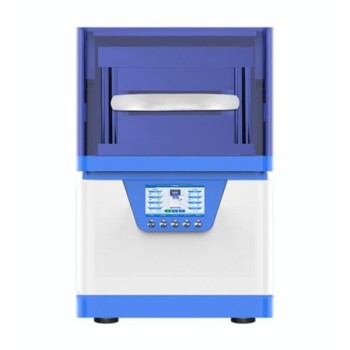
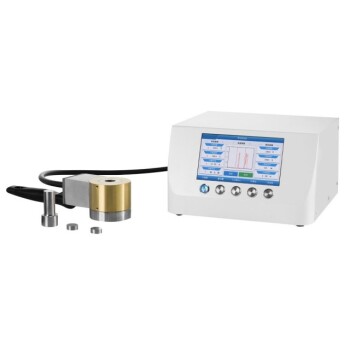
The heating function of a laboratory hydraulic press is the critical driver for thermal bonding during Membrane Electrode Assembly (MEA) fabrication. By applying heat alongside precise mechanical pressure, the press fuses the catalyst layer, the ion exchange membrane, and the gas diffusion layer (GDL) into a single, cohesive unit. This process is essential for minimizing interfacial contact resistance and creating the continuous ion transport channels required for high power density in Direct Ethanol Fuel Cells (DEFC).
The integration of heat and pressure transforms individual components into a high-performance electrochemical interface. This thermal bonding ensures the physical intimacy required to lower ohmic losses and maintain structural integrity during fuel cell operation.
Optimizing the Electrochemical Interface
Facilitating Thermal Bonding and Adhesion
In DEFC assembly, heat is used to soften the ion exchange membrane and the binders within the catalyst layer. This softening allows the catalyst particles to become slightly embedded into the membrane surface, creating a robust mechanical bond. Without heat, the layers remain as discrete entities with poor adhesion, leading to high resistance and potential delamination.
Establishing Continuous Ion Transport Channels
The primary goal of the hot-pressing process is to create an uninterrupted path for ions to travel between the catalyst sites and the membrane. By applying temperatures—often around 80°C for anion exchange membranes or higher for other types—the press ensures the ionomer phase is well-distributed. This continuity is vital for maximizing the actual output power of the fuel cell during operation.
Minimizing Parasitic Energy Losses
Reducing Interfacial Contact Resistance
Physical gaps between the GDL, catalyst layer, and membrane act as barriers to both electron and ion flow, resulting in significant ohmic losses. A heated hydraulic press flattens these micro-scale irregularities, ensuring intimate physical contact across the entire active area. This reduction in contact resistance is the most direct way to improve the efficiency of the electrochemical reaction.
Enhancing Mechanical Stability and Sealing
DEFCs operate under various thermal and chemical stresses that can cause material expansion or contraction. The thermal bond created by the heated press provides the mechanical strength needed to resist delamination and prevent electrolyte leakage. This stability is critical when the cell is subjected to pressure differentials or high current densities.
Navigating Critical Trade-offs
Risk of Thermal Degradation
While heat is necessary for bonding, excessive temperatures can permanently damage the polymer structure of the membrane. Anion exchange membranes used in DEFCs are particularly sensitive to thermal degradation, which can lead to a loss of ion-exchange capacity. Precision control is required to ensure the temperature remains high enough for bonding but low enough to protect material integrity.
Over-Compression and Mass Transport
Applying high pressure while the materials are in a heated, softened state carries the risk of over-compressing the Gas Diffusion Layer (GDL). If the GDL is crushed, its porosity is reduced, which hinders the transport of the ethanol fuel and oxygen to the catalyst sites. Finding the "sweet spot" between contact resistance and gas permeability is a fundamental challenge in MEA optimization.
How to Apply This to Your MEA Project
Depending on your specific research or production goals, your approach to the hot-pressing process should vary.
- If your primary focus is Maximum Power Density: Prioritize the optimization of the temperature-to-pressure ratio (e.g., 80°C at specific bar settings) to minimize interfacial resistance while maintaining ionomer continuity.
- If your primary focus is Long-Term Durability: Focus on the "dwelling time" (the duration the pressure and heat are held) to ensure a deep, stable thermal bond that prevents delamination over hundreds of operating hours.
- If your primary focus is Material Characterization: Use a press with highly uniform heat distribution across the platens to ensure that the electrochemical data collected is consistent across the entire surface of the MEA.
Mastering the synergy between heat and pressure is the definitive step in transitioning from raw materials to a high-performance fuel cell assembly.
Summary Table:
| Key Aspect | Role in MEA Assembly | Impact on DEFC Performance |
|---|---|---|
| Thermal Bonding | Fuses membrane, catalyst, and GDL layers | Ensures structural integrity and prevents delamination |
| Ion Transport | Softens ionomer for continuous channels | Increases actual output power and efficiency |
| Resistance Reduction | Eliminates micro-scale gaps at interfaces | Lowers ohmic losses for higher power density |
| Precision Control | Manages heat to prevent polymer degradation | Protects material integrity and ion-exchange capacity |
Elevate Your Fuel Cell Research with KINTEK Precision
Achieving the perfect electrochemical interface requires more than just pressure—it requires absolute thermal precision. KINTEK specializes in advanced laboratory equipment designed to meet the rigorous demands of DEFC and MEA fabrication. Our comprehensive range of laboratory hydraulic presses (pellet, hot, and isostatic) ensures uniform heat distribution and stable pressure application for superior thermal bonding.
Beyond assembly, KINTEK supports your entire research lifecycle with:
- Material Preparation: Crushing and milling systems, sieving equipment, and high-purity ceramics.
- Thermal Processing: A full suite of muffle, tube, vacuum, and atmosphere furnaces.
- Advanced Reactivity: High-temperature high-pressure reactors and autoclaves.
- Energy Research Tools: Specialized battery research consumables, electrolytic cells, and electrodes.
Don't let interfacial resistance or material degradation stall your progress. Contact KINTEK today to discuss how our high-performance equipment can optimize your laboratory workflow and enhance your material characterization results.
References
- Jinfa Chang, Yang Yang. Interface synergism and engineering of Pd/Co@N-C for direct ethanol fuel cells. DOI: 10.1038/s41467-023-37011-z
This article is also based on technical information from Kintek Solution Knowledge Base .
Related Products
- 24T 30T 60T Heated Hydraulic Press Machine with Heated Plates for Laboratory Hot Press
- Heated Hydraulic Press Machine with Integrated Manual Heated Plates for Lab Use
- Automatic Heated Hydraulic Press Machine with Heated Plates for Laboratory Hot Press 25T 30T 50T
- Heated Hydraulic Press Machine with Heated Plates for Vacuum Box Laboratory Hot Press
- Automatic High Temperature Heated Hydraulic Press Machine with Heated Plates for Lab
People Also Ask
- What role does a heated hydraulic press play in Cold Sintering (CSP)? Enhancing LATP-Halide Densification
- What technical conditions does a heated hydraulic press provide for PEO batteries? Optimize Solid-State Interfaces
- How is a heated hydraulic press used for Li-LLZO batteries? Optimize Interfacial Bonding with Thermal-Pressure
- What is the core function of a laboratory heated hydraulic press in CSP? Revolutionize Low-Temp Ceramic Sintering
- What are heated hydraulic presses used for? Molding Composites, Vulcanizing Rubber, and More