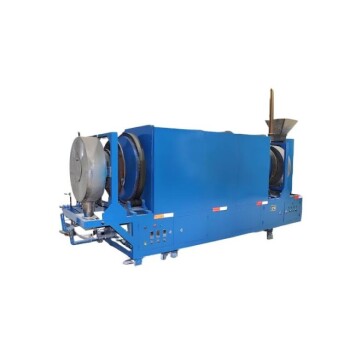
Precise thermal regulation acts as a catalyst for microstructural change. A precision heat treatment furnace ensures joint strength in aluminum-magnesium-scandium (Al-Mg-Sc) welds by maintaining a tightly controlled environment, specifically aimed at artificial aging. By holding the weld at 350°C for one hour, the furnace triggers the dispersed precipitation of the Al3Sc strengthening phase, transforming a weak supersaturated solid solution into a hardened, robust structure.
The core function of the furnace is to facilitate a controlled phase transformation that allows the weld zone to match or exceed the strength of the base material, effectively eliminating the structural weaknesses caused by the welding process.
The Mechanism of Strengthening
Leveraging Artificial Aging
The primary method for strengthening Al-Mg-Sc alloys is artificial aging. The furnace does not merely heat the part; it sustains a specific temperature—typically 350°C—for a definitive duration, such as one hour.
This specific thermal profile is critical. It provides the necessary kinetic energy for the material to evolve from an unstable state into a strengthened state.
Precipitating the Al3Sc Phase
The welding process leaves the metal in a state known as a supersaturated solid solution. While the elements are mixed, they are not yet arranged to provide maximum strength.
The furnace facilitates the dispersed precipitation of the Al3Sc (Aluminum-Scandium) phase. These fine precipitates form uniformly throughout the metal matrix, acting as reinforcements that impede deformation.
Restoring Mechanical Properties
Without this post-processing, the weld zone may be significantly softer than the surrounding metal.
By successfully precipitating the Al3Sc phase, the furnace increases the hardness and strength of the weld. This ensures the joint is no longer the "weak link" in the assembly.
The Critical Role of Precision
Ensuring Uniformity
A standard oven is often insufficient for this task. A precision furnace is required to provide a uniform thermal environment across the entire part.
If the temperature varies across the furnace chamber, the precipitation of Al3Sc will be uneven. This leads to inconsistent strength profiles, where some sections of the weld are fully hardened while others remain weak.
Balancing Strength and Ductility
Beyond simply hardening the material, the heat treatment process addresses internal issues caused by the extreme heat of welding.
As noted in broader heat treatment principles, precise thermal control helps reduce excessive internal stress. This balance is vital for eliminating brittleness, ensuring the part retains enough ductility to perform in complex engineering applications without cracking.
Understanding the Trade-offs
The Risk of Thermal Deviation
The "window" for treating Al-Mg-Sc alloys is distinct. Deviating from the 350°C benchmark or the one-hour duration can have negative consequences.
Under-heating results in incomplete precipitation, leaving the joint weak. Over-heating or extending the time too long can lead to "over-aging," where the precipitates grow too large and lose their strengthening effectiveness.
Process Time vs. Production Speed
Artificial aging is a time-consuming batch process. It requires holding parts for at least one hour, plus heating and cooling cycles.
While this creates a bottleneck in production compared to the speed of welding, it is a non-negotiable trade-off required to achieve aerospace-grade joint integrity.
Making the Right Choice for Your Goal
To maximize the performance of Al-Mg-Sc alloy welds, the heat treatment strategy must align with your specific engineering requirements.
- If your primary focus is Maximum Strength: strictly adhere to the 350°C for one hour protocol to ensure complete precipitation of the Al3Sc phase.
- If your primary focus is Reliability: Prioritize furnace uniformity to prevent "soft spots" in the weld caused by uneven heating.
- If your primary focus is Dimensional Stability: Utilize the heat cycle to relieve internal stresses, which minimizes warping during subsequent machining or use.
The precision furnace transforms the weld from a simple connection into a metallurgical bond capable of bearing structural loads equal to the parent material.
Summary Table:
| Process Parameter | Action | Microstructural Outcome |
|---|---|---|
| Temperature | 350°C (Precise Control) | Triggers dispersed Al3Sc phase precipitation |
| Duration | 1 Hour Holding Time | Ensures transition from solid solution to hardened state |
| Mechanism | Artificial Aging | Increases hardness and restores mechanical properties |
| Thermal Uniformity | Even Heat Distribution | Eliminates "soft spots" and internal stress variations |
| Post-Cooling | Controlled Descent | Balances structural strength with essential ductility |
Elevate Your Material Integrity with KINTEK
Achieve aerospace-grade joint strength and precision in every weld. KINTEK specializes in advanced laboratory solutions, providing high-performance muffle, tube, and vacuum furnaces engineered for the rigorous thermal profiles required by Al-Mg-Sc alloys.
Whether you are refining battery research, developing complex alloys, or performing critical crushing and milling, our comprehensive portfolio—from high-pressure reactors to isostatic hydraulic presses—ensures your lab delivers consistent, high-quality results.
Ready to eliminate structural weaknesses in your production? Contact our technical experts today to find the perfect precision heating solution for your application.
References
- Olena Berdnikova, I.I. Alekseenko. Structure and crack resistance of special steels with 0.25−0.31 % carbon under the conditions of simulation of thermal cycles of welding. DOI: 10.37434/tpwj2020.05.01
This article is also based on technical information from Kintek Solution Knowledge Base .
Related Products
- 600T Vacuum Induction Hot Press Furnace for Heat Treat and Sintering
- Vacuum Heat Treat Furnace with Ceramic Fiber Liner
- 2200 ℃ Graphite Vacuum Heat Treat Furnace
- Molybdenum Vacuum Heat Treat Furnace
- 1400℃ Controlled Atmosphere Furnace with Nitrogen and Inert Atmosphere
People Also Ask
- What role does an induction vacuum hot pressing furnace play in sintering? Achieve 98% Density in Carbide Blocks
- What advantages does a vacuum hot press furnace provide for LSLBO ceramic electrolytes? Achieve 94% Relative Density
- What role does a Vacuum Hot Press (VHP) furnace play in the densification of austenitic stainless steel 316 composites?
- What are the advantages of a vacuum hot press furnace for W-50%Cu? Achieve 99.6% Density at Lower Temperatures
- What role does mechanical pressure play during the vacuum diffusion bonding of tungsten and copper? Keys to Solid Bonding