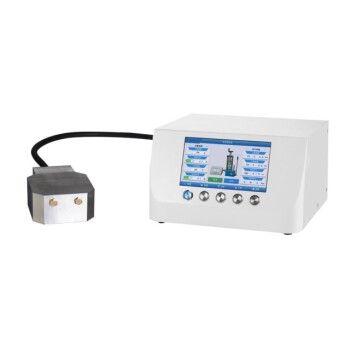
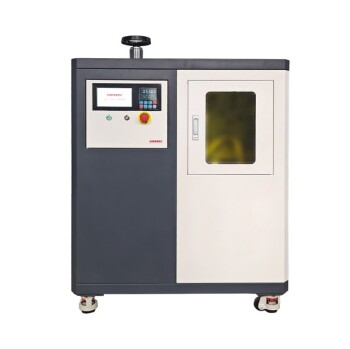
A precision hot press ensures detector performance by subjecting purified thallium bromide (TlBr) to a rigorously controlled environment of high temperature (455-465°C) and constant pressure (approximately 30 kN). This two-hour process transforms the raw material into a dense, high-integrity bulk crystal with minimized internal stress. By stabilizing the crystal structure at this formative stage, the equipment directly enables superior charge collection efficiency and energy resolution in the final photon-counting detector.
Core Takeaway The hot press functions as a critical structural stabilizer, utilizing thermal-mechanical coupling to convert raw TlBr powder into a unified solid. By eliminating internal voids and inducing specific lattice orientations, it creates the physical foundation necessary for high-sensitivity radiation detection.
The Mechanics of Crystal Optimization
Precise Thermal-Mechanical Coupling
The hot press does not merely shape the material; it fundamentally alters its physical state through solid-phase molding. By applying a vertical pressure of 30 kN while simultaneously heating the material to near its melting point, the system induces plastic flow.
This dual action promotes bonding between particles, ensuring that the purified TlBr powder coalesces into a singular, dense block.
Eliminating Structural Defects
Raw semiconductor materials often contain microscopic voids or inconsistencies that can trap charge carriers. The high-pressure environment of the hot press forces the material to achieve maximum density.
This densification process effectively eliminates internal voids, ensuring structural consistency throughout the depth of the material.
Controlling Stress and Orientation
A major challenge in crystal growth is the development of internal stress, which degrades detector performance. The precise control of temperature and pressure allows for the elimination of residual internal stresses.
Furthermore, this controlled environment dictates the crystal orientation. Proper lattice alignment is essential for the material's ability to interact with radiation predictably.
Translating Structure to Detector Performance
Enhanced Charge Collection
The primary metric for a semiconductor detector is how efficiently it collects the electrical charge generated by incident radiation. Because the hot press creates a uniform structure with fewer defects, electrons can move through the crystal with less resistance.
This results in significantly improved charge collection efficiency, a prerequisite for accurate sensing.
Superior Energy Resolution
When the internal structure is uniform, the detector can resolve energy peaks with greater precision. Crystals processed via this method demonstrate superior peak spectra, specifically noted at 662 keV.
This capability is vital for photon-counting detectors that must distinguish between different radiation energy levels.
Optimized Gamma-Ray Attenuation
The density achieved through hot pressing directly impacts the material's stopping power. Denser crystals exhibit higher gamma-ray attenuation coefficients.
This makes the resulting detectors highly efficient at capturing and registering high-energy photons that might otherwise pass through less dense materials.
Understanding the Critical Dependencies
The Necessity of Parameter Stability
The "precision" in precision hot pressing is not a marketing term; it is a technical requirement. The pressure must remain constant at 30 kN, and the temperature must stay strictly within the 455-465°C window.
Deviations in these parameters can lead to incomplete densification or the re-introduction of stress, negating the benefits of the process.
The Role of Post-Processing
While the hot press creates the bulk crystal, it is not the final step. The primary reference notes that mechanical polishing is required after pressing to treat the surface.
The hot press ensures internal integrity, but surface treatment is still necessary to optimize the interface for final detector assembly.
Making the Right Choice for Your Project
To maximize the performance of TlBr detectors, you must align your processing parameters with your specific performance goals.
- If your primary focus is Energy Resolution: Prioritize precise temperature control (455-465°C) to minimize internal stress and ensure uniform lattice orientation.
- If your primary focus is Detection Efficiency: Ensure the hydraulic system maintains a constant 30 kN pressure to achieve maximum density and gamma-ray attenuation.
By strictly controlling the thermomechanical conditions during the hot press cycle, you transform raw chemical purity into reliable, high-performance electronic capability.
Summary Table:
| Feature | Parameter | Impact on Detector Performance |
|---|---|---|
| Temperature Range | 455 - 465°C | Minimizes internal stress and ensures lattice alignment. |
| Vertical Pressure | ≈ 30 kN | Achieves maximum density for high gamma-ray attenuation. |
| Process Duration | 2 Hours | Facilitates solid-phase molding and particle bonding. |
| Mechanical State | Plastic Flow | Eliminates internal voids to improve charge collection. |
Maximize Your Semiconductor Research with KINTEK Precision Solutions
To achieve superior energy resolution and detection efficiency, your laboratory needs equipment that maintains uncompromising parameter stability. KINTEK specializes in advanced hydraulic presses (pellet, hot, isostatic) and high-temperature systems specifically designed for the rigorous demands of material science.
Whether you are developing TlBr detectors or engineering next-generation ceramics, our portfolio of high-temperature furnaces, crushing systems, and specialized lab consumables ensures your crystals achieve maximum density and integrity.
Ready to elevate your material performance? Contact KINTEK today for a consultation and discover how our precision engineering can support your research goals.
References
- Tamar Makharadze, Giorgi Makharadze. Measurement of complex formation process of lead (II) with fulvic acids isolated from natural waters at pH=9. DOI: 10.21175/rad.abstr.book.2023.13.3
This article is also based on technical information from Kintek Solution Knowledge Base .
Related Products
- 30T 40T Split Automatic Heated Hydraulic Press Machine with Heated Plates for Laboratory Hot Press
- Automatic High Temperature Heated Hydraulic Press Machine with Heated Plates for Lab
- Ball Press Mold for Lab
- Lab Infrared Press Mold
- Double Plate Heating Press Mold for Lab
People Also Ask
- What are the advantages of using a laboratory hydraulic press for hot pressing? Achieve Peak Nano-Composite Density
- What are the core advantages of using a laboratory hot press to produce Bi2Se3? Achieve 93% Density & High Conductivity
- Why is a laboratory hydraulic hot press essential for high-density, additive-free Silicon Carbide? Unlock Pure SiC.
- How does a laboratory hydraulic hot press ensure the quality of PHBV/natural fiber composites? Expert Guide
- What is the function of a laboratory hydraulic hot press in the assembly of solid-state photoelectrochemical cells?