Knowledge muffle furnace How does a resistance furnace work? Unlocking the Science of Electric Heating
Author avatar

Tech Team · Kintek Solution

Updated 3 months ago

How does a resistance furnace work? Unlocking the Science of Electric Heating


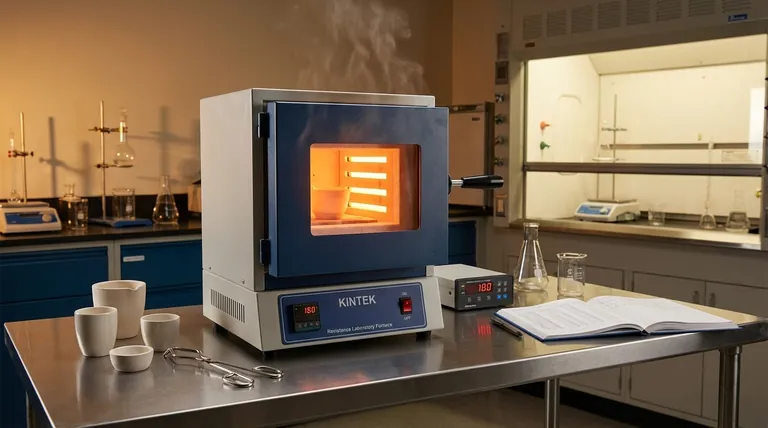
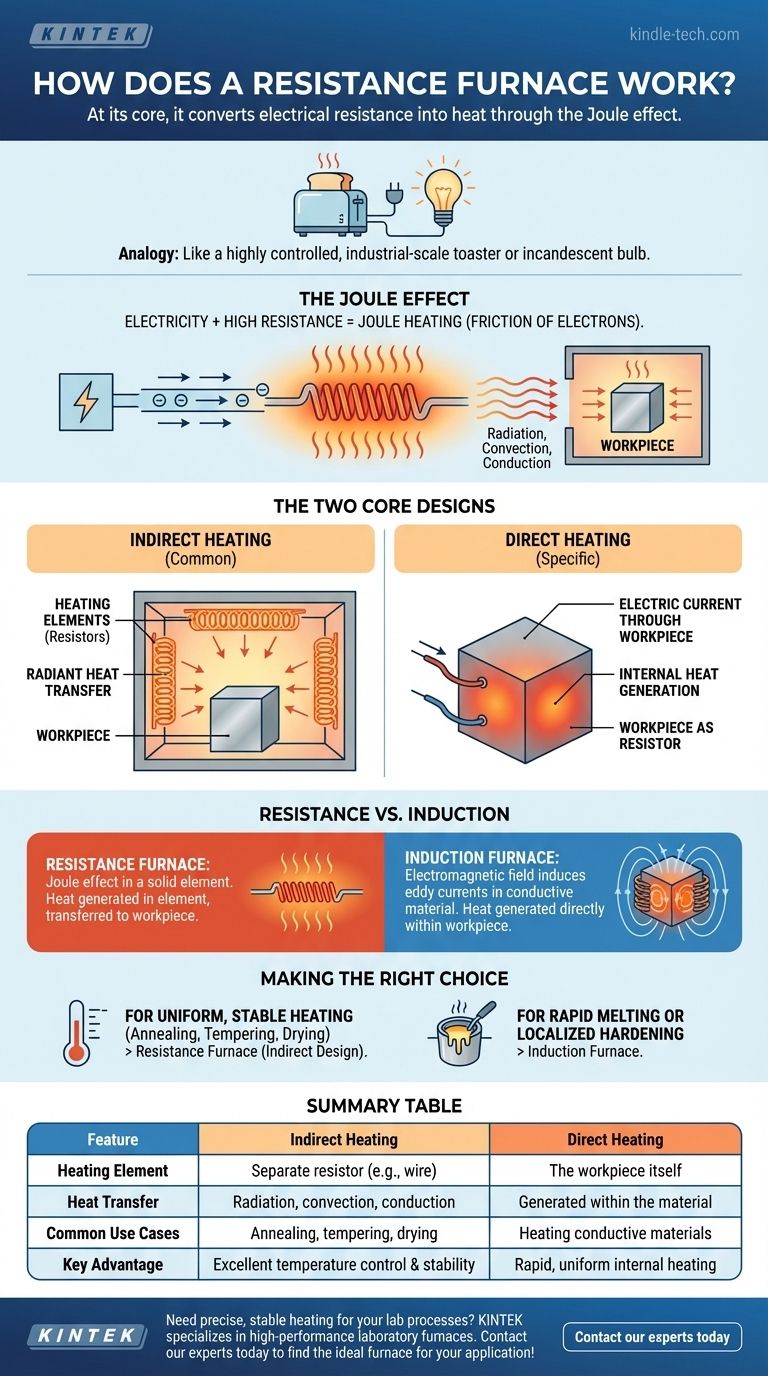
At its core, a resistance furnace operates on a simple, fundamental principle: it passes an electric current through a material that resists the flow of electricity. This resistance converts electrical energy directly into heat through a phenomenon known as the Joule effect. This generated heat is then transferred to the workpiece inside the furnace via radiation, convection, or conduction.

A resistance furnace is best understood as a highly controlled, industrial-scale version of a common household appliance like a toaster or an incandescent light bulb. It leverages the predictable heat generated when electricity struggles to pass through a conductor, making it a workhorse for processes requiring stable and uniform temperatures.
How does a resistance furnace work? Unlocking the Science of Electric Heating

The Fundamental Principle: The Joule Effect

What is the Joule Effect?

The Joule effect, or resistive heating, is a physical law stating that the passage of an electric current through a conductor produces heat.

Imagine electricity as water flowing through a pipe. If the pipe is wide and smooth, the water flows easily. If the pipe is narrow and rough (high resistance), friction is created, which generates heat. In an electrical circuit, this "friction" against the flow of electrons is what creates thermal energy.

From Electricity to Heat

The primary function of a resistance furnace is to be an energy converter. It takes in electrical energy and, using a carefully selected resistive material, transforms it into thermal energy with very high efficiency.

This process is highly controllable. By precisely regulating the voltage and current, you can achieve and maintain extremely stable temperatures within the furnace chamber.

The Two Core Designs of Resistance Furnaces

Resistance furnaces are built around two different methods of applying this principle: indirect heating and direct heating.

Indirect Heating: The Common Approach

This is the most prevalent design. In an indirect furnace, specialized heating elements (resistors) made of high-resistance materials are placed along the walls or ceiling of the furnace chamber.

The electric current flows through these elements, causing them to become extremely hot. This heat then radiates or convects onto the workpiece or material placed inside the furnace, raising its temperature without the electricity ever touching the material itself.

Direct Heating: Using the Material Itself

In a direct heating design, the workpiece or material being heated serves as the resistor. An electric current is passed directly through the material itself.

This method is less common but highly effective for specific applications, particularly with materials that are electrically conductive. It generates heat from within the material, which can lead to very rapid and uniform heating cycles.

Understanding the Key Distinction: Resistance vs. Induction

It is crucial not to confuse resistance heating with induction heating, as they operate on entirely different physical principles.

The Source of Heat

A resistance furnace uses the Joule effect in a solid resistive element (or the workpiece). The heat generation is a direct consequence of electrical resistance.

An induction furnace uses a powerful, fluctuating electromagnetic field. This field induces internal electrical currents (eddy currents) within the conductive material, and these swirling currents generate the heat.

The Method of Heat Generation

In resistance heating, the heat is generated in a distinct element and then transferred to the workpiece.

In induction heating, the heat is generated directly within the workpiece itself with no physical contact. The furnace coil that creates the magnetic field may remain cool while the metal inside becomes molten.

Making the Right Choice for Your Goal

Understanding these mechanisms allows you to select the appropriate technology for a specific industrial goal.

  • If your primary focus is uniform, stable heating for processes like annealing, tempering, or drying: A resistance furnace, particularly an indirect design, provides exceptional temperature control and environmental stability.
  • If your primary focus is rapidly melting conductive metals or applying localized surface hardening: An induction furnace is far superior, as it generates heat directly and instantly within the material itself.

By grasping the core principle of electrical resistance, you can demystify the furnace's operation and appreciate its role as a foundational tool of modern industry.

Summary Table:

Feature Indirect Heating Direct Heating
Heating Element Separate resistor (e.g., wire, element) The workpiece itself
Heat Transfer Radiation, convection, conduction Generated within the material
Common Use Cases Annealing, tempering, drying Heating conductive materials
Key Advantage Excellent temperature control & stability Rapid, uniform internal heating

Need precise, stable heating for your lab processes? KINTEK specializes in high-performance laboratory furnaces, including resistance models perfect for annealing, tempering, and heat treatment. Our equipment delivers the uniform temperatures and control your research demands. Contact our experts today to find the ideal furnace for your specific application!

Visual Guide
How does a resistance furnace work? Unlocking the Science of Electric Heating Visual Guide

Related Products

People Also Ask

Related Products

1200℃ Controlled Atmosphere Furnace Nitrogen Inert Atmosphere Furnace

1200℃ Controlled Atmosphere Furnace Nitrogen Inert Atmosphere Furnace

Discover our KT-12A Pro Controlled atmosphere furnace - high precision, heavy duty vacuum chamber, versatile smart touch screen controller, and excellent temperature uniformity up to 1200C. Ideal for both laboratory and industrial application.

1700℃ Controlled Atmosphere Furnace Nitrogen Inert Atmosphere Furnace

1700℃ Controlled Atmosphere Furnace Nitrogen Inert Atmosphere Furnace

KT-17A Controlled atmosphere furnace: 1700℃ heating, vacuum sealing technology, PID temperature control, and versatile TFT smart touch screen controller for laboratory and industrial use.

2200 ℃ Tungsten Vacuum Heat Treat and Sintering Furnace

2200 ℃ Tungsten Vacuum Heat Treat and Sintering Furnace

Experience the ultimate refractory metal furnace with our Tungsten vacuum furnace. Capable of reaching 2200℃, perfect for sintering advanced ceramics and refractory metals. Order now for high-quality results.

Graphite Vacuum Furnace High Thermal Conductivity Film Graphitization Furnace

Graphite Vacuum Furnace High Thermal Conductivity Film Graphitization Furnace

The high thermal conductivity film graphitization furnace has uniform temperature, low energy consumption and can operate continuously.

Vertical High Temperature Graphite Vacuum Graphitization Furnace

Vertical High Temperature Graphite Vacuum Graphitization Furnace

Vertical high temperature graphitization furnace for carbonization and graphitization of carbon materials up to 3100℃.Suitable for shaped graphitization of carbon fiber filaments and other materials sintered in a carbon environment.Applications in metallurgy, electronics, and aerospace for producing high-quality graphite products like electrodes and crucibles.

1400℃ Controlled Atmosphere Furnace with Nitrogen and Inert Atmosphere

1400℃ Controlled Atmosphere Furnace with Nitrogen and Inert Atmosphere

Achieve precise heat treatment with KT-14A controlled atmosphere furnace. Vacuum sealed with a smart controller, it's ideal for lab and industrial use up to 1400℃.

Laboratory Muffle Oven Furnace Bottom Lifting Muffle Furnace

Laboratory Muffle Oven Furnace Bottom Lifting Muffle Furnace

Efficiently produce batches with excellent temperature uniformity using our Bottom Lifting Furnace. Features two electric lifting stages and advanced temperature control up to 1600℃.

High Temperature Muffle Oven Furnace for Laboratory Debinding and Pre Sintering

High Temperature Muffle Oven Furnace for Laboratory Debinding and Pre Sintering

KT-MD High temperature debinding and pre-sintering furnace for ceramic materials with various molding processes. Ideal for electronic components such as MLCC and NFC.

Controlled Nitrogen Inert Hydrogen Atmosphere Furnace

Controlled Nitrogen Inert Hydrogen Atmosphere Furnace

KT-AH Hydrogen atmosphere furnace - induction gas furnace for sintering/annealing with built-in safety features, dual housing design, and energy-saving efficiency. Ideal for lab and industrial use.

Non Consumable Vacuum Arc Induction Melting Furnace

Non Consumable Vacuum Arc Induction Melting Furnace

Explore the benefits of Non-Consumable Vacuum Arc Furnace with high melting point electrodes. Small, easy to operate & eco-friendly. Ideal for laboratory research on refractory metals & carbides.

1200℃ Split Tube Furnace with Quartz Tube Laboratory Tubular Furnace

1200℃ Split Tube Furnace with Quartz Tube Laboratory Tubular Furnace

KT-TF12 split tube furnace: high-purity insulation, embedded heating wire coils, and max. 1200C. Widely used for new materials and chemical vapour deposition.

Mesh belt controlled atmosphere furnace

Mesh belt controlled atmosphere furnace

Discover our KT-MB mesh belt sintering furnace - perfect for high-temperature sintering of electronic components & glass insulators. Available for open air or controlled atmosphere environments.

Graphite Vacuum Furnace Bottom Discharge Graphitization Furnace for Carbon Materials

Graphite Vacuum Furnace Bottom Discharge Graphitization Furnace for Carbon Materials

Bottom-out graphitization furnace for carbon materials, ultra-high temperature furnace up to 3100°C, suitable for graphitization and sintering of carbon rods and carbon blocks. Vertical design, bottom discharging, convenient feeding and discharging, high temperature uniformity, low energy consumption, good stability, hydraulic lifting system, convenient loading and unloading.

Vertical Laboratory Tube Furnace

Vertical Laboratory Tube Furnace

Elevate your experiments with our Vertical Tube Furnace. Versatile design allows for operation under various environments and heat treatment applications. Order now for precise results!

Vacuum Arc Induction Melting Furnace

Vacuum Arc Induction Melting Furnace

Discover the power of Vacuum Arc Furnace for melting active & refractory metals. High-speed, remarkable degassing effect, and free of contamination. Learn more now!

Ultra-High Temperature Graphite Vacuum Graphitization Furnace

Ultra-High Temperature Graphite Vacuum Graphitization Furnace

The ultra-high temperature graphitization furnace utilizes medium frequency induction heating in a vacuum or inert gas environment. The induction coil generates an alternating magnetic field, inducing eddy currents in the graphite crucible, which heats up and radiates heat to the workpiece, bringing it to the desired temperature. This furnace is primarily used for graphitization and sintering of carbon materials, carbon fiber materials, and other composite materials.

Multi-zone Laboratory Tube Furnace

Multi-zone Laboratory Tube Furnace

Experience precise, efficient thermal testing with our Multi Zone Tube Furnace. Independent heating zones and temperature sensors allow for controlled high-temperature gradient heating fields. Order now for advanced thermal analysis!

Vacuum Heat Treat and Pressure Sintering Furnace for High Temperature Applications

Vacuum Heat Treat and Pressure Sintering Furnace for High Temperature Applications

Vacuum pressure sintering furnaces are designed for high temperature hot pressing applications in metal and ceramic sintering. Its advanced features ensure precise temperature control, reliable pressure maintenance, and a robust design for seamless operation.

Graphite Vacuum Continuous Graphitization Furnace

Graphite Vacuum Continuous Graphitization Furnace

High-temperature graphitization furnace is a professional equipment for graphitization treatment of carbon materials. It is a key equipment for the production of high-quality graphite products. It has high temperature, high efficiency and uniform heating. It is suitable for various high-temperature treatments and graphitization treatments. It is widely used in metallurgy, electronics, aerospace, etc. industry.

1700℃ Muffle Oven Furnace for Laboratory

1700℃ Muffle Oven Furnace for Laboratory

Get superior heat control with our 1700℃ Muffle Furnace. Equipped with intelligent temperature microprocessor, TFT touch screen controller & advanced insulation materials for precise heating up to 1700C. Order now!


Leave Your Message



















