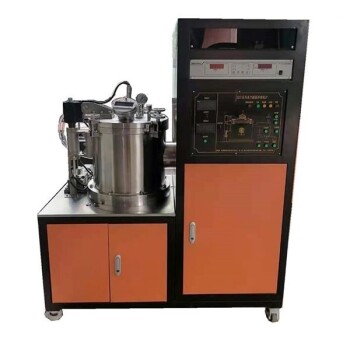
The vacuum tube furnace is the critical link between mechanical alloying and final consolidation in the production of high-entropy alloy (HEA) powders. It performs low-temperature heat treatments to release internal residual stresses and remove residual process control agents (such as ethanol) and moisture. By operating in a controlled vacuum, it prevents the oxidation of highly reactive nano-crystalline powders while ensuring that internal stresses do not lead to cracking during subsequent pressing and sintering.
Core Takeaway: A vacuum tube furnace stabilizes ball-milled HEA powders by relieving mechanical stress and removing chemical contaminants without triggering significant grain growth. This precise thermal control is essential for maintaining the purity and nano-crystalline integrity of the alloy before it is formed into a solid part.
Managing Mechanical Stress and Microstructure
Relieving Residual Stresses
Mechanical ball milling is an intensive process that leaves nano-crystalline powders in a high-energy state filled with internal residual stresses. The vacuum tube furnace provides a controlled environment to recover the internal dislocation density, which significantly reduces the risk of the powder cracking due to stress concentration during mold loading and pressing.
Preserving Nano-crystalline Structure
One of the primary challenges in post-milling is preventing grain growth, which can destroy the unique properties of nano-scale materials. The furnace allows for low-temperature heat treatments that are sufficient to stabilize the material's morphology while keeping the grains at the nanometer scale.
Enhancing Crystallization Quality
Beyond simple stress relief, the thermal energy provided by the furnace improves the crystallization quality of the powder. This process refines the heterostructures within the high-entropy alloy, ensuring a more stable and uniform chemical state across the composite.
Purification and Chemical Stabilization
Removal of Process Control Agents (PCAs)
During ball milling, process control agents like ethanol are often added to prevent cold welding; however, these must be removed before final casting. The vacuum tube furnace facilitates the evaporation and extraction of these residual liquids and any trapped moisture that could otherwise contaminate the final alloy.
Elimination of Brittle Phases
In certain alloy systems, milling and leaching can introduce brittle phases, such as hydrides, that compromise ductility. Heating the powders under vacuum induces reactions—such as dehydrogenation—that remove these brittle components, resulting in a high-purity powder with superior mechanical performance.
Surface Decontamination
High-vacuum environments are particularly effective at removing oxygen-containing functional groups and unstable organic components from the surface of the nanoparticles. This cleaning process improves the chemical stability of the powder and can even increase the specific surface area by introducing micropores through component degradation.
The Role of Atmosphere Control
Preventing Powder Oxidation
Nano-crystalline HEA powders are highly reactive due to their massive surface-area-to-volume ratio and will oxidize instantly if exposed to air at elevated temperatures. The vacuum environment is non-negotiable for maintaining the metallic purity of the powders during the heating cycle.
Inert Gas Flexibility
While vacuum is standard, these furnaces also allow for inert gas atmospheres (such as Argon). This flexibility enables the technician to tailor the thermodynamic conditions to the specific needs of the alloy, whether the goal is simple annealing or high-temperature synthesis of complex composites.
Understanding the Trade-offs
Temperature vs. Grain Growth
The most significant risk in post-milling treatment is the temperature-time trade-off. While higher temperatures or longer durations (e.g., 18-hour cycles) may be necessary for grain refinement or phase precipitation, exceeding a specific thermal threshold will trigger rapid grain growth, negating the benefits of the nano-crystalline structure.
Vacuum Depth vs. Contamination
Not all "vacuums" are equal; for sensitive alloys like those containing Niobium or Titanium, an ultra-high vacuum (below 2 × 10⁻⁷ torr) may be required. Using a lower-quality vacuum can result in trace oxidation, which creates a brittle "skin" on the powder particles that hinders effective sintering.
How to Apply This to Your Project
Recommendations for Targeted Outcomes
- If your primary focus is maximizing ductility: Prioritize a dehydrogenation cycle at approximately 973 K to eliminate brittle phases and ensure high purity.
- If your primary focus is maintaining nano-scale properties: Utilize a lower-temperature annealing process (around 300 °C) for a shorter duration to relieve stress without inducing grain growth.
- If your primary focus is preventing press-cracking: Focus on a recovery cycle that targets internal dislocation density to soften the powder for better compaction during mold loading.
- If your primary focus is surface chemistry: Use a high-vacuum environment to strip organic residues and oxygen groups, ensuring the powder is chemically "clean" before melting.
By precisely balancing thermal energy and atmospheric purity, the vacuum tube furnace transforms unstable, stressed nano-powders into high-quality feedstock ready for advanced manufacturing.
Summary Table:
| Process Objective | Furnace Function | Impact on HEA Powder Quality |
|---|---|---|
| Stress Relief | Internal dislocation recovery | Prevents cracking during pressing and final consolidation |
| Purification | Thermal extraction of PCAs | Removes ethanol and moisture to ensure chemical purity |
| Structure Stability | Controlled low-temp heating | Preserves nano-crystalline grain size and morphology |
| Oxidation Control | High-vacuum environment | Protects highly reactive powders from atmospheric oxygen |
| Phase Refinement | Dehydrogenation & reaction | Eliminates brittle phases for superior ductility |
Optimize Your HEA Powder Treatment with KINTEK
Precision is paramount when managing the delicate balance between stress relief and grain growth in nano-crystalline materials. KINTEK provides industry-leading thermal solutions, including high-vacuum tube furnaces, atmosphere-controlled systems, and rotary furnaces designed specifically for advanced metallurgy.
Beyond heating, we offer a comprehensive ecosystem for high-entropy alloy research:
- Processing: High-energy ball milling systems and crushing equipment.
- Consolidation: Hydraulic pellet presses and isostatic systems.
- Analysis & Storage: High-purity ceramics, crucibles, and ULT freezers.
- Advanced Synthesis: CVD/PECVD systems and high-pressure reactors.
Ensure the integrity of your high-performance alloys with equipment engineered for reliability and precision. Contact KINTEK experts today to discuss your project requirements!
References
- S. Sivasankaran, Abdel-baset H. Mekky. Effect of Al2O3 (x = 0, 1, 2, and 3 vol.%) in CrFeCuMnNi-x High-Entropy Alloy Matrix Composites on Their Microstructure and Mechanical and Wear Performance. DOI: 10.3390/ma16103672
This article is also based on technical information from Kintek Solution Knowledge Base .
Related Products
- Vacuum Sealed Continuous Working Rotary Tube Furnace Rotating Tube Furnace
- Laboratory High Pressure Vacuum Tube Furnace
- Laboratory Vacuum Tilt Rotary Tube Furnace Rotating Tube Furnace
- Split Chamber CVD Tube Furnace with Vacuum Station Chemical Vapor Deposition System Equipment Machine
- 1200℃ Controlled Atmosphere Furnace Nitrogen Inert Atmosphere Furnace
People Also Ask
- What are the process advantages of using a rotary tube furnace for WS2 powder? Achieve Superior Material Crystallinity
- What are the advantages of using a rotary tube furnace for MoVOx catalysts? Elevate Uniformity and Crystallinity
- Why is a vacuum tube furnace with argon protection required for RGO/Cu? Ensure Conductivity and Material Purity
- Why is a rotary tube furnace preferred over a fixed tube furnace for the carbonization of asphaltenes? Superior Quality
- What is a rotary tube furnace? Achieve Superior Uniformity for Powders and Granules