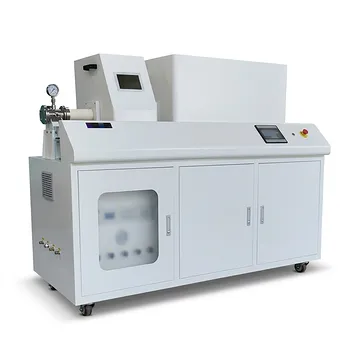
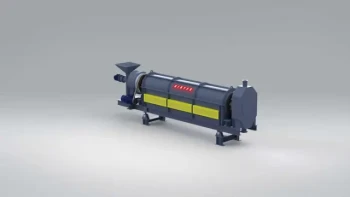
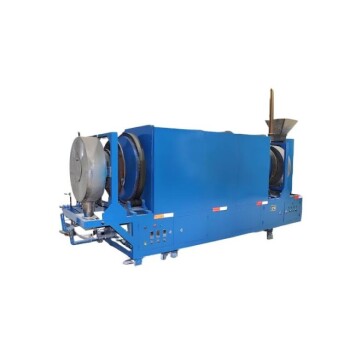
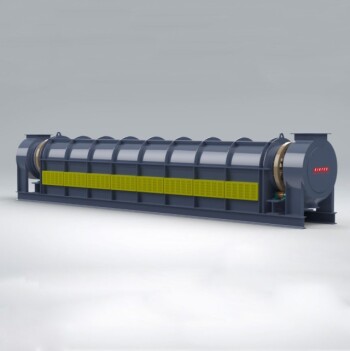
Uniform thermal exposure and product homogeneity are the primary reasons a rotary tube furnace is superior to a fixed tube furnace for asphaltene carbonization. By utilizing 360-degree rotation and continuous oscillation, the rotary furnace ensures that every asphaltene particle receives identical heat treatment, preventing the non-uniformity and high ash content typically found in static processes.
The rotary tube furnace solves the inherent limitations of static heating by using dynamic motion to eliminate heat and mass transfer gradients. This results in high-quality graphene derivatives with consistent structural parameters and superior surface characteristics.
Overcoming Thermal and Mass Transfer Gradients
Eliminating Internal Heat Gradients
In a fixed tube furnace, material sits in a static bed where the outer layers shield the core from heat. This creates significant temperature gradients that lead to uneven carbonization. A rotary furnace uses continuous rotation to keep particles tumbling and mixing, ensuring they pass through the high-temperature zone uniformly.
Optimizing Gas Diffusion
Carbonization often requires a specific atmosphere, such as an acetylene or nitrogen mix, to facilitate carbon deposition. The tumbling action of a rotary furnace ensures the entire surface area of each particle is exposed to the processing gas. This improves gas diffusion efficiency, reduces total gas consumption, and facilitates the deep diffusion of carbon into the crystal lattice.
Preventing Material Accumulation
Fixed furnaces often suffer from powder accumulation, where particles fuse or "clump" together, trapping impurities. The dynamic motion of a rotary tube prevents this accumulation, which is critical for maintaining a consistent pore size distribution and a high specific surface area in the resulting graphene derivatives.
Enhancing Product Quality and Yield
Achieving Structural Consistency
For asphaltenes to transform into high-quality graphene derivatives, the structural parameters must be tightly controlled. The 360-degree oscillation of a rotary furnace provides the homogeneous environment necessary to achieve consistent atomic structures across the entire batch. This level of precision is virtually impossible to replicate in a static environment where thermal exposure varies by position.
Reducing Ash and Impurities
Fixed tube furnaces often result in products with high ash content because localized overheating or under-heating prevents clean carbonization. The efficient heat transfer of the rotary model promotes a more complete chemical reaction. This results in a higher purity product with lower residual ash, making the derivatives more suitable for advanced technical applications.
Improving Heat Transfer Efficiency
Rotary furnaces are designed to transfer heat rapidly across a large volume of material. By moving the material continuously through a consistent temperature profile, these systems achieve shorter processing times compared to static batches. This efficiency does not just save time; it prevents the degradation that can occur from prolonged exposure to high heat.
Understanding the Trade-offs
Mechanical Complexity and Maintenance
While superior in performance, rotary tube furnaces involve significantly more moving parts than fixed furnaces. The drive systems, rollers, and seals required to maintain a vacuum or controlled atmosphere while the tube rotates introduce higher maintenance requirements. Failure of these mechanical components can lead to costly downtime.
Sealing and Atmosphere Integrity
Maintaining a high-purity atmosphere is more challenging in a rotating system. The dynamic seals at the ends of the rotating tube are potential points of leakage for oxygen or process gases. In applications requiring extreme atmospheric precision, the engineering required to ensure a perfect seal can increase the initial capital investment.
Making the Right Choice for Your Goal
How to Apply This to Your Project
Choosing between these technologies depends on your specific requirements for scale, purity, and budget.
- If your primary focus is high-purity graphene production: Utilize a rotary tube furnace to ensure uniform carbon deposition and consistent structural parameters across all particles.
- If your primary focus is minimizing initial capital expenditure: A fixed tube furnace may suffice for small-scale R&D where absolute homogeneity is less critical than cost.
- If your primary focus is maximizing specific surface area (BET): The rotary furnace is essential, as the tumbling motion prevents particle fusion and ensures optimal pore development.
- If your primary focus is high-volume industrial throughput: A continuous rotary model offers the best balance of production capacity and lead recovery rates while reducing manual labor.
The transition from static to dynamic carbonization is the most effective way to ensure the structural integrity and commercial viability of asphaltene-derived graphene.
Summary Table:
| Feature | Rotary Tube Furnace | Fixed Tube Furnace |
|---|---|---|
| Heating Uniformity | 360° rotation eliminates gradients | Static bed creates heat shields |
| Gas Diffusion | High (constant particle tumbling) | Low (limited to surface layers) |
| Material State | Prevents clumping/accumulation | Prone to fusion and impurities |
| Product Purity | High (consistent carbonization) | Variable (high ash content possible) |
| Application | High-purity graphene & BET optimization | Small-scale R&D / Low-budget projects |
Elevate Your Material Synthesis with KINTEK Precision
Achieve unmatched structural consistency and purity in your graphene derivatives. KINTEK specializes in high-performance laboratory equipment, offering a premium range of rotary tube furnaces, CVD systems, and vacuum atmosphere furnaces designed to eliminate thermal gradients and optimize gas diffusion.
Whether you are focused on carbonization, battery research, or advanced material milling, our comprehensive portfolio—including high-temperature reactors, hydraulic presses, and specialized ceramics—is engineered to meet the rigorous demands of modern science.
Ready to upgrade your lab’s efficiency and product yield? Contact a KINTEK Specialist Today to find the perfect solution for your specific application.
References
- Faisal S. AlHumaidan, R. Navvamani. Synthesis of graphene derivatives from asphaltenes and effect of carbonization temperature on their structural parameters. DOI: 10.1039/d2ra07481h
This article is also based on technical information from Kintek Solution Knowledge Base .
Related Products
- Rotary Tube Furnace Split Multi Heating Zone Rotating Tube Furnace
- Vacuum Sealed Continuous Working Rotary Tube Furnace Rotating Tube Furnace
- Laboratory Vacuum Tilt Rotary Tube Furnace Rotating Tube Furnace
- Inclined Rotary Plasma Enhanced Chemical Vapor Deposition PECVD Equipment Tube Furnace Machine
- Electric Rotary Kiln Small Rotary Furnace for Activated Carbon Regeneration
People Also Ask
- What are the process advantages of using a rotary tube furnace for WS2 powder? Achieve Superior Material Crystallinity
- What are the advantages of using a rotary tube furnace for MoVOx catalysts? Elevate Uniformity and Crystallinity
- Why is a rotary tube furnace recommended for the calcination stage of potassium vanadium oxide catalysts? Optimize Purity
- What is a rotary tube furnace? Achieve Superior Uniformity for Powders and Granules
- What is a rotary furnace used for? Achieve Unmatched Process Uniformity and Control