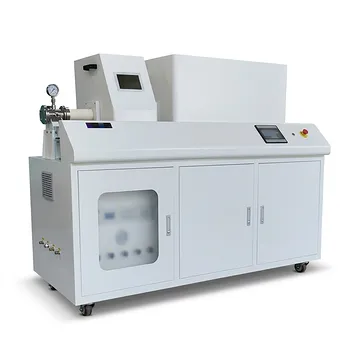
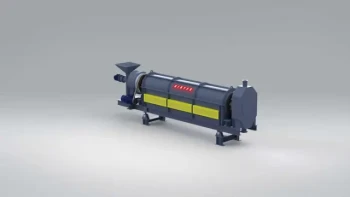
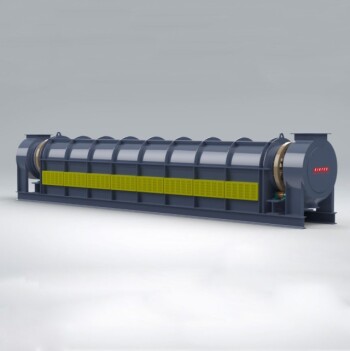
A rotary tube furnace is essential for potassium vanadium oxide calcination because its continuous rotation ensures total thermal uniformity and maximum gas-solid contact. At the critical calcination temperature of 620°C, the tumbling motion prevents localized hot spots and ensures that potassium and vanadium reactants are distributed evenly across the support surface, resulting in a high-purity crystalline phase like potassium pentavanadate.
Core Takeaway: The rotary tube furnace transforms a static heating process into a dynamic one, eliminating the thermal gradients and atmosphere isolation that typically degrade catalyst performance. This results in superior dispersion of vanadium species and a more consistent chemical reaction across the entire batch.
Achieving Superior Phase Purity through Dynamic Mixing
Thermal Spreading and Precursor Distribution
The continuous rotation of the quartz tube keeps the catalyst powder in a constant state of tumbling. This movement facilitates thermal spreading, where precursor materials are distributed uniformly across the carrier surfaces rather than clumping or migrating unevenly.
Eliminating Localized Overheating
Static furnaces often suffer from internal temperature gradients where the core of the material stays cool while the exterior overheats. The rotary action ensures every particle experiences an identical temperature profile, which is vital for the precise formation of the potassium pentavanadate crystalline structure.
Prevention of Atmosphere Isolation
In a static bed, the inner layers of powder can become isolated from the processing gas. The tumbling motion of a rotary furnace ensures that the oxidizing atmosphere reaches every surface area, allowing for the complete reaction of potassium and vanadium components.
Optimizing Gas-Solid Interactions
Enhanced Gas Diffusion
The rotary furnace allows for better gas-solid contact modes, which facilitates the controlled diffusion of atoms during the calcination process. This is critical for catalysts that require an oxidizing environment to achieve their final active state.
Efficiency and Reduced Consumption
Because the material is constantly exposed to the atmosphere, the reaction proceeds more efficiently. This often leads to reduced gas consumption and shorter processing times compared to traditional static roasting methods.
Strengthening Active Site Interactions
High-temperature calcination in a dynamic environment strengthens the interaction between active sites and the support. This ensures that the vanadium species remain consistently dispersed, which is a key driver of high catalytic activity and long-term stability.
Understanding the Trade-offs
Mechanical Complexity and Maintenance
Unlike static furnaces, rotary systems involve moving parts, such as vacuum seals and drive motors, that operate under high heat. This increases the maintenance overhead and requires specialized seals to maintain a controlled atmosphere or vacuum.
Particle Attrition and Dust Management
The constant tumbling of the catalyst support can lead to mechanical wear or "attrition," where particles rub against each other and create fines or dust. This necessitates careful control of rotation speeds and may require additional filtration systems to manage airborne powder.
Scaling and Material Handling
While rotary furnaces are excellent for batch consistency, scaling them for massive industrial volumes requires complex engineering of continuous feed mechanisms. Users must balance the benefits of uniformity against the higher capital expenditure of specialized rotary equipment.
How to Apply This to Your Catalyst Project
Making the Right Choice for Your Goal
To achieve the best results with potassium vanadium oxide catalysts, align your furnace parameters with your specific performance requirements.
- If your primary focus is Phase Purity: Utilize the rotary function at 620°C to ensure the complete transformation of precursors into the potassium pentavanadate crystalline phase.
- If your primary focus is Active Site Dispersion: Optimize the rotation speed to maximize thermal spreading, ensuring vanadium species are uniformly distributed across the alumina or silica support.
- If your primary focus is Throughput and Efficiency: Select a continuous rotary model that allows material to pass through a consistent temperature profile, reducing the time spent on manual material handling.
By leveraging the dynamic environment of a rotary tube furnace, you ensure that your potassium vanadium oxide catalysts achieve the structural integrity and chemical consistency required for high-performance industrial applications.
Summary Table:
| Feature | Impact on Catalyst Calcination |
|---|---|
| Continuous Rotation | Ensures total thermal uniformity and prevents localized hotspots at 620°C. |
| Dynamic Mixing | Facilitates even precursor distribution and prevents clumping on support surfaces. |
| Maximum Gas-Solid Contact | Ensures the oxidizing atmosphere reaches all particles for complete chemical reaction. |
| Enhanced Gas Diffusion | Optimizes atom diffusion, reducing processing times and gas consumption. |
| Dynamic Environment | Strengthens interactions between active vanadium sites and the catalyst support. |
Elevate Your Catalyst Performance with KINTEK
Achieve unmatched chemical consistency and phase purity in your materials research. KINTEK specializes in high-performance laboratory equipment, offering a comprehensive range of rotary tube furnaces specifically designed for precision calcination.
Whether you are developing potassium vanadium oxide catalysts or advanced battery materials, our portfolio provides the tools you need for success—from crushing and milling systems for precursor preparation to high-temperature reactors and CVD systems for advanced synthesis.
Ready to optimize your thermal processing? Contact our experts today to find the perfect rotary furnace solution tailored to your laboratory's needs.
References
- Ezgi Erdem, Annette Trunschke. The Influence of Melting on Catalysis in Propane Oxidation. DOI: 10.1002/cctc.202301242
This article is also based on technical information from Kintek Solution Knowledge Base .
Related Products
- Rotary Tube Furnace Split Multi Heating Zone Rotating Tube Furnace
- Vacuum Sealed Continuous Working Rotary Tube Furnace Rotating Tube Furnace
- Laboratory Vacuum Tilt Rotary Tube Furnace Rotating Tube Furnace
- Inclined Rotary Plasma Enhanced Chemical Vapor Deposition PECVD Equipment Tube Furnace Machine
- Electric Rotary Kiln Small Rotary Furnace for Activated Carbon Regeneration
People Also Ask
- What are the advantages of using a rotary tube furnace for MoVOx catalysts? Elevate Uniformity and Crystallinity
- What are the process advantages of using a rotary tube furnace for WS2 powder? Achieve Superior Material Crystallinity
- Why is a rotary tube furnace preferred over a fixed tube furnace for the carbonization of asphaltenes? Superior Quality
- What is a rotary tube furnace? Achieve Superior Uniformity for Powders and Granules
- What is a rotary furnace used for? Achieve Unmatched Process Uniformity and Control