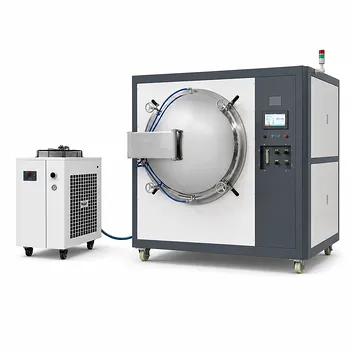
The vertical vacuum hot pressing furnace serves as the definitive processing environment for consolidating graphite film and copper composite materials. By integrating high-temperature heating up to 1150°C with controlled mechanical pressure, the furnace facilitates the critical "softening" of the copper matrix. This process eliminates interlayer gaps and cracks between the copper and graphite films while strictly maintaining a vacuum to prevent material degradation.
Core Takeaway The furnace’s primary value lies in its ability to simultaneously apply vertical pressure and heat in an oxygen-free environment. This synergy forces the softened copper matrix into intimate contact with graphite films, resulting in a high-density composite with minimized interfacial thermal resistance.
Mechanisms of Material Consolidation
The Critical Role of the Vacuum Environment
The fundamental challenge in processing copper composites at high temperatures is oxidation. Copper reacts readily with oxygen when heated, which degrades its thermal and electrical properties.
The vertical vacuum hot pressing furnace operates in a high-vacuum state to completely eliminate oxygen during the heating cycle. This preserves the purity of the copper matrix and protects the graphite films from degradation, ensuring the final composite retains its intended performance characteristics.
Optimizing Interfacial Contact
Achieving low thermal resistance requires eliminating microscopic voids between material layers. The furnace utilizes vertical mechanical pressure (up to 1 MPa for film applications) to compress the materials.
As the temperature rises, the copper matrix softens. The applied pressure forces this softened copper to conform perfectly to the surface of the graphite films. This action effectively squeezes out voids and heals interlayer cracks, creating a solid, high-density structure.
Thermal Uniformity and Diffusion
The combination of heat and pressure drives diffusion bonding. This process encourages atomic-level interaction between the layers without melting the materials completely.
The furnace ensures that thermal energy is distributed evenly across the composite. This uniformity is vital for consistent densification, ensuring that the material properties are identical throughout the entire geometry of the final product.
The Function of Graphite Molds
Structural Containment and Shaping
While the furnace provides the environment, graphite molds within the furnace define the physical shape of the product. These molds possess high structural strength and do not deform under the intense heat and pressure required for processing.
Pressure and Heat Transmission
Graphite molds act as the transmission medium. They transfer the axial pressure from the furnace rams directly to the composite material.
Simultaneously, the high thermal conductivity of the graphite mold ensures that the heat from the furnace elements reaches the composite material uniformly. This prevents "hot spots" that could lead to warping or uneven bonding.
Understanding the Trade-offs
Process Cycle Time
Vacuum hot pressing is inherently a batch process. The requirement to pump down the vacuum, heat the mass to over 1000°C, and then cool it down under controlled conditions creates a significant cycle time compared to continuous processing methods.
Equipment Complexity and Cost
These furnaces are complex systems requiring precise synchronization of vacuum pumps, hydraulic rams, and heating elements. The capital investment is high, and the graphite molds themselves are consumables that wear down over time, adding to operational costs.
Making the Right Choice for Your Goal
To maximize the effectiveness of a vertical vacuum hot pressing furnace, align your process parameters with your specific material objectives:
- If your primary focus is Thermal Conductivity: Prioritize higher vacuum levels and precise temperature control to ensure absolute purity of the copper interface, minimizing thermal resistance.
- If your primary focus is Structural Density: Focus on optimizing the vertical pressure profile during the copper "softening" phase to ensure maximum void elimination between layers.
The success of your composite relies not just on the materials used, but on the precise control of the heat-pressure-vacuum triangle during the final molding stage.
Summary Table:
| Feature | Function in Composite Molding | Key Benefit |
|---|---|---|
| High Vacuum Environment | Eliminates oxygen during high-temp heating | Prevents oxidation; preserves copper purity |
| Vertical Pressure | Compresses layers during copper softening | Eliminates voids and interlayer cracks |
| Controlled Heating | Facilitates diffusion bonding (up to 1150°C) | Ensures atomic-level material interaction |
| Graphite Molds | Structural containment and heat transmission | Provides uniform thermal distribution and shape |
Elevate Your Material Research with KINTEK Precision
Unlock superior performance in your graphite and copper composites with KINTEK’s industry-leading vertical vacuum hot pressing furnaces. Our advanced systems provide the precise synchronization of high-vacuum, mechanical pressure, and thermal uniformity required for high-density molding and minimized thermal resistance.
From high-temperature furnaces (muffle, tube, and vacuum) to specialized graphite molds and crucibles, KINTEK delivers the comprehensive equipment and consumable solutions your laboratory needs to achieve breakthrough results. Whether you are focusing on battery research, thermal management, or advanced metallurgy, our experts are ready to assist.
Ready to optimize your composite production? Contact us today to find the perfect furnace for your application!
Related Products
- 600T Vacuum Induction Hot Press Furnace for Heat Treat and Sintering
- Vacuum Hot Press Furnace Heated Vacuum Press Machine Tube Furnace
- Vacuum Hot Press Furnace Machine Heated Vacuum Press
- Vertical High Temperature Graphite Vacuum Graphitization Furnace
- Vacuum Hot Press Furnace Machine for Lamination and Heating
People Also Ask
- What role does an induction vacuum hot pressing furnace play in sintering? Achieve 98% Density in Carbide Blocks
- What advantages does a vacuum hot press furnace provide for LSLBO ceramic electrolytes? Achieve 94% Relative Density
- What role does a Vacuum Hot Press (VHP) furnace play in the densification of austenitic stainless steel 316 composites?
- What are the advantages of a vacuum hot press furnace for W-50%Cu? Achieve 99.6% Density at Lower Temperatures
- What role does mechanical pressure play during the vacuum diffusion bonding of tungsten and copper? Keys to Solid Bonding