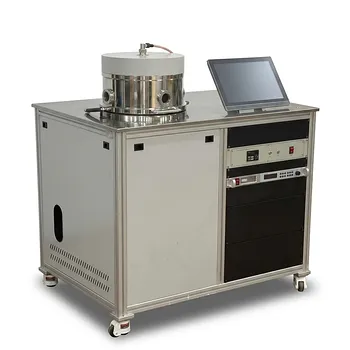
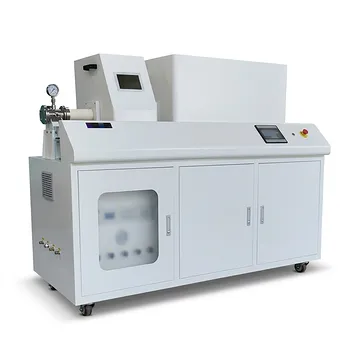
To ensure the quality of palladium nanoparticles during the hydrogen reduction of Pd/C catalysts, an atmosphere furnace provides a dual-environment control system that manages both thermal energy and gas dynamics. This precise regulation allows for the conversion of palladium ions ($Pd^{2+}$) into metallic palladium ($Pd^{0}$) at approximately 200°C to 400°C while simultaneously suppressing particle aggregation. By maintaining a stable hydrogen flow field and exact temperature profiles, the furnace creates small-sized, highly dispersed active centers essential for high-performance catalysis.
The central takeaway: An atmosphere furnace functions as a precision reactor that balances the chemical kinetics of reduction with the physical prevention of sintering, ensuring that palladium particles remain at the nanoscale with maximum surface area.
Managing the Reduction Transformation
Converting Ions to Metallic Nanoparticles
The primary role of the atmosphere furnace is to facilitate the chemical transition of palladium precursors into their active metallic state. By providing a stable hydrogen gas flow field, the furnace ensures that reducing agents reach the palladium ions adsorbed on the carbon support uniformly. This consistency is vital for achieving a complete reduction of the metal salts into zero-valent metallic states ($Pd^{0}$).
Precise Thermal Programming
Thermal control is not merely about reaching a target temperature but about the path taken to get there. Atmosphere furnaces use precise heating programs to maintain specific temperatures, such as 200°C or 400°C, depending on the precursor requirements. This accuracy ensures that the energy provided is sufficient for reduction without triggering unwanted secondary reactions or material degradation.
Preventing Nanoparticle Degradation
Suppressing Particle Aggregation
One of the greatest challenges in catalyst synthesis is preventing individual metal atoms from clumping together. The atmosphere furnace uses chamber pressure and flow control to help suppress the aggregation of palladium particles. By managing the environment at the micro-level, the furnace helps maintain small-sized, highly dispersed active centers across the carbon support.
Avoiding Thermal Sintering
Overheating is the primary enemy of nanoscale particles, as it leads to grain growth and reduced surface activity. A controlled atmosphere furnace prevents the growth of metal grains by strictly limiting temperature fluctuations and localized hotspots. This protection ensures that the resulting nanoparticles maintain the high-activity surfaces required for efficient chemical processing.
Understanding the Trade-offs and Pitfalls
The Balance of Temperature and Time
There is a critical trade-off between the thoroughness of reduction and the final particle size. While higher temperatures ensure that every palladium ion is reduced, they also increase the risk of sintering and larger grain sizes. Conversely, temperatures that are too low may leave residual precursors, which can poison the catalyst or reduce its overall efficiency.
Gas Flow Uniformity Issues
Inconsistent gas flow within the furnace chamber can lead to non-uniform catalyst batches. Areas with lower hydrogen concentrations may result in incomplete reduction, while areas with stagnant gas can lead to localized heat buildup. Ensuring a stable and uniform flow field is a technical requirement that distinguishes high-quality atmosphere furnaces from standard laboratory ovens.
Making the Right Choice for Your Goal
How to Apply This to Your Project
- If your primary focus is Maximum Surface Activity: Prioritize a furnace with high-precision thermal ramping to keep temperatures at the lowest effective reduction point (e.g., 200°C) to prevent any grain growth.
- If your primary focus is Industrial Scalability: Focus on furnaces that offer superior gas flow field stability and pressure control to ensure uniformity across larger batches of Pd/C material.
- If your primary focus is Complex Alloy Catalysts: Select a furnace capable of maintaining higher temperatures (up to 400°C) and controlled process atmospheres to facilitate interactions between palladium and other metals, like zinc.
By mastering the intersection of gas chemistry and thermal precision, the atmosphere furnace transforms raw precursors into high-performance palladium nanoparticles.
Summary Table:
| Feature | Function in Pd/C Synthesis | Impact on Catalyst Quality |
|---|---|---|
| Hydrogen Flow Field | Uniform distribution of reducing gas | Ensures complete and consistent metallic conversion ($Pd^{0}$) |
| Precise Thermal Ramping | Controlled heating (200°C–400°C) | Prevents thermal sintering and preserves nanoscale grain size |
| Atmosphere Management | Pressure and flow dynamics control | Suppresses particle aggregation for highly dispersed active centers |
| Process Stability | Elimination of localized hotspots | Maintains high surface area and consistent catalytic activity |
Elevate Your Catalyst Research with KINTEK Precision
Achieving the perfect balance of particle size and dispersion in Pd/C catalysts requires more than just heat—it requires total environmental mastery. KINTEK specializes in advanced laboratory equipment designed to give you absolute control over your chemical reduction processes.
From high-precision atmosphere furnaces and CVD/PECVD systems to high-temperature high-pressure reactors and autoclaves, our solutions are engineered to prevent sintering and maximize the surface activity of your nanoparticles. Our comprehensive portfolio also includes:
- Thermal Processing: Muffle, tube, rotary, and vacuum furnaces.
- Sample Preparation: Crushing, milling, sieving, and hydraulic pellet presses.
- Specialized Lab Tools: Electrolytic cells, battery research consumables, and high-purity ceramics/crucibles.
- Cooling & Mixing: ULT freezers, freeze dryers, and homogenizers.
Ready to optimize your nanoparticle synthesis? Contact KINTEK today to consult with our experts and find the ideal equipment for your laboratory!
References
- Lin jun Tong, Xiaoting Deng. Effect of calcium ion concentration on the ORR performance of Pd/C catalysts. DOI: 10.1039/d3ra07553b
This article is also based on technical information from Kintek Solution Knowledge Base .
Related Products
- Controlled Nitrogen Inert Hydrogen Atmosphere Furnace
- 1400℃ Controlled Atmosphere Furnace with Nitrogen and Inert Atmosphere
- 1200℃ Controlled Atmosphere Furnace Nitrogen Inert Atmosphere Furnace
- 1700℃ Controlled Atmosphere Furnace Nitrogen Inert Atmosphere Furnace
- Mesh belt controlled atmosphere furnace
People Also Ask
- Why is hydrogen used in furnaces? Achieve Superior Purity and Bright Finishes
- What is the role of a hydrogen atmosphere furnace in diamond/copper composites? Enhance Your Material Purity
- What are the characteristics and risks of a hydrogen atmosphere in a furnace? Master the Balance of Power and Control
- Why is a hydrogen atmosphere furnace necessary for W-Cu composite? Unlock Superior Infiltration and Density
- What role does an atmosphere furnace utilizing hydrogen gas play in Cu-Cr-Nb alloy powder pretreatment? (Key Insights)