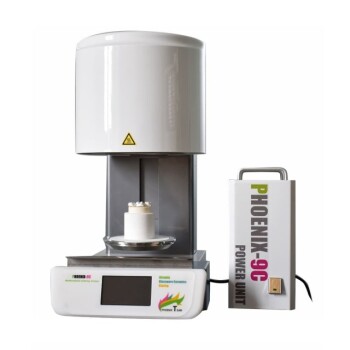
An industrial-grade ageing furnace enhances Copper-Chromium (Cu-Cr) alloys by subjecting solution-treated castings to a precise temperature range of 450°C to 510°C for an extended duration. This controlled heating process triggers the precipitation of extremely fine chromium particles from the metal's supersaturated solid solution. These particles physically block internal structural shifts, resulting in significantly increased hardness and strength while simultaneously restoring electrical conductivity.
The core function of the ageing furnace is to maximize the alloy's utility by resolving the conflict between strength and conductivity. By forcing chromium to precipitate as fine barriers, the process transforms a soft, resistive material into a hard, conductive, and industrial-ready component.
The Mechanism of Precipitation Hardening
Controlled Thermal Activation
The furnace must maintain a strict operating window between 450°C and 510°C. This specific thermal environment provides the necessary energy to alter the alloy's internal structure without melting the material or causing grain growth that would weaken it.
Exiting the Solid Solution
Prior to entering the furnace, the casting is in a "solution-treated" state, where chromium is forced to dissolve into the copper matrix. The ageing process reverses this instability.
Formation of Fine Precipitates
The sustained heat causes the dissolved chromium to separate (precipitate) from the copper. It re-forms as extremely fine particles dispersed uniformly throughout the material.
Impact on Mechanical and Electrical Properties
Blocking Dislocation Movement
The fundamental driver of the alloy's enhanced strength is the physical presence of these new chromium particles. They act as obstacles within the crystal lattice.
Increasing Hardness and Strength
When stress is applied to a metal, microscopic defects called "dislocations" usually move, causing the metal to deform. The fine chromium precipitates act as barriers to this dislocation movement. By pinning these dislocations in place, the alloy becomes significantly harder and stronger.
Restoring Conductivity
In the initial solution-treated state, dissolved chromium atoms interfere with the flow of electrons, reducing conductivity. As the ageing process pulls chromium out of the solution and into discrete particles, the copper matrix is effectively purified. This restores the electrical conductivity that was previously compromised.
Critical Process Variables and Trade-offs
Temperature Precision
The effectiveness of the furnace relies entirely on maintaining the 450°C to 510°C range. If the temperature is too low, precipitation will be sluggish or incomplete; if too high, the precipitates may coarsen, reducing their effectiveness as barriers.
The Necessity of Duration
The reference emphasizes that this process occurs over an extended duration. Attempting to accelerate the process by cutting time will result in an under-aged alloy that achieves neither peak strength nor maximum conductivity.
Optimizing Your Material Strategy
The ageing furnace is the final, critical step in defining the performance characteristics of your Cu-Cr alloy.
- If your primary focus is maximum strength: Prioritize the formation of fine particles to maximize the barriers against dislocation movement.
- If your primary focus is electrical efficiency: Ensure the ageing cycle is fully completed to precipitate as much chromium as possible out of the solution, purifying the copper matrix.
By strictly adhering to the temperature and time parameters, the ageing furnace ensures the alloy delivers high mechanical durability without sacrificing electrical performance.
Summary Table:
| Feature | Ageing Process Detail | Impact on Cu-Cr Alloy |
|---|---|---|
| Temperature Range | 450°C to 510°C | Enables controlled chromium precipitation |
| Internal Mechanism | Precipitation Hardening | Blocks dislocation movement for higher strength |
| Mechanical Change | Hardness Increase | Transforms soft castings into durable components |
| Electrical Change | Matrix Purification | Restores conductivity by removing dissolved atoms |
| Critical Factor | Extended Duration | Ensures peak hardness and maximum efficiency |
Elevate Your Material Performance with KINTEK Precision
Unlock the full potential of your Copper-Chromium alloys and advanced materials with KINTEK’s industry-leading thermal solutions. Whether you are optimizing electrical conductivity or maximizing mechanical strength, our high-performance industrial-grade ageing furnaces and muffle furnaces provide the thermal precision required for superior precipitation hardening.
From high-temperature furnaces and vacuum systems to specialized crushing, milling, and hydraulic presses, KINTEK delivers the comprehensive lab equipment and consumables your research and production demand.
Ready to achieve superior material properties? Contact our technical experts today to find the perfect furnace solution for your laboratory or industrial facility.
References
- St. Rzadkosz, W. Cieślak. Research on Technology of Alloyed Copper Casting. DOI: 10.2478/afe-2014-0041
This article is also based on technical information from Kintek Solution Knowledge Base .
Related Products
- High Temperature Muffle Oven Furnace for Laboratory Debinding and Pre Sintering
- Dental Porcelain Zirconia Sintering Ceramic Furnace Chairside with Transformer
- Vertical High Temperature Graphite Vacuum Graphitization Furnace
- Electric Rotary Kiln Small Rotary Furnace for Activated Carbon Regeneration
- Ultra-High Temperature Graphite Vacuum Graphitization Furnace
People Also Ask
- Why is the annealing treatment in a high-temperature muffle furnace critical for the preparation of an Sb-SnO2 interlayer?
- What are the main components of a high-temperature muffle furnace? A Guide to the Core Systems
- What is the role of a muffle furnace in magnetite pellet roasting? Optimize Mineral Phase & Compressive Strength
- What role does a high-temperature muffle furnace play in the synthesis of manganese/cobalt-modified ceramic catalysts?
- What function does a high-temperature muffle furnace serve in Ti3AlC2 MAX phase synthesis? Master Molten Salt Diffusion