Knowledge Vacuum Furnace How does argon and nitrogen cooling compare in vacuum furnaces? A Guide to Faster, Cheaper Quenching
Author avatar

Tech Team · Kintek Solution

Updated 2 months ago

How does argon and nitrogen cooling compare in vacuum furnaces? A Guide to Faster, Cheaper Quenching


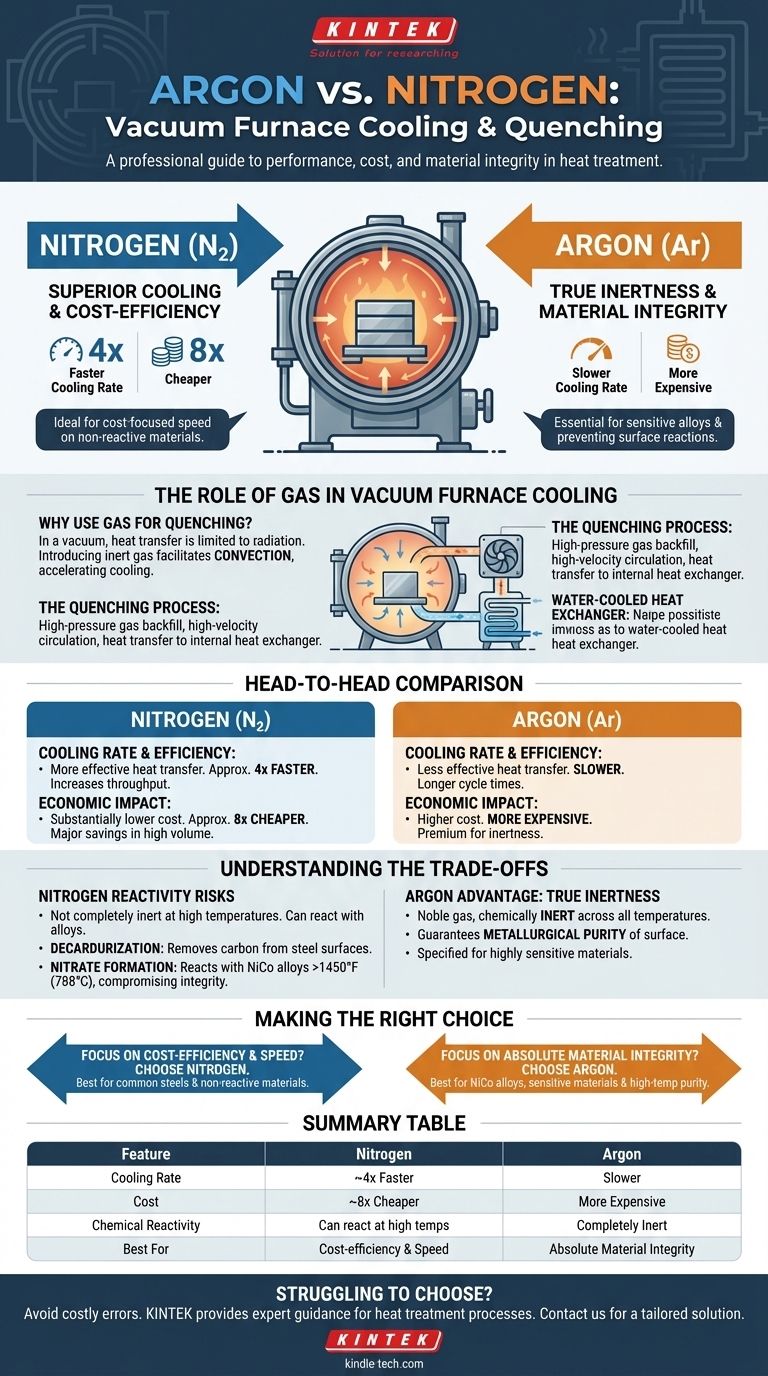
In a direct comparison, nitrogen is the superior cooling gas for vacuum furnaces in terms of both performance and cost. It offers a cooling rate approximately four times faster than argon and is about eight times cheaper, making it the default choice for a wide range of applications.

The decision between nitrogen and argon is a classic engineering trade-off. While nitrogen provides significant cost and speed advantages, argon's value lies in its complete chemical inertness, which is essential for preventing unwanted surface reactions with sensitive materials at high temperatures.
How does argon and nitrogen cooling compare in vacuum furnaces? A Guide to Faster, Cheaper Quenching

The Role of Gas in Vacuum Furnace Cooling

Why Use Gas for Quenching?

In a vacuum, heat transfer is limited primarily to radiation. To rapidly cool a workload—a process known as quenching—an inert gas is introduced back into the hot zone.

This gas facilitates convection, dramatically accelerating the transfer of heat from the workpiece to the furnace's cooling systems, such as water-cooled heat exchangers.

The Quenching Process

The process involves backfilling the heated furnace chamber with high-pressure gas. A powerful fan then circulates this gas, creating a high-velocity flow that moves heat away from the parts and toward the internal heat exchanger, which then transfers the heat out of the furnace.

A Head-to-Head Comparison: Nitrogen vs. Argon

Cooling Rate and Efficiency

Nitrogen's physical properties allow it to transfer heat more effectively than argon under typical furnace conditions. This results in a cooling rate that is approximately four times faster.

For processes where cycle time is a critical factor, the faster quenching provided by nitrogen can significantly increase throughput.

Economic Impact

The cost difference is substantial. Nitrogen is roughly eight times cheaper than argon, a factor that cannot be overlooked in production environments.

For high-volume heat-treating operations, the cumulative savings from using nitrogen can have a major impact on the bottom line.

Understanding the Trade-offs: When to Choose Argon

The Risk of Nitrogen Reactivity

The primary drawback of nitrogen is that it is not completely inert at the high temperatures seen in many heat-treating processes. It can react with certain elements in the alloys being treated.

This chemical reactivity is the single most important factor to consider when choosing between the two gases.

Impact on Steels

For some steels, nitrogen can have a slight decarburizing effect. This means it can react with and remove carbon from the surface of the part, potentially altering its final mechanical properties.

Impact on Nickel-Cobalt (NiCo) Alloys

At temperatures above 1450°F (788°C), nitrogen can react with the surface of NiCo alloys to form nitrates. This is often undesirable and can compromise the integrity and performance of the final component, especially in critical aerospace or medical applications.

Argon's Key Advantage: True Inertness

Argon is a noble gas, meaning it is chemically inert across the entire temperature range of a vacuum furnace. It will not react with the workpiece, no matter the material or temperature.

This absolute inertness guarantees the metallurgical purity of the part's surface, which is why it is specified for highly sensitive or reactive materials.

Making the Right Choice for Your Goal

  • If your primary focus is cost-efficiency and speed: Nitrogen is the clear choice for treating common steels and other materials that are not susceptible to nitrogen reactions in your process window.
  • If your primary focus is absolute material integrity: Argon is the only option when treating reactive materials like NiCo alloys or certain high-carbon steels at elevated temperatures where surface purity cannot be compromised.

Ultimately, the correct gas choice depends entirely on balancing the compelling economic benefits of nitrogen against the critical inertness your specific material requires.

Summary Table:

Feature Nitrogen Argon
Cooling Rate ~4x Faster Slower
Cost ~8x Cheaper More Expensive
Chemical Reactivity Can react with some alloys at high temps Completely Inert
Best For Cost-efficiency & speed on non-reactive materials Absolute material integrity & sensitive alloys

Struggling to choose the right quenching gas for your vacuum furnace process? The wrong choice can lead to costly rework, scrapped parts, or compromised material properties. KINTEK specializes in lab equipment and consumables, serving laboratory needs with expert guidance on heat treatment processes. Our team can help you analyze your specific materials and application to determine the optimal gas for maximizing throughput or ensuring flawless surface integrity.

Ensure your next heat treatment is a success. Contact our experts today to discuss your requirements and get a tailored solution from KINTEK.

Visual Guide
How does argon and nitrogen cooling compare in vacuum furnaces? A Guide to Faster, Cheaper Quenching Visual Guide

Related Products

People Also Ask

Related Products

Vacuum Hot Press Furnace Heated Vacuum Press Machine Tube Furnace

Vacuum Hot Press Furnace Heated Vacuum Press Machine Tube Furnace

Reduce forming pressure & shorten sintering time with Vacuum Tube Hot Press Furnace for high-density, fine-grain materials. Ideal for refractory metals.

600T Vacuum Induction Hot Press Furnace for Heat Treat and Sintering

600T Vacuum Induction Hot Press Furnace for Heat Treat and Sintering

Discover the 600T Vacuum Induction Hot Press Furnace, designed for high-temperature sintering experiments in vacuum or protected atmospheres. Its precise temperature and pressure control, adjustable working pressure, and advanced safety features make it ideal for nonmetal materials, carbon composites, ceramics, and metal powders.

Vacuum Hot Press Furnace Machine Heated Vacuum Press

Vacuum Hot Press Furnace Machine Heated Vacuum Press

Discover the advantages of Vacuum Hot Press Furnace! Manufacture dense refractory metals & compounds, ceramics, and composites under high temp and pressure.

Vacuum Heat Treat Furnace and Levitation Induction Melting Furnace

Vacuum Heat Treat Furnace and Levitation Induction Melting Furnace

Experience precise melting with our Vacuum Levitation Melting Furnace. Ideal for high melting point metals or alloys, with advanced technology for effective smelting. Order now for high-quality results.

2200 ℃ Tungsten Vacuum Heat Treat and Sintering Furnace

2200 ℃ Tungsten Vacuum Heat Treat and Sintering Furnace

Experience the ultimate refractory metal furnace with our Tungsten vacuum furnace. Capable of reaching 2200℃, perfect for sintering advanced ceramics and refractory metals. Order now for high-quality results.

Vacuum Heat Treat and Pressure Sintering Furnace for High Temperature Applications

Vacuum Heat Treat and Pressure Sintering Furnace for High Temperature Applications

Vacuum pressure sintering furnaces are designed for high temperature hot pressing applications in metal and ceramic sintering. Its advanced features ensure precise temperature control, reliable pressure maintenance, and a robust design for seamless operation.

Molybdenum Vacuum Heat Treat Furnace

Molybdenum Vacuum Heat Treat Furnace

Discover the benefits of a high-configuration molybdenum vacuum furnace with heat shield insulation. Ideal for high-purity, vacuum environments like sapphire crystal growth and heat treatment.

Graphite Vacuum Furnace IGBT Experimental Graphitization Furnace

Graphite Vacuum Furnace IGBT Experimental Graphitization Furnace

IGBT experimental graphitization furnace, a tailored solution for universities and research institutions, with high heating efficiency, user-friendliness, and precise temperature control.

Vacuum Sealed Continuous Working Rotary Tube Furnace Rotating Tube Furnace

Vacuum Sealed Continuous Working Rotary Tube Furnace Rotating Tube Furnace

Experience efficient material processing with our vacuum-sealed rotary tube furnace. Perfect for experiments or industrial production, equipped with optional features for controlled feeding and optimized results. Order now.

2200 ℃ Graphite Vacuum Heat Treat Furnace

2200 ℃ Graphite Vacuum Heat Treat Furnace

Discover the power of the KT-VG Graphite Vacuum Furnace - with a maximum working temperature of 2200℃, it's perfect for vacuum sintering of various materials. Learn more now.

Lab-Scale Vacuum Induction Melting Furnace

Lab-Scale Vacuum Induction Melting Furnace

Get precise alloy composition with our Vacuum Induction Melting Furnace. Ideal for aerospace, nuclear energy, and electronic industries. Order now for effective smelting and casting of metals and alloys.

Vacuum Heat Treat Sintering Brazing Furnace

Vacuum Heat Treat Sintering Brazing Furnace

A vacuum brazing furnace is a type of industrial furnace used for brazing, a metalworking process that joins two pieces of metal using a filler metal that melts at a lower temperature than the base metals. Vacuum brazing furnaces are typically used for high-quality applications where a strong, clean joint is required.

Ultra-High Temperature Graphite Vacuum Graphitization Furnace

Ultra-High Temperature Graphite Vacuum Graphitization Furnace

The ultra-high temperature graphitization furnace utilizes medium frequency induction heating in a vacuum or inert gas environment. The induction coil generates an alternating magnetic field, inducing eddy currents in the graphite crucible, which heats up and radiates heat to the workpiece, bringing it to the desired temperature. This furnace is primarily used for graphitization and sintering of carbon materials, carbon fiber materials, and other composite materials.

Small Vacuum Heat Treat and Tungsten Wire Sintering Furnace

Small Vacuum Heat Treat and Tungsten Wire Sintering Furnace

The small vacuum tungsten wire sintering furnace is a compact experimental vacuum furnace specially designed for universities and scientific research institutes. The furnace features a CNC welded shell and vacuum piping to ensure leak-free operation. Quick-connect electrical connections facilitate relocation and debugging, and the standard electrical control cabinet is safe and convenient to operate.

Vacuum Heat Treat Furnace with Ceramic Fiber Liner

Vacuum Heat Treat Furnace with Ceramic Fiber Liner

Vacuum furnace with polycrystalline ceramic fiber insulation liner for excellent heat insulation and uniform temperature field. Choose from 1200℃ or 1700℃ max. working temperature with high vacuum performance and precise temperature control.

Vacuum Heat Treat and Molybdenum Wire Sintering Furnace for Vacuum Sintering

Vacuum Heat Treat and Molybdenum Wire Sintering Furnace for Vacuum Sintering

A vacuum molybdenum wire sintering furnace is a vertical or bedroom structure, which is suitable for withdrawal, brazing, sintering and degassing of metal materials under high vacuum and high temperature conditions. It is also suitable for dehydroxylation treatment of quartz materials.

Vacuum Arc Induction Melting Furnace

Vacuum Arc Induction Melting Furnace

Discover the power of Vacuum Arc Furnace for melting active & refractory metals. High-speed, remarkable degassing effect, and free of contamination. Learn more now!

Horizontal High Temperature Graphite Vacuum Graphitization Furnace

Horizontal High Temperature Graphite Vacuum Graphitization Furnace

Horizontal Graphitization Furnace: This type of furnace is designed with the heating elements placed horizontally, allowing for uniform heating of the sample. It's well-suited for graphitizing large or bulky samples that require precise temperature control and uniformity.

Non Consumable Vacuum Arc Induction Melting Furnace

Non Consumable Vacuum Arc Induction Melting Furnace

Explore the benefits of Non-Consumable Vacuum Arc Furnace with high melting point electrodes. Small, easy to operate & eco-friendly. Ideal for laboratory research on refractory metals & carbides.

Vacuum Dental Porcelain Sintering Furnace

Vacuum Dental Porcelain Sintering Furnace

Get precise and reliable results with KinTek's Vacuum Porcelain Furnace. Suitable for all porcelain powders, it features hyperbolic ceramic furnace function, voice prompt, and automatic temperature calibration.


Leave Your Message