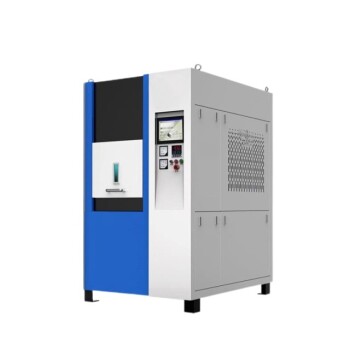
High-temperature sintering is a transformative process that significantly enhances the electrical properties of carbon anodes in Microbial Fuel Cells (MFCs). By treating carbon felt or paper in a high-vacuum or atmosphere furnace, the material undergoes structural densification that lowers resistance and optimizes the transfer of energy from the biofilm to the circuit.
Core Takeaway: Sintering utilizes high heat in controlled environments to create tighter physical connections between carbon particles. This process minimizes grain boundary resistance, thereby maximizing electrical conductivity and ensuring efficient electron collection from the microbial biofilm.
The Physical Mechanism of Sintering
Tightening Physical Connections
The fundamental benefit of sintering lies in its ability to alter the microscopic structure of the anode material. When carbon felt or carbon paper is subjected to high temperatures in a high-vacuum or atmosphere furnace, the individual carbon particles are fused more closely together.
Reducing Grain Boundary Resistance
In untreated materials, the interfaces between particles—known as grain boundaries—act as barriers to electron flow. Sintering tightens these connections, effectively reducing the grain boundary resistance. This creates a continuous, unobstructed path for electrons to travel through the material.
Operational Impact on MFC Performance
Enhancing Electrical Conductivity
The reduction in resistance leads to a direct enhancement of the material's overall electrical conductivity. A more conductive anode ensures that the energy generated by the microbes is not wasted as it moves through the electrode material itself.
Lowering Internal Losses
Anodes treated via sintering experience significantly lower internal losses during battery operation. By minimizing the energy dissipated as heat due to resistance, the system retains more usable power.
Improving Electron Collection Efficiency
The ultimate goal of an MFC anode is to harvest electrons generated by the microbial biofilm. The sintered anode improves the efficiency of electron collection, facilitating a smoother transfer of electrons from the biological layer to the external electrical circuit.
Understanding the Process Requirements
Necessity of Controlled Environments
It is critical to note that this performance boost is dependent on specific processing conditions. The reference highlights the use of a high-vacuum or atmosphere furnace.
The Cost of Performance
Achieving these "tighter physical connections" requires specialized equipment capable of maintaining these controlled environments. The trade-off for superior conductivity and reduced internal losses is the requirement for a rigorous, high-temperature manufacturing step.
Making the Right Choice for Your Goal
When designing your Microbial Fuel Cell, consider how the anode treatment aligns with your performance targets.
- If your primary focus is maximizing power output: Prioritize sintered anodes to minimize internal resistance and ensure the highest possible electron collection efficiency.
- If your primary focus is analyzing basic material properties: Recognize that unsintered carbon paper or felt will inherently possess higher grain boundary resistance, which may skew efficiency data.
Sintering transforms the anode from a loose network of particles into a highly conductive electron collector, making it a vital step for high-performance MFCs.
Summary Table:
| Feature | Untreated Carbon Anode | Sintered Carbon Anode (Vacuum/Atmosphere) |
|---|---|---|
| Microstructure | Loose carbon particle network | Fused, dense particle connections |
| Resistance | High grain boundary resistance | Minimized internal resistance |
| Conductivity | Moderate to low | Superior electrical conductivity |
| Electron Flow | Obstructed by particle interfaces | Continuous, unobstructed path |
| MFC Efficiency | Higher internal energy losses | Maximum electron collection efficiency |
Elevate Your Microbial Fuel Cell Research with KINTEK
Precision in sintering is the key to unlocking the full potential of your carbon anodes. At KINTEK, we specialize in providing high-performance laboratory equipment designed for the most demanding material transformations. Our advanced range of high-temperature furnaces (vacuum, atmosphere, and tube) and high-pressure reactors ensures you achieve the exact structural densification required for superior electrical conductivity.
Whether you are optimizing carbon felt anodes, developing advanced battery materials, or conducting rigorous electrolytic research, KINTEK’s comprehensive portfolio—including crushing systems, hydraulic presses, and specialized ceramics—is engineered to minimize internal losses and maximize your lab's output.
Ready to transform your MFC performance? Contact KINTEK today to find the perfect furnace solution for your research!
References
- Mustakeem Mustakeem. Electrode materials for microbial fuel cells: nanomaterial approach. DOI: 10.1007/s40243-015-0063-8
This article is also based on technical information from Kintek Solution Knowledge Base .
Related Products
- 2200 ℃ Tungsten Vacuum Heat Treat and Sintering Furnace
- Vacuum Heat Treat and Sintering Furnace with 9MPa Air Pressure
- Vacuum Heat Treat and Pressure Sintering Furnace for High Temperature Applications
- 2200 ℃ Graphite Vacuum Heat Treat Furnace
- Ultra-High Temperature Graphite Vacuum Graphitization Furnace
People Also Ask
- What is the melting point of tungsten in a vacuum? The Real Limit is Sublimation, Not Melting
- What happens to tungsten when heated? Discover Its Extreme Heat Resistance and Unique Properties
- How does a high-temperature vacuum sintering furnace facilitate the post-treatment of Zirconia coatings?
- Why is it necessary to use sintering aids for PLS? Achieve Full Density in Ultra-High Temperature Ceramics
- How does a high-temperature vacuum sintering furnace contribute to the formation of Fe-Cr-Al porous materials?