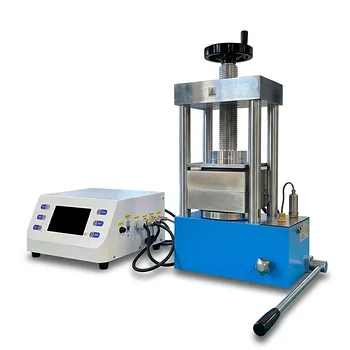
The application of 40MPa mechanical pressure acts as the primary driver for the physical rearrangement and plastic deformation of powder particles within the composite. In the presence of liquid phase silicon (specifically below 1400°C), this external force accelerates the liquid's flow into the boron carbide framework, effectively filling voids to eliminate residual porosity.
Core Takeaway Thermal energy alone is often insufficient to achieve full density in boron carbide-silicon composites. The 40MPa pressure serves as a critical mechanical catalyst, forcing liquid silicon into the particle interstitial spaces to transform a porous framework into a high-density, structurally sound bulk ceramic.
Mechanisms of Structural Change
Forcing Particle Rearrangement
The initial impact of applying 40MPa is the rearrangement of solid particles. The external pressure overcomes the frictional resistance between the boron carbide powders.
This forces the particles to slide past one another into a more compact configuration. It effectively breaks down the "bridges" that naturally form in loose powder, reducing the volume of large voids immediately.
Inducing Plastic Deformation
Beyond simple movement, the pressure causes plastic deformation at the contact points between particles.
As particles deform under the 40MPa load, their contact area increases. This is essential for closing the small gaps that rearrangement alone cannot eliminate, creating a tighter interlocking solid structure.
The Interaction with Liquid Silicon
Accelerating Liquid Redistribution
The most critical function of this pressure occurs when liquid silicon is present, typically at temperatures below 1400°C. The 40MPa load creates a pressure gradient that accelerates the flow of the liquid phase.
This forces the molten silicon to penetrate deeply into the rigid boron carbide particle framework. Without this pressure, the liquid might pool or wet the surface unevenly due to surface tension.
Eliminating Residual Porosity
The ultimate goal of this pressure-assisted flow is the elimination of residual porosity.
By mechanically driving the liquid into the smallest interstices, the process fills the voids between the solid particles. This transforms the material from a porous aggregate into a dense, non-porous bulk ceramic composite.
Critical Considerations for Sintering Quality
The Necessity of External Force
It is a common pitfall to assume that high temperature alone will densify these composites. However, pressure is the deciding factor for removing the final percentage of porosity.
Without the continuous application of 40MPa, the liquid phase may not fully infiltrate the particle boundaries. This results in trapped voids which significantly compromise the material's final properties.
Impact on Mechanical Integrity
The pressure does more than just increase density; it directly improves mechanical reliability.
Pores act as fracture sources—weak points where cracks initiate under stress. By using pressure to minimize the quantity and size of these pores, you significantly enhance the material's fracture toughness and flexural strength.
Making the Right Choice for Your Goal
To optimize your sintering process, align your pressure strategy with your specific material requirements:
- If your primary focus is Maximum Density: Ensure the full 40MPa load is maintained specifically during the liquid phase window (<1400°C) to force complete void filling.
- If your primary focus is Mechanical Strength: Prioritize pressure application to eliminate grain boundary pores, as these are the primary initiation sites for structural failure.
The successful fabrication of boron carbide-silicon composites relies not just on melting the silicon, but on mechanically forcing it to become the glue that binds the microstructure together.
Summary Table:
| Mechanism | Impact of 40MPa Pressure | Structural Outcome |
|---|---|---|
| Particle Rearrangement | Overcomes friction and breaks powder 'bridges' | Reduced void volume & compact configuration |
| Plastic Deformation | Increases contact area at particle interfaces | Tighter interlocking solid structure |
| Liquid Redistribution | Accelerates molten silicon flow into frameworks | Deep penetration and uniform wetting |
| Porosity Elimination | Mechanically drives liquid into small interstices | High-density, non-porous bulk ceramic |
| Mechanical Integrity | Minimizes crack initiation sites (pores) | Enhanced fracture toughness & flexural strength |
Elevate your material synthesis with KINTEK’s precision engineering. As specialists in advanced laboratory equipment, KINTEK provides high-performance hydraulic hot presses, pellet presses, and isostatic systems designed to meet the rigorous 40MPa+ demands of ceramic composite sintering. Whether you are developing B4C-Si composites or exploring battery research and high-temperature vacuum applications, our comprehensive range of crushing, milling, and sintering solutions ensures maximum density and mechanical integrity for your research. Contact us today to optimize your laboratory workflow!
Related Products
- Automatic High Temperature Heated Hydraulic Press Machine with Heated Plates for Lab
- Heated Hydraulic Press Machine with Heated Plates for Vacuum Box Laboratory Hot Press
- Manual High Temperature Heated Hydraulic Press Machine with Heated Plates for Lab
- 24T 30T 60T Heated Hydraulic Press Machine with Heated Plates for Laboratory Hot Press
- Heated Hydraulic Press Machine with Heated Plates for Vacuum Box Laboratory Hot Press
People Also Ask
- What is a heated hydraulic press used for? Essential Tool for Curing, Molding, and Laminating
- Why is a heated hydraulic press used for warm pressing NASICON green tapes? Optimize Your Solid Electrolyte Density
- Why is a heated laboratory hydraulic press necessary for composite laminates? Achieve Void-Free Structural Integrity
- What is a hot hydraulic press? Harness Heat and Pressure for Advanced Manufacturing
- What technical conditions does a heated hydraulic press provide for PEO batteries? Optimize Solid-State Interfaces