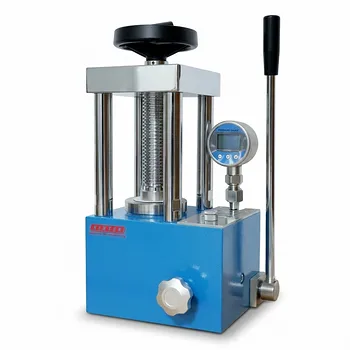
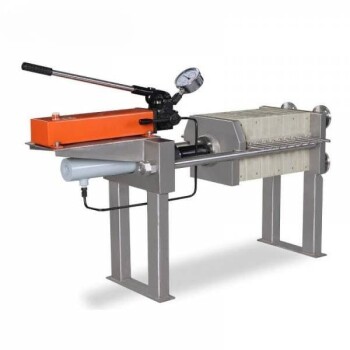
High uniaxial pressure acts as the critical binding agent in the assembly of bipolar stacked all-solid-state batteries. By utilizing a laboratory hydraulic press, you apply force to tightly compact pre-fabricated cathode, solid electrolyte, and anode membranes, effectively fusing them into a single, cohesive unit to eliminate microscopic gaps.
The fundamental challenge in solid-state batteries is establishing intimate contact between solid particles. The hydraulic press solves this by densifying the stack to eliminate voids, thereby reducing resistance and preventing structural failure during charging cycles.
The Mechanics of Densification
Eliminating Interlayer Gaps
The primary function of the hydraulic press is to address the inherent roughness of solid materials. Even smooth-looking membranes have microscopic voids that impede performance.
By applying high pressure, you force the cathode, electrolyte, and anode membranes into tight physical contact. This removes the air gaps that would otherwise act as insulators between the layers.
Inducing Plastic Deformation
Solid electrolytes, such as LiBH4, possess high deformability under stress. When subjected to significant pressure (often up to 360 MPa), these materials undergo plastic deformation.
This process forces the electrolyte particles to change shape and flow into the voids between electrode particles. The result is a highly dense, non-porous layer that mimics the continuous contact found in liquid electrolyte systems.
Optimizing Electrochemical Performance
Reducing Interface Resistance
The efficiency of a battery is defined by how easily ions move through it. In solid-state systems, the greatest barrier to this movement is interfacial impedance—resistance at the point where layers meet.
The densification provided by the press maximizes the active contact area between solids. This significantly lowers grain boundary resistance and solid-solid interface resistance, allowing for efficient ion transfer.
Ensuring Efficient Ion Transport
A porous electrolyte layer is a bottleneck for energy flow. The press compresses powders into dense pellets or discs, drastically reducing porosity.
By creating a dense, continuous pathway, the press ensures that lithium (or sodium) ions can transport freely between the active material and the electrolyte without encountering voids.
Structural Integrity and Stability
Preventing Delamination
Batteries expand and contract during charging and discharging cycles. In a stacked structure, this movement can cause layers to separate, leading to failure.
The compaction process creates a mechanically robust multi-layer structure. This initial high-pressure bonding is essential for preventing delamination, ensuring the battery retains its integrity over repeated cycles.
Mitigating Dendrite Growth
Gaps and soft spots in an electrolyte layer provide a path of least resistance for dendrites (metal spikes) to grow and short-circuit the battery.
By compressing materials like Na4(CB11H12)2(B12H12) into dense pellets, the press eliminates the pathways required for dendrite penetration. This densification is a critical safety mechanism.
Understanding the Trade-offs
The Necessity of Uniformity
While high pressure is beneficial, it must be applied uniformly. The press utilizes uniaxial pressure to ensure the force is directed in a single axis, maintaining the alignment of the bipolar stack.
Pressure Calibration
Applying pressure is not a "more is better" scenario without limits. The goal is densification, not destruction.
You must apply enough pressure to induce plastic deformation and eliminate pores, but you must do so within the mechanical limits of the pre-fabricated membranes to avoid crushing the active materials or creating new stress fractures.
Making the Right Choice for Your Goal
To maximize the utility of your laboratory hydraulic press, tailor your approach to your specific performance metrics.
- If your primary focus is Electrochemical Efficiency: Prioritize high-pressure settings that induce plastic deformation to minimize porosity and interfacial impedance.
- If your primary focus is Cycle Life and Durability: Focus on the consistency of the compaction to ensure a mechanically integrated stack that resists delamination over time.
The hydraulic press is not just a tool for shaping; it is a precision instrument for engineering the microscopic interfaces that define battery performance.
Summary Table:
| Mechanism | Impact on Battery Assembly | Primary Benefit |
|---|---|---|
| Interlayer Compaction | Eliminates microscopic air gaps between membranes | Removes insulators for seamless layers |
| Plastic Deformation | Forces electrolyte particles to flow into electrode voids | Creates a dense, non-porous solid interface |
| Interface Densification | Maximizes active contact area between solids | Significantly lowers interfacial impedance |
| Structural Bonding | Fuses cathode, electrolyte, and anode into one unit | Prevents delamination during charge cycles |
| Porosity Reduction | Creates a continuous, void-free pathway | Mitigates dendrite growth and short circuits |
Elevate Your Battery Research with KINTEK Precision
Unlock superior electrochemical performance and structural integrity in your all-solid-state battery research. KINTEK specializes in advanced laboratory equipment designed for the rigorous demands of material science. Our high-precision hydraulic presses (pellet, hot, isostatic) and crushing and milling systems provide the uniform uniaxial pressure necessary to eliminate interfacial resistance and prevent delamination in bipolar stacks.
From high-temperature high-pressure reactors to essential consumables like PTFE products, ceramics, and crucibles, KINTEK offers a comprehensive ecosystem for energy storage innovation. Let our experts help you calibrate the perfect pressure for your next breakthrough.
Contact KINTEK Today for a Specialized Solution
Related Products
- Laboratory Hydraulic Press Split Electric Lab Pellet Press
- Laboratory Hydraulic Press Lab Pellet Press Machine for Glove Box
- Laboratory Hydraulic Press Lab Pellet Press for Button Battery
- Automatic Laboratory Hydraulic Pellet Press Machine for Lab Use
- Automatic Laboratory Hydraulic Press for XRF & KBR Pellet Press
People Also Ask
- What role does a laboratory hydraulic press play in platinum recovery research? Enhancing Sample Precision
- What are the specific applications of a lab hydraulic press in biochar evaluation? Optimize density and data accuracy.
- What are the roles of a laboratory hydraulic press and stainless steel molds in the preparation of graphite samples?
- What is the role of a laboratory hydraulic press in electrode prep? Maximize Energy Density & Sealing Precision
- Why must a laboratory hydraulic press equipped with cylindrical molds be used when preparing BZY green bodies? High Density