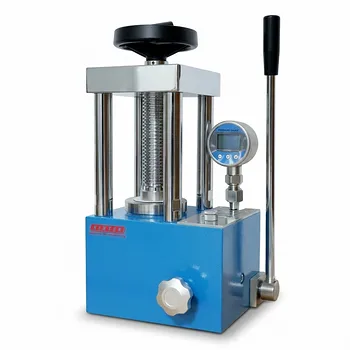
The pressing pressure applied by a laboratory hydraulic press is the primary determinant of the final performance characteristics of Nickel-Chromium (Ni–Cr) alloys. It acts as the foundational step that dictates contact density, directly influencing how effectively the material densifies and diffuses during the subsequent sintering process.
The precise application of molding pressure ensures maximum contact between powder particles, which is the prerequisite for effective sintering. This step minimizes porosity and guarantees the homogeneous microstructure required for high mechanical strength and environmental durability.
The Mechanism of Densification
Controlling Contact Density
The immediate function of the hydraulic press is to establish the contact density between the raw powder particles.
By applying a precise force, you reduce the distance between individual grains. This physical proximity is critical because it sets the baseline for all subsequent chemical and thermal reactions.
Enhancing Diffusion Kinetics
Once the particles are mechanically compressed, the efficiency of elemental diffusion increases significantly.
During the sintering (heat treatment) phase, atoms move across particle boundaries to bond the material. Sufficient initial pressure accelerates this kinetics, allowing the alloy to form a cohesive solid more efficiently.
Microstructural Integrity
Minimizing Internal Pores
One of the primary goals of pressing is the creation of a high-quality "green body" (the compacted powder before heating).
Uniform and sufficient pressure forces air out and closes the gaps between particles. This minimizes the presence of internal pores, which are structural weaknesses that can persist even after the alloy is heated.
Ensuring Homogeneity
A consistent application of pressure results in a homogeneous microstructure.
When the density is uniform throughout the compact, the final alloy avoids localized weak spots. This structural uniformity is essential for predictable performance in the finished component.
Impact on Final Properties
Mechanical Performance
The reduction of porosity and the enhancement of particle bonding directly translate to improved mechanical properties.
A denser, more homogeneous alloy exhibits higher strength and better structural integrity. The initial pressing force effectively dictates the upper limit of the material's load-bearing capacity.
Environmental Resistance
Beyond pure strength, the density of the alloy affects its interaction with the environment.
A structure with fewer pores and tighter particle bonding offers superior environmental resistance. This makes the Ni–Cr alloy less susceptible to degradation from external factors such as oxidation or corrosion.
Critical Considerations and Trade-offs
The Necessity of Uniformity
While high pressure is generally beneficial for density, the source emphasizes that pressure must be uniform as well as sufficient.
If the hydraulic press applies force unevenly, it will create density gradients within the green body. These gradients lead to varying diffusion rates during sintering, resulting in a distorted or inconsistent final microstructure.
The Risk of Insufficient Pressure
Failing to achieve the threshold of "sufficient" pressure renders the sintering process inefficient.
Low contact density leads to slow diffusion kinetics and retained porosity. No amount of heat treatment can fully correct the structural defects caused by an under-pressed green body.
Making the Right Choice for Your Goal
To maximize the potential of your Ni–Cr powder compacts, you must view the hydraulic press not just as a shaping tool, but as a microstructural engineer.
- If your primary focus is Mechanical Strength: Prioritize sufficient pressure to maximize contact density and eliminate internal pores that act as stress concentrators.
- If your primary focus is Environmental Resistance: Ensure the pressure is applied with absolute uniformity to create a homogeneous surface and internal structure that resists degradation.
The quality of your final alloy is established the moment the press applies its force.
Summary Table:
| Factor Influenced | Effect of Sufficient Pressure | Resulting Material Property |
|---|---|---|
| Contact Density | Maximizes particle-to-particle contact | Enhanced diffusion kinetics |
| Porosity | Minimizes internal gaps and air pockets | Higher structural integrity |
| Microstructure | Promotes uniform grain distribution | Homogeneous performance |
| Mechanical Strength | Reduces stress concentrators | Increased load-bearing capacity |
| Durability | Creates a tighter physical barrier | Superior environmental resistance |
Elevate Your Material Research with KINTEK
Precision in pressing is the foundation of high-performance alloy development. KINTEK specializes in advanced laboratory solutions designed to give you total control over your material characteristics. Whether you are working with Ni–Cr powders or complex ceramics, our comprehensive range of hydraulic presses (pellet, hot, isostatic), crushing and milling systems, and high-temperature furnaces ensure your samples achieve maximum density and structural integrity.
From high-pressure reactors to specialized PTFE and ceramic consumables, KINTEK provides the tools necessary for cutting-edge metallurgical and battery research.
Ready to achieve superior densification and eliminate porosity in your samples? Contact our experts today to find the perfect equipment for your lab!
References
- Liang‐Feng Huang, James M. Rondinelli. Elemental partitioning and corrosion resistance of Ni–Cr alloys revealed by accurate ab-initio thermodynamic and electrochemical calculations. DOI: 10.1038/s41529-023-00414-w
This article is also based on technical information from Kintek Solution Knowledge Base .
Related Products
- Laboratory Hydraulic Press Split Electric Lab Pellet Press
- Laboratory Hydraulic Press Lab Pellet Press Machine for Glove Box
- Laboratory Hydraulic Press Lab Pellet Press for Button Battery
- Automatic Laboratory Hydraulic Press for XRF & KBR Pellet Press
- Automatic Laboratory Hydraulic Pellet Press Machine for Lab Use
People Also Ask
- What role does a laboratory hydraulic press play in platinum recovery research? Enhancing Sample Precision
- What are the specific applications of a lab hydraulic press in biochar evaluation? Optimize density and data accuracy.
- What are the roles of a laboratory hydraulic press and stainless steel molds in the preparation of graphite samples?
- What is the role of a laboratory hydraulic press in electrode prep? Maximize Energy Density & Sealing Precision
- Why must a laboratory hydraulic press equipped with cylindrical molds be used when preparing BZY green bodies? High Density