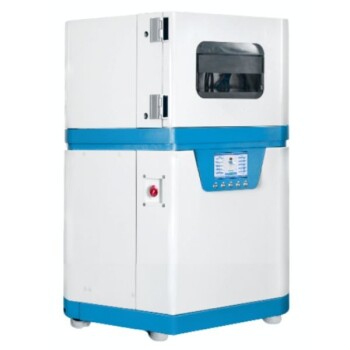
The temperature control system of a vacuum hot press preserves nanometer-scale microstructures by enforcing a strict low-temperature sintering environment. By operating at precise temperatures, such as 523 K, the system provides just enough thermal energy to bond particles together while preventing the excessive atomic movement that leads to grain growth.
The core principle is energy management: the system utilizes high pressure to facilitate bonding at lower temperatures, thereby strictly limiting long-distance atomic diffusion and freezing the grain size at the nanometer level.
The Mechanics of Microstructure Preservation
The Strategy of Low-Temperature Sintering
The primary function of the temperature control system is to maintain a thermal ceiling. In the context of copper materials, this involves sintering at relatively low temperatures, specifically around 523 K.
By capping the temperature at this level, the system drastically limits the total thermal energy available to the material. This is the first line of defense against the coarsening of the microstructure.
Facilitating Neck Bonding
Despite the low temperature, the material must still form a solid structure. The system ensures there is sufficient energy to initiate neck bonding between copper particles.
This bonding is the initial stage of sintering where particles join at their contact points. The goal is to achieve this connection without melting the particles or allowing them to merge completely.
Restricting Long-Distance Diffusion
The critical factor in maintaining a nanometer-scale grain size (approximately 45 nm) is the restriction of atomic movement.
At higher temperatures, atoms diffuse over long distances, causing grains to consume one another and grow larger. The precise temperature control prevents this long-distance diffusion, effectively locking the atoms in place relative to their original grain boundaries.
Understanding the Role of Pressure
It is impossible to discuss the temperature control system in isolation from pressure. The vacuum hot press relies on a symbiotic relationship between thermal energy and mechanical force.
Compensating for Lower Thermal Energy
Because the temperature is kept low to prevent grain growth, thermal energy alone is insufficient to densify the material.
The system relies on high pressure to compensate for this lack of heat. The pressure forces particles together, mechanically driving the sintering process that would otherwise require higher temperatures.
The Trade-off: Densification vs. Coarsening
There is a delicate balance at play. If the temperature rises even slightly above the target, diffusion accelerates, and the nanoscale structure is lost.
Conversely, if the temperature is too low, even high pressure may not be enough to form strong inter-particle bonds. The precise control system exists to walk the fine line between achieving structural integrity and preventing microstructural degradation.
Making the Right Choice for Your Goal
To optimize the microstructure of copper materials using a vacuum hot press, consider the following parameters:
- If your primary focus is maintaining nanometer grain size: Prioritize strict temperature limits (e.g., 523 K) to inhibit long-distance atomic diffusion.
- If your primary focus is material density: Ensure the applied pressure is high enough to drive neck bonding, compensating for the reduced thermal energy.
By substituting thermal energy with mechanical pressure, you can achieve robust sintering without sacrificing the unique properties of nanometer-scale grains.
Summary Table:
| Parameter | Target Value/Effect | Role in Microstructure Preservation |
|---|---|---|
| Sintering Temperature | Approximately 523 K | Provides minimum energy for bonding while preventing grain coarsening. |
| Atomic Movement | Restricted Long-Distance Diffusion | Locks atoms in place to maintain nanometer-scale grain size (~45 nm). |
| Applied Pressure | High Mechanical Force | Compensates for low thermal energy to drive densification and neck bonding. |
| Atmosphere | Vacuum | Prevents oxidation and contamination during the sensitive sintering process. |
Elevate Your Material Research with KINTEK's Precision Solutions
Achieving the perfect balance between densification and microstructural integrity requires world-class equipment. KINTEK specializes in advanced laboratory solutions, offering high-performance vacuum hot presses and isostatic presses designed for precise temperature and pressure management.
Whether you are working with nanometer-scale copper, advanced ceramics, or battery research, our comprehensive portfolio—including high-temperature furnaces (vacuum, CVD, dental, induction), crushing systems, and high-pressure reactors—provides the reliability your lab demands.
Ready to optimize your sintering process? Contact KINTEK today to discover how our expert tools can transform your research outcomes.
Related Products
- Vacuum Hot Press Furnace Machine Heated Vacuum Press
- Vacuum Hot Press Furnace Machine for Lamination and Heating
- Vacuum Hot Press Furnace Heated Vacuum Press Machine Tube Furnace
- 600T Vacuum Induction Hot Press Furnace for Heat Treat and Sintering
- Touchscreen Automatic Vacuum Heat Press
People Also Ask
- What advantages does a vacuum hot press furnace provide for LSLBO ceramic electrolytes? Achieve 94% Relative Density
- What role does a Vacuum Hot Press (VHP) furnace play in the densification of austenitic stainless steel 316 composites?
- What are the advantages of using a vacuum hot pressing furnace? Superior Densification for 2024Al/Gr/SiC Composites
- Why is it necessary to maintain a high-vacuum environment within a vacuum hot press furnace? Optimize Cu-SiC Sintering
- How does the pressure system of a vacuum hot press furnace affect Cu-18Ni-2W alloys? Enhance Density & Performance