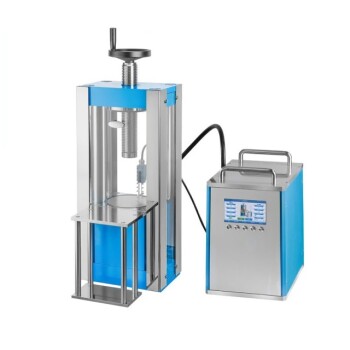
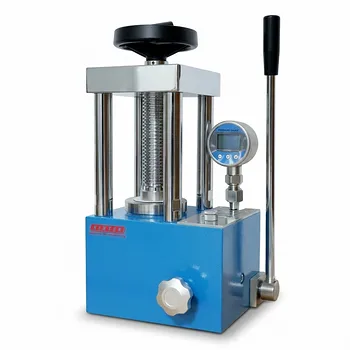
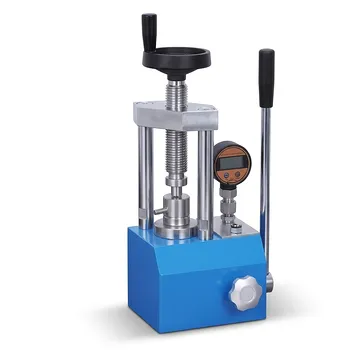
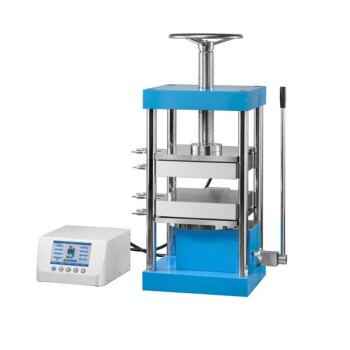
The use of a laboratory hydraulic press is a critical fabrication step that optimizes electrode performance by mechanically bonding the active material to the current collector. By applying high, precise pressure (typically 10 MPa or higher), the press deforms the nickel foam substrate and embeds the Ag@CuO@rGO composite directly into its pores. This physical integration significantly reduces contact resistance and ensures high structural durability during rigorous electrochemical cycling.
The laboratory hydraulic press transforms a loose slurry coating into a high-performance electrode by minimizing interfacial resistance and maximizing mechanical adhesion between the Ag@CuO@rGO composite and the conductive substrate.
Enhancing Electrical Conductivity and Charge Transfer
Minimizing Contact Resistance
High pressure ensures tight electrical contact between the Ag@CuO@rGO particles, conductive additives, and the current collector. This reduction in interfacial resistance allows for faster electron transmission across the electrode-collector interface.
Improving Rate Performance
Enhanced electrical contact directly translates to better performance under high current densities. This allows the supercapacitor to charge and discharge rapidly without significant voltage drops or energy loss.
Optimizing Ion Transport Impedance
By compacting the active material layer, the hydraulic press can optimize the pathways for ions within the electrode structure. This reduces ion transport impedance, which is essential for achieving high capacitance at fast operating speeds.
Optimizing Structural Integrity and Longevity
Strengthening Mechanical Adhesion
The hydraulic press deforms the nickel foam, physically embedding the Ag@CuO@rGO composite into the substrate's macropores. This creates a robust mechanical bond that prevents the active material from delaminating or peeling off during use.
Maintaining Stability During Cycling
Structural integrity is vital when the electrode is immersed in liquid electrolytes. The compression ensures that the active material remains securely attached to the current collector throughout thousands of charge-discharge cycles, preventing capacity decay.
Resistance to Electrolyte Immersion
The high-pressure bonding process ensures that the active material layer does not swell or detach when exposed to the electrolyte. This maintains a consistent ohmic contact, which is necessary for long-term device reliability.
Precision and Reproducibility in Fabrication
Controlling Electrode Thickness
A hydraulic press allows researchers to achieve a precise and uniform electrode thickness (e.g., 30 μm). Consistency in thickness is vital for comparing results across different samples and ensuring reproducible electrochemical data.
Ensuring Uniform Density
The application of constant, distributed pressure ensures that the Ag@CuO@rGO slurry is evenly compacted across the entire surface of the nickel mesh or foam. This eliminates "hot spots" of high resistance and ensures the entire electrode contributes to energy storage.
Understanding the Trade-offs
Risk of Over-Compression
While high pressure is beneficial, exceeding the optimal range (e.g., going significantly beyond 30 MPa) can collapse the porous structure of the nickel foam. If the pores are completely crushed, the electrolyte cannot penetrate the electrode effectively, reducing the accessible surface area.
Impact on Electrolyte Diffusion
Excessive compaction can reduce the interstitial space between the Ag@CuO@rGO particles. If the density is too high, the diffusion of ions into the inner parts of the electrode may be hindered, negatively impacting the total capacitance.
How to Apply This to Your Project
Recommendations Based on Your Goals
- If your primary focus is High Power Delivery: Prioritize minimizing contact resistance by using precise pressure control to ensure the lowest possible internal ohmic losses.
- If your primary focus is Long-Term Cycling Stability: Use higher pressures (toward the 25-30 MPa range) to maximize the mechanical bond between the active material and the substrate.
- If your primary focus is Maximizing Specific Capacitance: Carefully calibrate the pressure to compact the material without collapsing the internal pores required for electrolyte access.
Mastering the application of hydraulic pressure allows you to bridge the gap between a promising composite material and a high-performance energy storage device.
Summary Table:
| Key Factor | Impact on Ag@CuO@rGO Performance | Critical Benefit |
|---|---|---|
| Interfacial Resistance | Minimizes contact resistance between active material & collector | Faster charge/discharge rates |
| Mechanical Adhesion | Deeply embeds composite into nickel foam pores | Prevents delamination & capacity decay |
| Structural Density | Ensures uniform thickness and particle packing | Highly reproducible electrochemical data |
| Pressure Control | Balances compaction with electrolyte accessibility | Optimized ion transport impedance |
Elevate Your Energy Storage Research with KINTEK Precision
Precision is paramount when fabricating advanced Ag@CuO@rGO electrodes. At KINTEK, we specialize in providing high-performance laboratory hydraulic presses—including manual, electric, and isostatic models—designed to deliver the exact pressure needed to optimize your supercapacitor performance without compromising material integrity.
Beyond pressing, our comprehensive portfolio supports every stage of your material science workflow:
- Advanced Synthesis: High-temperature furnaces (CVD, PECVD, vacuum, and atmosphere) for precise material growth.
- Sample Preparation: Crushing, milling, and sieving systems to ensure perfectly uniform slurries.
- Electrochemical Excellence: High-pressure reactors, electrolytic cells, and high-quality electrodes.
- Consumables: Premium PTFE products, ceramics, and crucibles for contamination-free processing.
Ready to bridge the gap between material design and high-performance energy storage? Contact KINTEK today to discover how our equipment can enhance your lab's efficiency and ensure the success of your next breakthrough.
References
- Yuxin Zhang, Wei‐Zhong Han. Synthesis by adding CTAB and characterization of Ag@CuO@rGO nanocomposite with a novel core–shell crystal sugar structure and its application in supercapacitors. DOI: 10.1039/d3ra03025c
This article is also based on technical information from Kintek Solution Knowledge Base .
Related Products
- Laboratory Hydraulic Press Split Electric Lab Pellet Press
- Laboratory Hydraulic Press Lab Pellet Press Machine for Glove Box
- Laboratory Hydraulic Press Lab Pellet Press for Button Battery
- Automatic Laboratory Hydraulic Pellet Press Machine for Lab Use
- Automatic Laboratory Hydraulic Press for XRF & KBR Pellet Press
People Also Ask
- What role does a laboratory hydraulic press play in platinum recovery research? Enhancing Sample Precision
- What are the specific applications of a lab hydraulic press in biochar evaluation? Optimize density and data accuracy.
- What are the roles of a laboratory hydraulic press and stainless steel molds in the preparation of graphite samples?
- What is the role of a laboratory hydraulic press in electrode prep? Maximize Energy Density & Sealing Precision
- Why must a laboratory hydraulic press equipped with cylindrical molds be used when preparing BZY green bodies? High Density