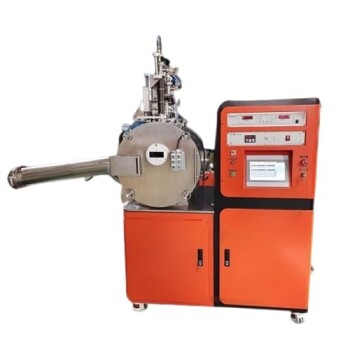
Vacuum induction melting (VIM) serves as a critical refinement process for nickel-base alloys, primarily by drastically reducing internal impurities and gas content. By purifying the material at a fundamental level, VIM creates alloys that exhibit significantly higher corrosion resistance—specifically 1.2 to 1.7 times greater than those produced by conventional melting—ensuring the structural integrity required for hydrofluorination reactors.
By minimizing internal contaminants, vacuum induction melting stabilizes the alloy's microstructure, enabling it to withstand the aggressive high-temperature acidic environments found in hydrofluorination processes.
The Purification Mechanism
Reducing Internal Impurities
The primary function of the vacuum induction melting process is the rigorous purification of the raw alloy.
By melting the material under a vacuum, the process actively removes non-metallic inclusions and other internal impurities that typically degrade material strength.
Elimination of Gas Content
Conventional melting often traps gases within the metal matrix, creating porosity and weak points.
VIM mitigates this by degassing the molten metal, resulting in a denser, more uniform composition that is less reliable to failure under stress.
Performance in Hydrofluorination Environments
Enhanced Microstructural Stability
Hydrofluorination reactors operate in high-temperature acidic environments that aggressively attack metal structures.
Alloys processed via VIM demonstrate superior microstructural stability, maintaining their physical properties even when exposed to these extreme thermal and chemical conditions.
Quantifiable Corrosion Resistance
The most distinct advantage of VIM-processed alloys is their resistance to chemical attack.
Data indicates that these materials possess a corrosion resistance 1.2 to 1.7 times higher than similar alloys produced through conventional melting methods.
This multiplier is not merely a marginal improvement; it represents a significant extension in the service life of reactor components.
The Critical Comparison: VIM vs. Conventional Melting
The Risk of Conventional Methods
While conventional melting is standard for less demanding applications, it leaves behind residual impurities.
In a hydrofluorination reactor, these impurities act as initiation sites for corrosion and cracking.
The Trade-off for Durability
The decision to utilize VIM is effectively a decision to prioritize material longevity over manufacturing simplicity.
The process ensures that the alloy's theoretical performance limits are actually met in the field, preventing premature failure caused by microscopic defects.
Making the Right Choice for Your Reactor
When selecting materials for hydrofluorination systems, the melting process is as critical as the alloy composition itself.
- If your primary focus is maximizing equipment lifespan: Prioritize VIM-processed nickel-base alloys to leverage the 1.2 to 1.7 times increase in corrosion resistance.
- If your primary focus is operational safety: Specify VIM materials to ensure microstructural stability in high-temperature acidic zones, minimizing the risk of unexpected structural failure.
High-purity processing is not a luxury; it is a prerequisite for reliability in aggressive chemical environments.
Summary Table:
| Feature | Conventional Melting | Vacuum Induction Melting (VIM) |
|---|---|---|
| Impurity Levels | Higher residual non-metallic inclusions | Rigorous purification & minimal inclusions |
| Gas Content | Trapped gases causing porosity | Effective degassing for denser composition |
| Corrosion Resistance | Baseline | 1.2 to 1.7 times higher |
| Microstructure | Prone to instability at high temps | Superior stability in acidic environments |
| Service Life | Standard | Significantly extended longevity |
Elevate Your Reactor Performance with KINTEK Precision
Ensure the longevity and safety of your hydrofluorination systems with high-purity materials processed to the highest standards. KINTEK specializes in advanced laboratory and industrial solutions, including high-performance induction melting systems designed to produce superior nickel-base alloys.
Beyond melting, we offer a comprehensive range of high-temperature furnaces (vacuum, tube, and atmosphere), high-pressure reactors, and crucibles tailored for aggressive chemical environments. Our team of experts is ready to help you minimize equipment failure and maximize operational efficiency.
Ready to upgrade your material integrity? Contact KINTEK today for a consultation!
References
- A. V. Volosnev, A.I. Rudnikov. Optimal reactor material for fluorinating uranium oxides by hydrogen fluoride gas. DOI: 10.1007/s10512-013-9723-x
This article is also based on technical information from Kintek Solution Knowledge Base .
Related Products
- Lab-Scale Vacuum Induction Melting Furnace
- Vacuum Induction Melting Spinning System Arc Melting Furnace
- Vacuum Heat Treat Furnace and Levitation Induction Melting Furnace
- Vacuum Arc Induction Melting Furnace
- Non Consumable Vacuum Arc Induction Melting Furnace
People Also Ask
- How do vacuum induction or arc melting furnaces facilitate the synthesis of U-Al-C MAX phases? Precision Heat & Purity
- What types of metals are typically processed in a vacuum induction melting furnace? High-Purity Alloys for Critical Applications
- Why use VIM for rare earth steel? Essential Precision for Melting Reactive Lanthanum and Cerium
- What is the primary function of a vacuum induction melting furnace in Ni-Mo-Cr-Fe master alloy prep? Ensure High Purity
- What are the advantages of a vacuum induction melting furnace? Achieve High-Purity Alloys with Precision VIM