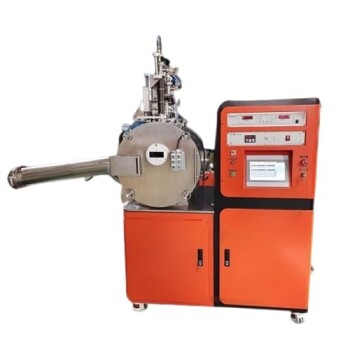
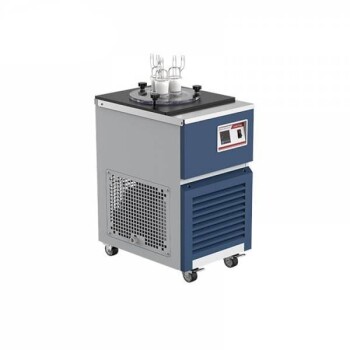
Vacuum induction melting (VIM) is a metallurgical process that uses electromagnetic induction to melt metal inside a tightly controlled vacuum chamber. This method is essential for producing high-purity, high-performance alloys because it prevents the molten metal from reacting with atmospheric gases like oxygen and nitrogen, which would otherwise introduce impurities and degrade the final material's quality.
By combining the non-contact heating of induction with the purifying effect of a vacuum, VIM is not merely a melting process; it is a refining process designed to achieve the highest possible levels of cleanliness, compositional accuracy, and material integrity.
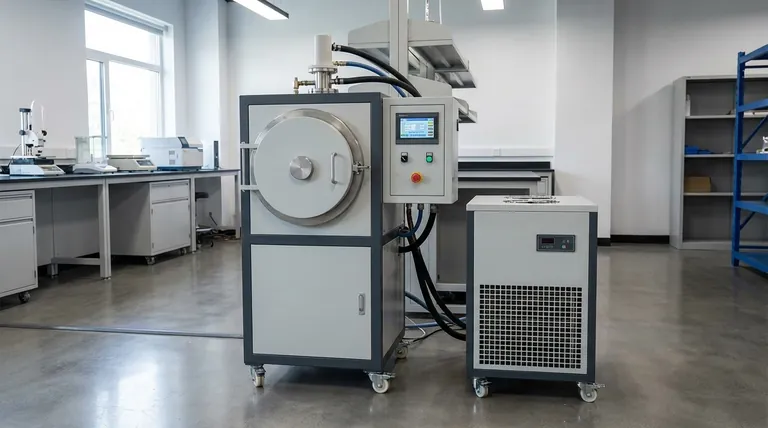
The Core Principle: Melting with Electromagnetism
The entire process hinges on a fundamental law of physics: a changing magnetic field induces an electric current in a nearby conductor. The VIM furnace leverages this principle to generate intense heat without any direct contact.
The Induction Coil
A powerful alternating current is passed through a water-cooled copper coil that encircles the crucible holding the raw metal. This coil acts as the primary winding of a transformer.
The Metal Charge
The solid metal placed inside the crucible acts as the secondary winding. The powerful magnetic field from the primary coil induces a massive flow of electricity within the metal itself.
Heating via Eddy Currents
These induced electrical currents, known as eddy currents, encounter resistance as they swirl through the metal. This resistance generates immense heat, rapidly melting the material from the inside out in a clean, contained manner.
The Critical Role of the Vacuum
Melting metal is only half the story. The true value of VIM comes from performing this action within a vacuum, which provides two distinct advantages.
Preventing Contamination
Many advanced alloys, such as superalloys and high-strength steels, contain highly reactive elements like titanium, aluminum, and niobium. When exposed to air at high temperatures, these elements readily form oxides and nitrides, creating impurities that compromise the material's strength and reliability. The vacuum eliminates this risk.
Removing Impurities
The vacuum environment actively pulls dissolved gases, such as oxygen and nitrogen, out of the molten metal. As the material melts, these trapped gases are released and evacuated by the vacuum pumps, resulting in a cleaner, denser, and more structurally sound final product.
Understanding the VIM Process Step-by-Step
The VIM process is a carefully orchestrated sequence designed to maximize purity and control at every stage.
1. Loading and Evacuation
Solid raw materials are loaded into a refractory-lined crucible inside the airtight furnace. The chamber is then sealed, and a powerful vacuum system removes the air to a specified low pressure.
2. The Melting Period
Power is applied to the induction coil. Due to the skin effect of the induction current, the outer layers of the metal charge melt first. This layer-by-layer melting is highly effective at releasing trapped gases.
3. The Refining Period
Once the entire charge is molten, the process enters the refining stage. The induction current naturally creates a stirring action within the molten bath, known as electromagnetic stirring. This ensures all elements are uniformly mixed and promotes the removal of any remaining impurities.
4. Alloying and Casting
With the base metal fully melted and refined, precise amounts of other alloying elements can be added under vacuum to achieve the exact final composition. Once the melt is ready, it is poured into molds to create ingots or castings, often without ever leaving the vacuum environment.
The Unmatched Advantages of VIM
Opting for VIM is a decision driven by the need for ultimate material quality, where the benefits far outweigh the complexity of the process.
Unmatched Purity
By eliminating atmospheric contamination and actively removing dissolved gases, VIM produces metals and alloys with exceptionally low levels of impurities.
Precise Compositional Control
The sealed, controlled environment allows for extremely precise additions of alloying elements, ensuring the final product meets exact chemical specifications without loss due to oxidation.
Superior Homogeneity
The inherent electromagnetic stirring action guarantees a perfectly uniform distribution of all elements throughout the melt, eliminating inconsistencies in the final material.
How to Apply This to Your Project
Your material requirements will determine if VIM is not just an option, but a necessity.
- If your primary focus is maximum material performance and reliability: VIM is the standard for critical applications like aerospace turbine blades, medical implants, or power generation components where material failure is not an option.
- If your primary focus is working with reactive or exotic alloys: For any material containing significant amounts of titanium, aluminum, or other reactive elements, VIM is required to prevent the formation of harmful impurities.
- If your primary focus is achieving extreme consistency across batches: The precise control over composition and purity offered by VIM ensures unparalleled repeatability for high-volume, high-spec production.
Ultimately, vacuum induction melting is the definitive process for transforming raw metals into the ultra-pure, high-performance alloys that modern technology demands.
Summary Table:
| Key Aspect | Description |
|---|---|
| Process | Melting metal via electromagnetic induction inside a vacuum chamber. |
| Primary Benefit | Produces ultra-pure alloys by preventing atmospheric contamination. |
| Ideal For | Reactive alloys (e.g., superalloys), aerospace, medical implants, and high-spec components. |
| Key Advantages | Unmatched purity, precise compositional control, and superior homogeneity. |
Need ultra-pure, high-performance alloys for your critical applications?
KINTEK specializes in advanced lab equipment and consumables for metallurgical processes. Our expertise can help you achieve the highest levels of material cleanliness and integrity required for aerospace, medical, and energy sectors.
Contact us today to discuss how our solutions can meet your laboratory's specific needs!
Visual Guide

Related Products
- Vacuum Induction Melting Spinning System Arc Melting Furnace
- Lab-Scale Vacuum Induction Melting Furnace
- Vacuum Arc Induction Melting Furnace
- Non Consumable Vacuum Arc Induction Melting Furnace
- Vacuum Heat Treat Furnace and Levitation Induction Melting Furnace
People Also Ask
- What core role does a Vacuum Induction Melting furnace play in nickel-free steel production? Achieve High-Purity Alloys
- How do vacuum induction or arc melting furnaces facilitate the synthesis of U-Al-C MAX phases? Precision Heat & Purity
- What technical advantages does a vacuum induction melting furnace offer? Achieve High-Purity Steel Composites
- What is the primary function of a vacuum induction melting furnace in Ni-Mo-Cr-Fe master alloy prep? Ensure High Purity
- What types of metals are typically processed in a vacuum induction melting furnace? High-Purity Alloys for Critical Applications