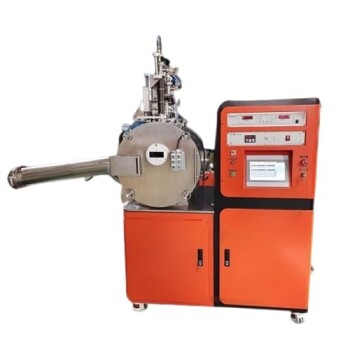
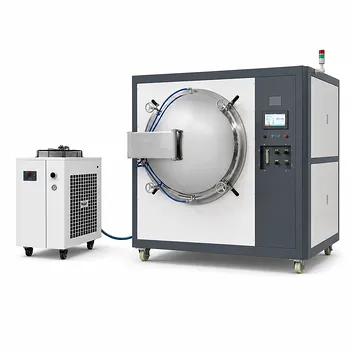
A vacuum induction melting (VIM) furnace offers two critical technical advantages for smelting cast steel composites: superior environmental control and active kinetic mixing. By maintaining a high-vacuum environment, the equipment minimizes gaseous impurities and prevents contamination of the steel melt. Furthermore, it utilizes electromagnetic induction to create automatic stirring, which facilitates the rapid melting of the master alloy carrier and ensures the uniform spatial distribution of nanoparticles throughout the final ingot.
The core value of a VIM furnace lies in its ability to simultaneously purify the matrix and homogenize the reinforcement. It removes contaminants through vacuum pressure while preventing nanoparticle clustering through vigorous electromagnetic agitation.
Achieving Superior Material Purity
The Role of the High-Vacuum Environment
The primary challenge in smelting cast steel is the introduction of atmospheric contaminants. A VIM furnace addresses this by operating under a high vacuum.
Minimizing Gaseous Impurities
This vacuum environment strictly limits the presence of gases that typically react with molten steel. By reducing these gaseous impurities, the furnace prevents porosity and oxide formation that would otherwise weaken the composite material.
Preventing Melt Contamination
Beyond gases, the sealed vacuum environment isolates the melt from external particulate contamination. This ensures that the base steel matrix remains pure, providing a clean foundation for the introduction of the nanoparticles.
Ensuring Homogeneity Through Induction
The Power of Automatic Stirring
Unlike static melting methods, a VIM furnace uses electromagnetic induction to generate heat and motion. This physical phenomenon creates an automatic stirring effect within the molten steel.
Rapid Melting of the Master Alloy
This vigorous stirring is essential when using the external nanoparticle method. It facilitates the rapid melting of the master alloy carrier, which introduces the nanoparticles into the melt. Fast integration is key to preventing premature reaction or segregation of the additives.
Achieving Uniform Spatial Distribution
The most critical advantage of induction stirring is the resulting homogeneity of the ingot. The constant motion ensures that nanoparticles do not settle or clump together. Instead, they achieve a uniform spatial distribution, which is vital for consistent mechanical properties across the cast steel composite.
Understanding the Process Requirements
The Necessity of Active Mixing
It is important to recognize that without the active stirring provided by electromagnetic induction, nanoparticles naturally tend to agglomerate. Reliance on passive diffusion alone is insufficient for these advanced composites.
Dependence on the Master Alloy
The VIM furnace is highly effective, but its efficiency in this context relies on the master alloy carrier. The furnace is designed to melt this carrier quickly; if the carrier design is poor, even VIM stirring may not achieve perfect dispersion.
Making the Right Choice for Your Project
To maximize the quality of your cast steel composites, align your equipment choice with your specific metallurgical goals.
- If your primary focus is structural integrity: Prioritize the VIM furnace for its high-vacuum capability to eliminate gas porosity and oxide inclusions.
- If your primary focus is mechanical consistency: rely on the electromagnetic induction feature to ensure the nanoparticles are evenly dispersed rather than clustered in specific zones.
The vacuum induction melting furnace is not just a melting vessel; it is a precision tool for engineering the microstructure of advanced steel composites.
Summary Table:
| Technical Feature | Benefit for Cast Steel Composites | Impact on Material Quality |
|---|---|---|
| High-Vacuum Environment | Eliminates gaseous impurities and prevents oxidation | Higher structural integrity and reduced porosity |
| Electromagnetic Induction | Provides automatic, vigorous kinetic stirring | Rapid melting of master alloys and uniform nanoparticle distribution |
| Sealed System | Prevents external particulate contamination | Ensures a clean steel matrix foundation |
| Controlled Agitation | Minimizes nanoparticle agglomeration/clustering | Consistent mechanical properties throughout the ingot |
Elevate Your Advanced Material Processing with KINTEK
Precise metallurgical control is the foundation of high-performance composites. KINTEK specializes in cutting-edge laboratory equipment, offering high-performance vacuum induction melting (VIM) furnaces designed to meet the rigorous demands of researchers and manufacturers.
Our extensive portfolio goes beyond melting, providing essential tools for every stage of your workflow, including:
- Advanced Thermal Processing: Muffle, tube, and rotary furnaces for precise heat treatment.
- Sample Preparation: High-performance crushing, milling systems, and hydraulic presses (pellet, hot, and isostatic).
- Specialized Reactors: High-temperature high-pressure reactors and autoclaves for complex chemical synthesis.
- Precision Lab Solutions: ULT freezers, freeze dryers, and high-quality consumables like PTFE products and crucibles.
Whether you are refining steel composites or developing next-generation batteries, KINTEK provides the expertise and equipment to ensure your results are consistent and superior. Contact us today to optimize your lab's performance!
References
- Feng Qiu, Qi‐Chuan Jiang. Application of nanoparticles in cast steel: An overview. DOI: 10.1007/s41230-020-0037-z
This article is also based on technical information from Kintek Solution Knowledge Base .
Related Products
- Lab-Scale Vacuum Induction Melting Furnace
- Vacuum Induction Melting Spinning System Arc Melting Furnace
- Vacuum Heat Treat Furnace and Levitation Induction Melting Furnace
- Vacuum Arc Induction Melting Furnace
- Non Consumable Vacuum Arc Induction Melting Furnace
People Also Ask
- How do vacuum induction or arc melting furnaces facilitate the synthesis of U-Al-C MAX phases? Precision Heat & Purity
- What is the primary function of a vacuum induction melting furnace in Ni-Mo-Cr-Fe master alloy prep? Ensure High Purity
- What types of metals are typically processed in a vacuum induction melting furnace? High-Purity Alloys for Critical Applications
- Why use VIM for rare earth steel? Essential Precision for Melting Reactive Lanthanum and Cerium
- What is the function of a vacuum induction melting furnace? Essential Guide for High-Purity FeCrAl Alloy Production