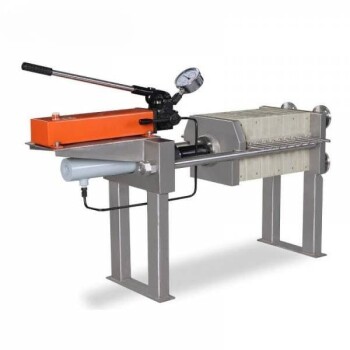
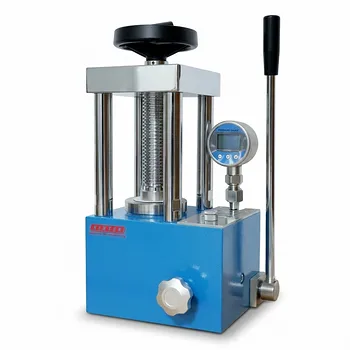
In the assembly of double-layer solid-state battery structures, a laboratory hydraulic press is utilized to execute a precise, graded pre-pressing technique during the powder filling stage. This process typically involves applying a lower initial pressure (e.g., 5 kN) to level the electrolyte layer, followed by a significantly higher pressure (e.g., 50 kN) to compress the combined electrolyte and composite cathode structure. This sequential loading ensures uniform layer flatness and establishes the necessary preliminary bonding before the final co-sintering process.
Core Takeaway The laboratory hydraulic press serves a critical preparatory role by establishing intimate physical contact and geometric uniformity between battery layers. This "graded pre-pressing" is a prerequisite for successful co-sintering, as it creates the initial interfacial pathways required for effective lithium-ion transport.
The Mechanics of Double-Layer Assembly
To construct a functional solid-state battery, the interface between the electrolyte and the cathode must be seamless. The hydraulic press facilitates this through a staged approach known as graded pre-pressing.
Step 1: The Leveling Phase
The assembly begins by placing the electrolyte powder into the mold.
At this stage, the hydraulic press applies a relatively low pressure, such as 5 kN.
The primary goal here is not total densification, but rather leveling. This ensures the electrolyte layer provides a flat, uniform foundation for the subsequent layer.
Step 2: The Integration Phase
Once the electrolyte is leveled, the composite cathode powder is added on top.
The press then applies a much higher load, such as 50 kN, to the combined stack.
This high-pressure step compresses both distinct layers into a single, cohesive double-layer structure.
Critical Objectives of Hydraulic Pressing
Beyond simple compaction, the hydraulic press addresses the specific physical requirements of solid-state electrochemistry.
Establishing Interfacial Contact
Solid-state batteries rely on physical contact for ion movement. Unlike liquid electrolytes that flow into voids, solid materials must be mechanically forced together.
The pressure applied by the press creates tight physical contact between the active electrode material and the solid electrolyte.
This contact establishes the lithium-ion transport channels necessary for the battery to function.
Ensuring Geometric Uniformity
The "graded" aspect of the pressure—starting low and ending high—preserves the distinct geometry of each layer.
By ensuring the flatness of each powder layer, the press prevents distinct layers from mixing unevenly or deforming.
This uniformity is vital for the subsequent step: Spark Plasma Sintering (SPS). A pre-pressed, flat structure ensures the sintering furnace can apply heat and current evenly.
Understanding the Trade-offs
While the hydraulic press is essential, it is important to understand its role within the wider manufacturing workflow.
Pre-pressing vs. Final Densification
The hydraulic press provides preliminary bonding, not the final product.
While it densifies the powder to establish contact, it does not replace the co-sintering process (such as SPS).
Relying solely on cold hydraulic pressing without subsequent sintering often results in insufficient mechanical strength and lower conductivity compared to sintered counterparts.
Material Considerations
The pressure settings must be tuned to the material's properties.
For example, sulfide electrolytes possess a moderate Young's modulus, allowing them to act as a buffer layer.
Proper hydraulic pressing utilizes this property to accommodate volume changes, preventing structural collapse during future charging cycles.
Making the Right Choice for Your Goal
To maximize the effectiveness of your laboratory hydraulic press in battery assembly, align your pressure parameters with your specific structural goals.
- If your primary focus is Layer Integrity: Prioritize the initial low-pressure leveling step (e.g., 5 kN) to ensure the electrolyte surface is perfectly flat before adding the cathode.
- If your primary focus is Ion Conductivity: Ensure the secondary high-pressure step (e.g., 50 kN) is sufficient to minimize voids and maximize the active contact area between particles.
- If your primary focus is Workflow Efficiency: Standardize your graded pressure sequence to create reproducible "green" pellets that are optimized for the specific dimensions of your SPS furnace dies.
Success in solid-state battery assembly depends not just on the materials used, but on the mechanical precision applied to bond them together.
Summary Table:
| Assembly Step | Applied Pressure (Typical) | Primary Objective | Resulting Benefit |
|---|---|---|---|
| Leveling Phase | 5 kN | Flattening electrolyte powder | Uniform foundation for the next layer |
| Integration Phase | 50 kN | Compressing cathode & electrolyte | Initial interfacial bonding & cohesion |
| Final Pre-Sintering | Variable | Preliminary densification | Enhanced ion transport channels for SPS |
Elevate Your Battery Research Precision with KINTEK
High-performance solid-state batteries demand mechanical perfection at the interface. KINTEK provides the specialized laboratory hydraulic presses (pellet, hot, and isostatic) and precision crushing and milling systems necessary to achieve the graded pre-pressing required for superior lithium-ion transport.
Whether you are developing double-layer structures or optimizing co-sintering workflows, our comprehensive portfolio—including SPS-compatible dies, muffle and vacuum furnaces, and battery consumables—is designed to meet the rigorous standards of modern electrochemistry.
Ready to optimize your battery assembly process? Contact our laboratory specialists today to find the perfect equipment solution for your research goals.
Related Products
- Automatic High Temperature Heated Hydraulic Press Machine with Heated Plates for Lab
- Heated Hydraulic Press Machine with Heated Plates for Vacuum Box Laboratory Hot Press
- Manual High Temperature Heated Hydraulic Press Machine with Heated Plates for Lab
- 24T 30T 60T Heated Hydraulic Press Machine with Heated Plates for Laboratory Hot Press
- Laboratory Hydraulic Press Split Electric Lab Pellet Press
People Also Ask
- What is a heated hydraulic press used for? Essential Tool for Curing, Molding, and Laminating
- Why is a heated hydraulic press used for warm pressing NASICON green tapes? Optimize Your Solid Electrolyte Density
- Why is a heated laboratory hydraulic press necessary for composite laminates? Achieve Void-Free Structural Integrity
- What is a hot hydraulic press? Harness Heat and Pressure for Advanced Manufacturing
- How is a heated hydraulic press used for Li-LLZO batteries? Optimize Interfacial Bonding with Thermal-Pressure