Knowledge How is heat transferred in empty space? Discover the Power of Thermal Radiation
Author avatar

Tech Team · Kintek Solution

Updated 1 week ago

How is heat transferred in empty space? Discover the Power of Thermal Radiation


In the vacuum of space, heat is transferred exclusively through a process called thermal radiation. Unlike other forms of heat transfer that require physical contact or a medium like air or water, radiation moves energy across empty space using electromagnetic waves. This is the same fundamental mechanism that allows the Sun's warmth to travel millions of miles to reach Earth.

The core principle to understand is that all matter with a temperature above absolute zero constantly emits energy. In a vacuum, this emission of electromagnetic waves, or thermal radiation, is the only possible way for heat to move from one object to another.
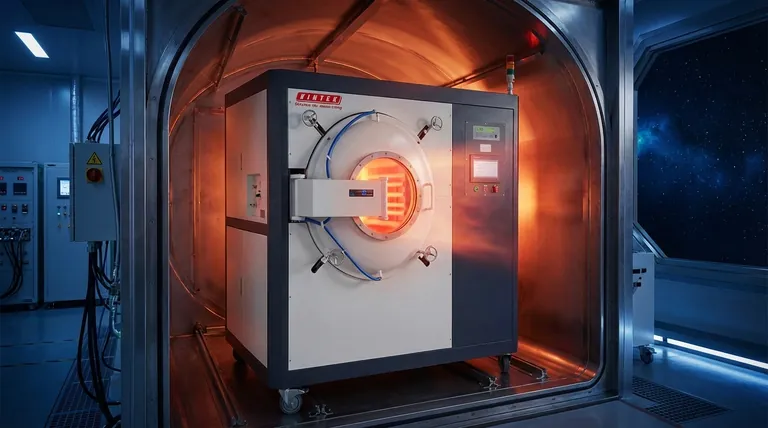
How is heat transferred in empty space? Discover the Power of Thermal Radiation

The Three Modes of Heat Transfer

To grasp why radiation is unique, it's helpful to quickly review all three ways heat can move.

Conduction: Transfer by Touch

Conduction is the transfer of heat through direct physical contact. When you touch a hot stovetop, the heat transfers directly to your hand.

This process relies on vibrating atoms bumping into their neighbors and transferring kinetic energy. It cannot happen without matter.

Convection: Transfer by Flow

Convection is the transfer of heat through the movement of fluids (liquids or gases). A furnace heats air, and that hot air circulates through a room to warm it.

This process requires a medium that can flow and carry heat energy with it. It is impossible in a vacuum.

Radiation: Transfer by Waves

Radiation is the transfer of energy via electromagnetic waves. It requires no medium at all. This is the sole method of heat transfer in empty space.

How Thermal Radiation Actually Works

The idea of "heat" traveling through nothingness can feel counterintuitive. The process is based on a fundamental property of all matter.

The Source: Atomic Vibration

The atoms and molecules within any object that has a temperature are in constant motion, vibrating and colliding.

The Carrier: Electromagnetic Waves

Because atoms contain charged particles (protons and electrons), this constant vibration creates oscillating electric and magnetic fields. These fields propagate away from the object as electromagnetic waves.

These waves carry energy. When the energy is a result of the object's temperature, we call it thermal radiation.

The Reception: Absorption of Energy

When these electromagnetic waves strike another object, they transfer their energy to it. This energy absorption causes the atoms in the receiving object to vibrate more intensely, which we measure as an increase in its temperature.

Understanding the Key Principles

Not all radiation is the same. The process is governed by a few critical factors that determine its effectiveness.

Temperature Is Paramount

The amount of energy an object radiates is directly and powerfully linked to its temperature. Hotter objects radiate significantly more energy than cooler objects.

For example, a red-hot piece of iron radiates far more heat than a lukewarm cup of coffee. This is why you can feel the heat from a bonfire from many feet away.

It's a Two-Way Street

Every object is constantly radiating energy to its surroundings and absorbing energy from them. Net heat transfer occurs when one object is emitting more energy than it absorbs from another.

Heat naturally flows from the hotter object (which radiates more) to the colder object (which radiates less).

Surface Properties Matter

The color and texture of an object's surface have a major impact on its ability to emit and absorb radiation.

  • Dark, matte surfaces are excellent absorbers and excellent emitters. A black t-shirt gets hotter in the sun and also cools down faster in the shade.
  • Light, shiny surfaces are poor absorbers and poor emitters; they are good reflectors. This is why emergency space blankets are shiny—to reflect heat back toward your body and prevent it from radiating away.

How to Apply This Knowledge

Understanding thermal radiation has direct practical applications, from everyday objects to spacecraft design.

  • If your goal is to keep something hot (like in a thermos): Use a highly reflective, shiny inner surface (like silvering) to minimize heat loss through radiation.
  • If your goal is to cool something in space (like a satellite): Use external radiators with dark, high-emissivity surfaces to efficiently radiate waste heat into the void.
  • If you are simply trying to understand the Sun's warmth: Recognize that the energy you feel traveled 93 million miles through the vacuum of space purely as thermal radiation.

By understanding radiation, you grasp a fundamental principle of how energy moves throughout the universe.

Summary Table:

Aspect Key Detail
Primary Mechanism Thermal Radiation (Electromagnetic Waves)
Medium Required? No (Works in a vacuum)
Governing Factor Object Temperature
Surface Impact Dark/matte surfaces are efficient; shiny surfaces are poor emitters/absorbers.
Practical Example Sun's heat reaching Earth; spacecraft thermal management.

Need precise thermal control for your lab processes?

Understanding heat transfer is critical for applications like vacuum furnaces, drying, and sample preparation. KINTEK specializes in lab equipment that leverages these principles for superior performance and reliability.

Contact our experts today to find the perfect thermal solution for your laboratory's unique needs.

Visual Guide

How is heat transferred in empty space? Discover the Power of Thermal Radiation Visual Guide

Related Products

People Also Ask

Related Products

Vacuum Heat Treat Furnace with Ceramic Fiber Liner

Vacuum Heat Treat Furnace with Ceramic Fiber Liner

Vacuum furnace with polycrystalline ceramic fiber insulation liner for excellent heat insulation and uniform temperature field. Choose from 1200℃ or 1700℃ max. working temperature with high vacuum performance and precise temperature control.

Molybdenum Vacuum Heat Treat Furnace

Molybdenum Vacuum Heat Treat Furnace

Discover the benefits of a high-configuration molybdenum vacuum furnace with heat shield insulation. Ideal for high-purity, vacuum environments like sapphire crystal growth and heat treatment.

2200 ℃ Graphite Vacuum Heat Treat Furnace

2200 ℃ Graphite Vacuum Heat Treat Furnace

Discover the power of the KT-VG Graphite Vacuum Furnace - with a maximum working temperature of 2200℃, it's perfect for vacuum sintering of various materials. Learn more now.

Vacuum Heat Treat and Pressure Sintering Furnace for High Temperature Applications

Vacuum Heat Treat and Pressure Sintering Furnace for High Temperature Applications

Vacuum pressure sintering furnaces are designed for high temperature hot pressing applications in metal and ceramic sintering. Its advanced features ensure precise temperature control, reliable pressure maintenance, and a robust design for seamless operation.

Graphite Vacuum Furnace Bottom Discharge Graphitization Furnace for Carbon Materials

Graphite Vacuum Furnace Bottom Discharge Graphitization Furnace for Carbon Materials

Bottom-out graphitization furnace for carbon materials, ultra-high temperature furnace up to 3100°C, suitable for graphitization and sintering of carbon rods and carbon blocks. Vertical design, bottom discharging, convenient feeding and discharging, high temperature uniformity, low energy consumption, good stability, hydraulic lifting system, convenient loading and unloading.

Graphite Vacuum Furnace High Thermal Conductivity Film Graphitization Furnace

Graphite Vacuum Furnace High Thermal Conductivity Film Graphitization Furnace

The high thermal conductivity film graphitization furnace has uniform temperature, low energy consumption and can operate continuously.

Ultra-High Temperature Graphite Vacuum Graphitization Furnace

Ultra-High Temperature Graphite Vacuum Graphitization Furnace

The ultra-high temperature graphitization furnace utilizes medium frequency induction heating in a vacuum or inert gas environment. The induction coil generates an alternating magnetic field, inducing eddy currents in the graphite crucible, which heats up and radiates heat to the workpiece, bringing it to the desired temperature. This furnace is primarily used for graphitization and sintering of carbon materials, carbon fiber materials, and other composite materials.

1200℃ Split Tube Furnace with Quartz Tube Laboratory Tubular Furnace

1200℃ Split Tube Furnace with Quartz Tube Laboratory Tubular Furnace

KT-TF12 split tube furnace: high-purity insulation, embedded heating wire coils, and max. 1200C. Widely used for new materials and chemical vapour deposition.

1200℃ Muffle Furnace Oven for Laboratory

1200℃ Muffle Furnace Oven for Laboratory

Upgrade your lab with our 1200℃ Muffle Furnace. Achieve fast, precise heating with Japan alumina fibers and Molybdenum coils. Features TFT touch screen controller for easy programming and data analysis. Order now!

Vacuum Heat Treat and Molybdenum Wire Sintering Furnace for Vacuum Sintering

Vacuum Heat Treat and Molybdenum Wire Sintering Furnace for Vacuum Sintering

A vacuum molybdenum wire sintering furnace is a vertical or bedroom structure, which is suitable for withdrawal, brazing, sintering and degassing of metal materials under high vacuum and high temperature conditions. It is also suitable for dehydroxylation treatment of quartz materials.

Large Vertical Graphite Vacuum Graphitization Furnace

Large Vertical Graphite Vacuum Graphitization Furnace

A large vertical high-temperature graphitization furnace is a type of industrial furnace used for the graphitization of carbon materials, such as carbon fiber and carbon black. It is a high-temperature furnace that can reach temperatures of up to 3100°C.

Vertical High Temperature Graphite Vacuum Graphitization Furnace

Vertical High Temperature Graphite Vacuum Graphitization Furnace

Vertical high temperature graphitization furnace for carbonization and graphitization of carbon materials up to 3100℃.Suitable for shaped graphitization of carbon fiber filaments and other materials sintered in a carbon environment.Applications in metallurgy, electronics, and aerospace for producing high-quality graphite products like electrodes and crucibles.

Horizontal High Temperature Graphite Vacuum Graphitization Furnace

Horizontal High Temperature Graphite Vacuum Graphitization Furnace

Horizontal Graphitization Furnace: This type of furnace is designed with the heating elements placed horizontally, allowing for uniform heating of the sample. It's well-suited for graphitizing large or bulky samples that require precise temperature control and uniformity.

Small Vacuum Heat Treat and Tungsten Wire Sintering Furnace

Small Vacuum Heat Treat and Tungsten Wire Sintering Furnace

The small vacuum tungsten wire sintering furnace is a compact experimental vacuum furnace specially designed for universities and scientific research institutes. The furnace features a CNC welded shell and vacuum piping to ensure leak-free operation. Quick-connect electrical connections facilitate relocation and debugging, and the standard electrical control cabinet is safe and convenient to operate.

Graphite Vacuum Furnace Negative Material Graphitization Furnace

Graphite Vacuum Furnace Negative Material Graphitization Furnace

Graphitization furnace for battery production has uniform temperature and low energy consumption. Graphitization furnace for negative electrode materials: an efficient graphitization solution for battery production and advanced functions to enhance battery performance.

Vacuum Sealed Continuous Working Rotary Tube Furnace Rotating Tube Furnace

Vacuum Sealed Continuous Working Rotary Tube Furnace Rotating Tube Furnace

Experience efficient material processing with our vacuum-sealed rotary tube furnace. Perfect for experiments or industrial production, equipped with optional features for controlled feeding and optimized results. Order now.

Vacuum Hot Press Furnace Machine for Lamination and Heating

Vacuum Hot Press Furnace Machine for Lamination and Heating

Experience clean and precise lamination with Vacuum Lamination Press. Perfect for wafer bonding, thin-film transformations, and LCP lamination. Order now!

Engineering Advanced Fine Ceramics Alumina Crucibles (Al2O3) for Thermal Analysis TGA DTA

Engineering Advanced Fine Ceramics Alumina Crucibles (Al2O3) for Thermal Analysis TGA DTA

TGA/DTA thermal analysis vessels are made of aluminum oxide (corundum or aluminum oxide). It can withstand high temperature and is suitable for analyzing materials that require high temperature testing.

Oil Free Diaphragm Vacuum Pump for Laboratory and Industrial Use

Oil Free Diaphragm Vacuum Pump for Laboratory and Industrial Use

Oil-free diaphragm vacuum pump for labs: clean, reliable, chemical-resistant. Ideal for filtration, SPE, and rotary evaporation. Maintenance-free operation.

Ultra-Vacuum Electrode Feedthrough Connector Flange Power Electrode Lead for High-Precision Applications

Ultra-Vacuum Electrode Feedthrough Connector Flange Power Electrode Lead for High-Precision Applications

Discover the Ultra-Vacuum Electrode Feedthrough Connector Flange, perfect for high-precision applications. Ensure reliable connections in ultra-vacuum environments with advanced sealing and conductive technology.


Leave Your Message