Knowledge How long is the annealing process? A Guide to Timing for Perfect Material Properties
Author avatar

Tech Team · Kintek Solution

Updated 6 days ago

How long is the annealing process? A Guide to Timing for Perfect Material Properties


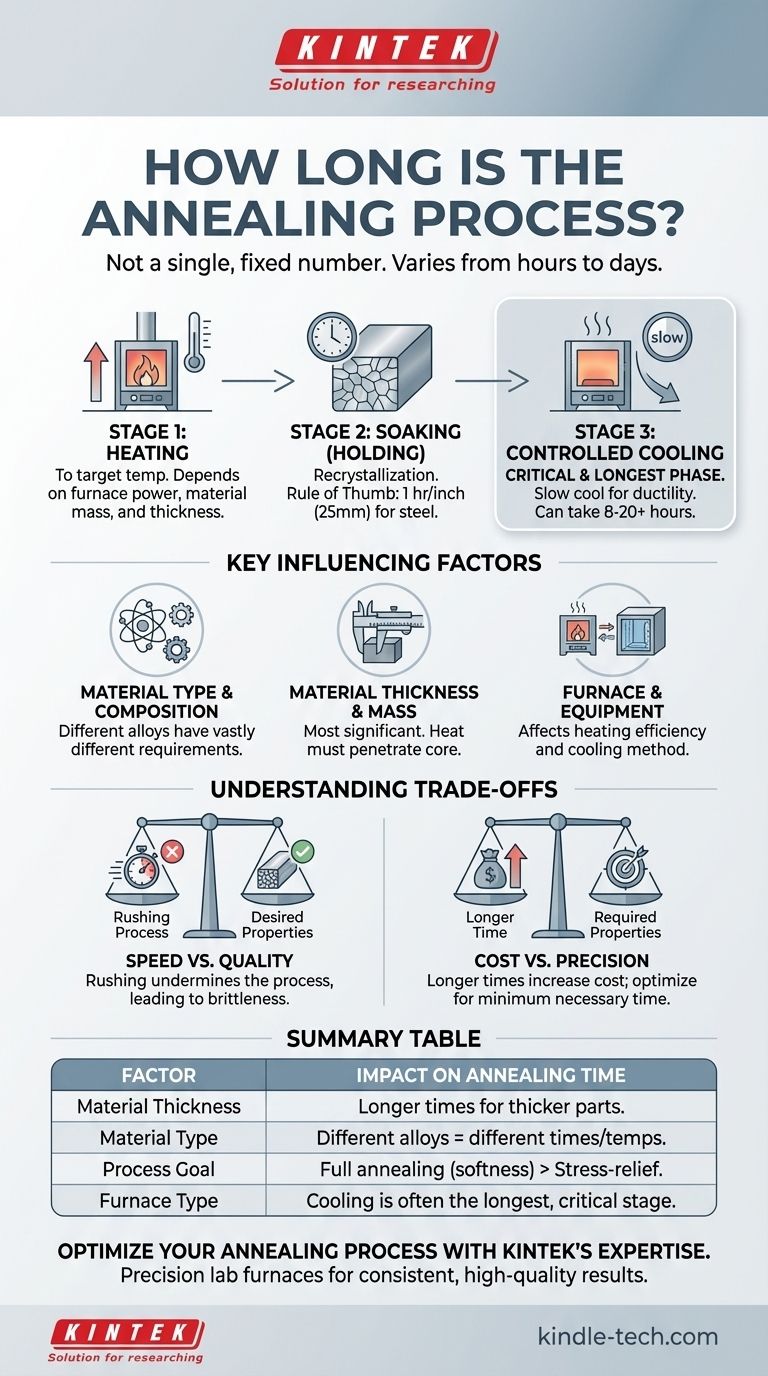
The duration of the annealing process is not a single, fixed number. It is a highly variable engineering parameter that can range from a few hours to several days, depending on the specific metal, the thickness of the part, and the desired final properties. The total time is a sum of three distinct stages: heating, soaking, and controlled cooling.

The critical insight is that annealing time is primarily dictated by the material's thickness and composition. While general rules of thumb exist, the duration must be calculated to ensure the entire workpiece undergoes the necessary structural changes without introducing new defects.
How long is the annealing process? A Guide to Timing for Perfect Material Properties

The Three Stages That Define Annealing Time

The total process time is the sum of its three core stages. The cooling stage is often the longest and most critical phase for achieving the desired outcome.

Stage 1: Heating to Temperature

The first stage involves heating the material to its specific annealing temperature. The time required depends directly on the furnace's power, the material's thermal conductivity, and the workpiece's overall mass and thickness.

A larger, thicker part will naturally take much longer to heat uniformly to its core than a small, thin one.

Stage 2: Soaking (Holding at Temperature)

Once the material reaches the target temperature, it is "soaked" or held there for a set period. This allows the material's internal crystalline structure to stabilize and repair defects through a process called recrystallization.

A common rule of thumb for steel is to soak for one hour for every inch (25mm) of thickness, but this is only a guideline. The exact time depends on the specific alloy and the initial state of the material.

Stage 3: Controlled Cooling

This is arguably the most critical stage for achieving the goals of annealing. The material must be cooled very slowly to allow a new, ductile, and stress-free grain structure to form.

Rushing this stage will undermine the entire process. Often, the most effective method is to simply turn the furnace off and allow the part to cool with the furnace, a process that can easily take 8-20 hours or more for large equipment.

Key Factors Influencing Total Duration

To properly estimate the time for an annealing process, you must consider the following variables. These factors work in combination to determine the final schedule.

Material Type and Composition

Different metals have vastly different annealing requirements. The annealing temperature for an aluminum alloy is far lower than for high-carbon steel, which directly impacts the heating and soaking time.

Furthermore, different alloying elements within a metal can significantly alter the time needed for the internal structure to transform.

Material Thickness and Mass

This is the most significant factor. Heat must penetrate the entire cross-section of the part. A thick component requires a longer heating period to ensure the core is at the same temperature as the surface.

Likewise, the soaking and cooling times are extended for thicker parts to ensure the entire mass undergoes a complete and uniform transformation.

Furnace and Equipment

The efficiency of the furnace plays a direct role. A high-power furnace can reduce the heating time, but the soaking and cooling rates are dictated by metallurgical principles, not equipment power.

The method of cooling—such as leaving the part in the insulated furnace versus moving it to a cooling chamber—will dramatically change the duration of the final stage.

Understanding the Trade-offs

Optimizing the annealing process requires balancing time and cost against the required material properties. Errors here can be costly and ineffective.

Rushing the Process vs. Desired Properties

The primary trade-off is speed versus quality. Attempting to shorten the cycle by cooling the material too quickly will negate the benefits of annealing. This can introduce new internal stresses and result in a brittle, rather than ductile, final product.

Cost vs. Precision

Longer furnace times directly translate to higher energy consumption and operational costs. The goal is to determine the minimum time necessary to achieve the desired metallurgical properties. Over-soaking can sometimes lead to excessive grain growth, which can be detrimental for certain applications.

Making the Right Choice for Your Goal

To determine the appropriate annealing time, you must first define your primary objective.

  • If your primary focus is maximum softness and ductility: You must commit to a full annealing cycle with a very slow, controlled cooling stage, which is typically the longest option.
  • If your primary focus is simply relieving internal stress: A shorter, lower-temperature process known as stress-relief annealing may be sufficient and save considerable time.
  • If your primary focus is process planning for a specific alloy: Always consult the material's technical datasheet or a qualified metallurgist, as generalized rules are not sufficient for critical applications.

Ultimately, the duration of annealing is a precise calculation tailored to the material and the engineering goal.

Summary Table:

Factor Impact on Annealing Time
Material Thickness Longer times for thicker parts (e.g., 1 hour/inch for steel soaking).
Material Type Different alloys (e.g., aluminum vs. steel) require different temperatures and times.
Process Goal Full annealing (softness) takes longer than stress-relief annealing.
Furnace Type Affects heating rate, but cooling is often the longest, most critical stage.

Optimize your annealing process with KINTEK's expertise.

The right annealing time is critical for achieving the desired material properties of softness, ductility, and stress relief. Getting it wrong can lead to costly rework or part failure.

KINTEK specializes in precision lab furnaces and consumables, providing the reliable equipment and technical support you need to execute perfect thermal cycles. Whether you're working with complex alloys or standard steels, our solutions help you achieve consistent, high-quality results.

Contact us today to discuss your specific application and ensure your annealing process is both efficient and effective.

Get in touch with our experts

Visual Guide

How long is the annealing process? A Guide to Timing for Perfect Material Properties Visual Guide

Related Products

People Also Ask

Related Products

Vacuum Heat Treat Sintering Brazing Furnace

Vacuum Heat Treat Sintering Brazing Furnace

A vacuum brazing furnace is a type of industrial furnace used for brazing, a metalworking process that joins two pieces of metal using a filler metal that melts at a lower temperature than the base metals. Vacuum brazing furnaces are typically used for high-quality applications where a strong, clean joint is required.

Vacuum Heat Treat Furnace with Ceramic Fiber Liner

Vacuum Heat Treat Furnace with Ceramic Fiber Liner

Vacuum furnace with polycrystalline ceramic fiber insulation liner for excellent heat insulation and uniform temperature field. Choose from 1200℃ or 1700℃ max. working temperature with high vacuum performance and precise temperature control.

Molybdenum Vacuum Heat Treat Furnace

Molybdenum Vacuum Heat Treat Furnace

Discover the benefits of a high-configuration molybdenum vacuum furnace with heat shield insulation. Ideal for high-purity, vacuum environments like sapphire crystal growth and heat treatment.

2200 ℃ Tungsten Vacuum Heat Treat and Sintering Furnace

2200 ℃ Tungsten Vacuum Heat Treat and Sintering Furnace

Experience the ultimate refractory metal furnace with our Tungsten vacuum furnace. Capable of reaching 2200℃, perfect for sintering advanced ceramics and refractory metals. Order now for high-quality results.

Graphite Vacuum Furnace High Thermal Conductivity Film Graphitization Furnace

Graphite Vacuum Furnace High Thermal Conductivity Film Graphitization Furnace

The high thermal conductivity film graphitization furnace has uniform temperature, low energy consumption and can operate continuously.

Vacuum Heat Treat and Molybdenum Wire Sintering Furnace for Vacuum Sintering

Vacuum Heat Treat and Molybdenum Wire Sintering Furnace for Vacuum Sintering

A vacuum molybdenum wire sintering furnace is a vertical or bedroom structure, which is suitable for withdrawal, brazing, sintering and degassing of metal materials under high vacuum and high temperature conditions. It is also suitable for dehydroxylation treatment of quartz materials.

Laboratory Quartz Tube Furnace Tubular RTP Heating Furnace

Laboratory Quartz Tube Furnace Tubular RTP Heating Furnace

Get lightning-fast heating with our RTP Rapid Heating Tube Furnace. Designed for precise, high-speed heating and cooling with convenient sliding rail and TFT touch screen controller. Order now for ideal thermal processing!

600T Vacuum Induction Hot Press Furnace for Heat Treat and Sintering

600T Vacuum Induction Hot Press Furnace for Heat Treat and Sintering

Discover the 600T Vacuum Induction Hot Press Furnace, designed for high-temperature sintering experiments in vacuum or protected atmospheres. Its precise temperature and pressure control, adjustable working pressure, and advanced safety features make it ideal for nonmetal materials, carbon composites, ceramics, and metal powders.

Vacuum Dental Porcelain Sintering Furnace

Vacuum Dental Porcelain Sintering Furnace

Get precise and reliable results with KinTek's Vacuum Porcelain Furnace. Suitable for all porcelain powders, it features hyperbolic ceramic furnace function, voice prompt, and automatic temperature calibration.

Small Vacuum Heat Treat and Tungsten Wire Sintering Furnace

Small Vacuum Heat Treat and Tungsten Wire Sintering Furnace

The small vacuum tungsten wire sintering furnace is a compact experimental vacuum furnace specially designed for universities and scientific research institutes. The furnace features a CNC welded shell and vacuum piping to ensure leak-free operation. Quick-connect electrical connections facilitate relocation and debugging, and the standard electrical control cabinet is safe and convenient to operate.

Ultra-High Temperature Graphite Vacuum Graphitization Furnace

Ultra-High Temperature Graphite Vacuum Graphitization Furnace

The ultra-high temperature graphitization furnace utilizes medium frequency induction heating in a vacuum or inert gas environment. The induction coil generates an alternating magnetic field, inducing eddy currents in the graphite crucible, which heats up and radiates heat to the workpiece, bringing it to the desired temperature. This furnace is primarily used for graphitization and sintering of carbon materials, carbon fiber materials, and other composite materials.

Graphite Vacuum Furnace IGBT Experimental Graphitization Furnace

Graphite Vacuum Furnace IGBT Experimental Graphitization Furnace

IGBT experimental graphitization furnace, a tailored solution for universities and research institutions, with high heating efficiency, user-friendliness, and precise temperature control.

High Temperature Muffle Oven Furnace for Laboratory Debinding and Pre Sintering

High Temperature Muffle Oven Furnace for Laboratory Debinding and Pre Sintering

KT-MD High temperature debinding and pre-sintering furnace for ceramic materials with various molding processes. Ideal for electronic components such as MLCC and NFC.

Vacuum Hot Press Furnace Machine for Lamination and Heating

Vacuum Hot Press Furnace Machine for Lamination and Heating

Experience clean and precise lamination with Vacuum Lamination Press. Perfect for wafer bonding, thin-film transformations, and LCP lamination. Order now!

1700℃ Muffle Oven Furnace for Laboratory

1700℃ Muffle Oven Furnace for Laboratory

Get superior heat control with our 1700℃ Muffle Furnace. Equipped with intelligent temperature microprocessor, TFT touch screen controller & advanced insulation materials for precise heating up to 1700C. Order now!

Dental Porcelain Zirconia Sintering Ceramic Furnace Chairside with Transformer

Dental Porcelain Zirconia Sintering Ceramic Furnace Chairside with Transformer

Experience top-notch sintering with Chairside Sintering Furnace with Transformer. Easy to operate, noise-free pallet, and automatic temperature calibration. Order now!

Engineering Advanced Fine Ceramics Aluminum Oxide Al2O3 Heat Sink for Insulation

Engineering Advanced Fine Ceramics Aluminum Oxide Al2O3 Heat Sink for Insulation

The hole structure of the ceramic heat sink increases the heat dissipation area in contact with the air, which greatly enhances the heat dissipation effect, and the heat dissipation effect is better than that of super copper and aluminum.

HFCVD Machine System Equipment for Drawing Die Nano-Diamond Coating

HFCVD Machine System Equipment for Drawing Die Nano-Diamond Coating

The nano-diamond composite coating drawing die uses cemented carbide (WC-Co) as the substrate, and uses the chemical vapor phase method ( CVD method for short ) to coat the conventional diamond and nano-diamond composite coating on the surface of the inner hole of the mold.

Laboratory Sterilizer Lab Autoclave Pulse Vacuum Lifting Sterilizer

Laboratory Sterilizer Lab Autoclave Pulse Vacuum Lifting Sterilizer

The pulse vacuum lifting sterilizer is a state-of-the-art equipment for efficient and precise sterilization. It uses pulsating vacuum technology, customizable cycles, and a user-friendly design for easy operation and safety.

Benchtop Laboratory Vacuum Freeze Dryer

Benchtop Laboratory Vacuum Freeze Dryer

Benchtop laboratory freeze dryer for efficient lyophilization of biological, pharmaceutical, and food samples. Features intuitive touchscreen, high-performance refrigeration, and durable design. Preserve sample integrity—consult now!


Leave Your Message