Knowledge Is brazing a permanent joint? Yes, and here's why it's stronger than you think.
Author avatar

Tech Team · Kintek Solution

Updated 1 week ago

Is brazing a permanent joint? Yes, and here's why it's stronger than you think.


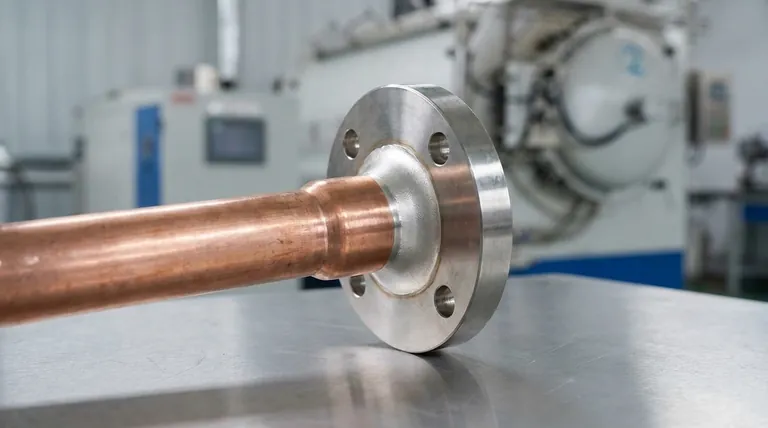
Yes, in all practical and engineering contexts, brazing creates a permanent joint. A properly executed brazed joint forms a strong, metallurgical bond that is not designed for disassembly and is intended to last the life of the assembly. The process is fundamentally different from mechanical fastening with bolts or screws.

While a brazed joint is considered permanent and can even be stronger than the metals it joins, its true permanence is defined by its application. It offers a powerful alternative to welding but has distinct limitations, particularly regarding service temperature.
Is brazing a permanent joint? Yes, and here's why it's stronger than you think.

How Brazing Achieves Permanence

The Metallurgical Bond

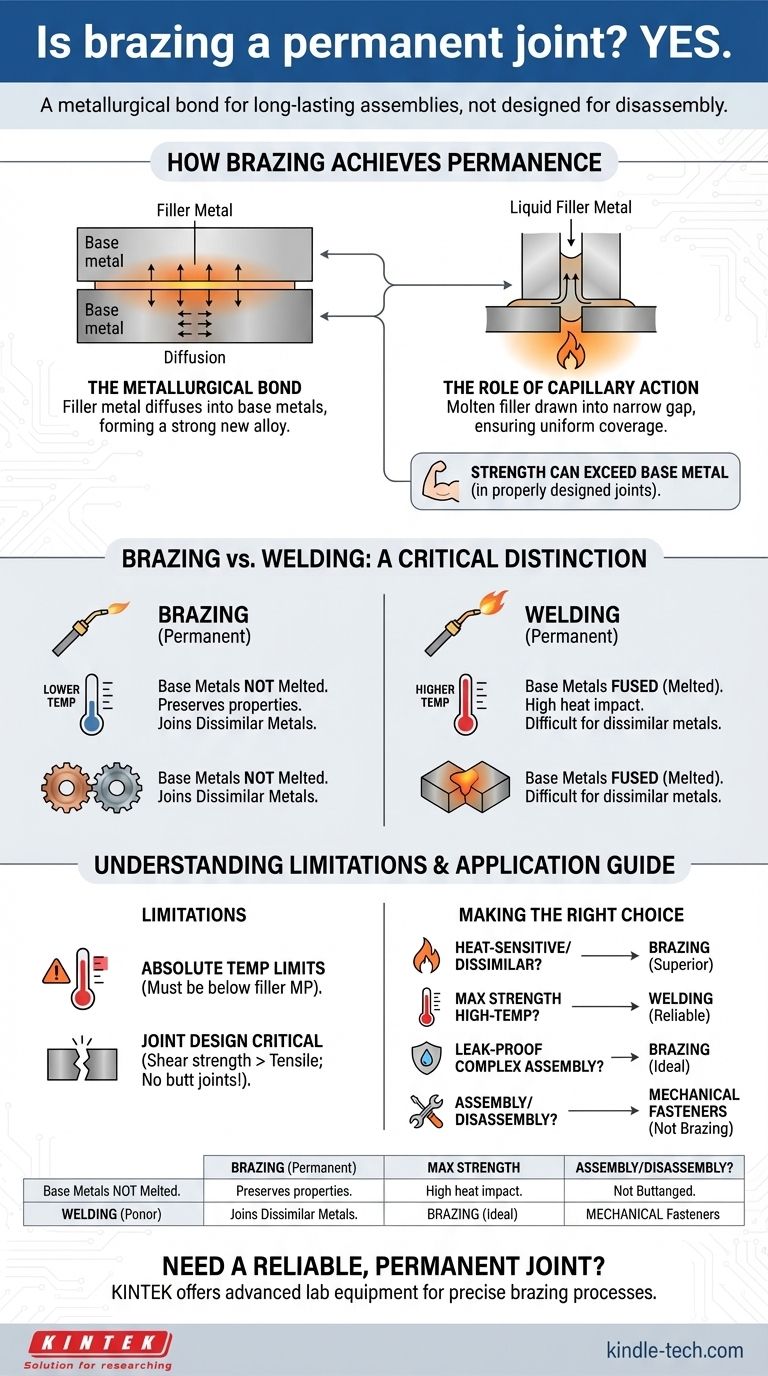
Brazing is not simply a high-temperature gluing process. It creates a metallurgical bond where the filler metal diffuses slightly into the surface of the base metals, forming a new, strong alloy at the interface.

This is a chemical connection, not a simple mechanical one, which is the source of its strength and permanence.

The Role of Capillary Action

The process works by heating two closely fitted parent metals to a temperature above the melting point of the filler metal, but below the melting point of the parent metals.

The molten filler is then drawn into the gap between the parts by capillary action, ensuring complete and uniform coverage. This is why joint design and cleanliness are so critical.

Strength Can Exceed the Base Metal

A common misconception is that a brazed joint is only as strong as its relatively soft filler metal.

However, in a properly designed joint (like a lap joint with a very thin gap), the filler metal's properties are enhanced by the geometry. This can result in a completed joint that has a tensile strength greater than the base metals themselves.

Brazing vs. Welding: A Critical Distinction

To understand brazing's permanence, it's useful to compare it to welding, the other common method for creating permanent metal joints.

Base Metals Are Not Melted

This is the single most important difference. Welding fuses metals by melting them together, often with a filler. Brazing joins metals without melting them.

Preserving Material Properties

Because brazing occurs at a much lower temperature, it has a minimal thermal impact on the base metals. This is a major advantage when joining materials that have been heat-treated, work-hardened, or have delicate microstructures.

Joining Dissimilar Metals

Brazing excels at joining fundamentally different metals, such as copper to steel or aluminum to copper. This is often extremely difficult or impossible to achieve with conventional welding processes.

Understanding the Trade-offs and Limitations

No joining method is perfect for every situation. Objectivity requires acknowledging brazing's limitations.

Absolute Temperature Limits

A brazed joint's primary weakness is its performance at high temperatures. The service temperature of the assembly must always remain well below the melting point of the filler metal used.

If the joint is exposed to temperatures that approach the filler's melting point, it will rapidly lose all its strength.

Joint Design is Non-Negotiable

Brazing relies heavily on shear strength, not tensile strength. Joints must be designed with an overlapping surface area (like a lap or scarf joint) to maximize strength.

A simple butt joint, where two pieces meet end-to-end, will be inherently weak and is not a suitable application for brazing.

Disassembly is a Repair, Not a Feature

While a brazed joint can technically be taken apart by reheating it until the filler melts, this is a repair or rework procedure. It is not a form of non-destructive disassembly like unbolting a fastener. The process often requires specialized skill and can damage the components.

Making the Right Choice for Your Application

Use these guidelines to determine if brazing is the correct approach for your project.

  • If your primary focus is joining heat-sensitive or dissimilar metals: Brazing is almost always the superior choice over welding due to its low-temperature process.
  • If your primary focus is maximum strength in a high-temperature environment: Welding is the more reliable method, as it creates a joint from the base metals themselves.
  • If your primary focus is creating a leak-proof seal in a complex assembly: Brazing is ideal, as capillary action can draw the filler into tight spaces that are inaccessible to a welding torch.
  • If your primary focus is assembly and disassembly: You must use mechanical fasteners; brazing is a permanent joining method.

Choosing the right joining method is about matching the process to the specific demands of the application and its service environment.

Summary Table:

Feature Brazing Welding
Base Metals Melted? No Yes
Joint Type Metallurgical Bond Fusion Weld
Service Temperature Limited by filler metal Limited by base metal
Ideal For Dissimilar metals, complex assemblies High-temperature environments
Permanence Permanent (not designed for disassembly) Permanent

Need a reliable, permanent joint for your application?

Brazing offers a superior solution for joining dissimilar or heat-sensitive metals while preserving their integrity. At KINTEK, we specialize in providing the advanced lab equipment and consumables needed for precise brazing processes.

Let our experts help you select the right solution for your laboratory's specific needs. Contact KINTEL today to discuss how we can support your project with durable, high-performance joining solutions.

Visual Guide
Is brazing a permanent joint? Yes, and here's why it's stronger than you think. Visual Guide

Related Products

People Also Ask

Related Products

Vacuum Heat Treat Sintering Brazing Furnace

Vacuum Heat Treat Sintering Brazing Furnace

A vacuum brazing furnace is a type of industrial furnace used for brazing, a metalworking process that joins two pieces of metal using a filler metal that melts at a lower temperature than the base metals. Vacuum brazing furnaces are typically used for high-quality applications where a strong, clean joint is required.

Molybdenum Vacuum Heat Treat Furnace

Molybdenum Vacuum Heat Treat Furnace

Discover the benefits of a high-configuration molybdenum vacuum furnace with heat shield insulation. Ideal for high-purity, vacuum environments like sapphire crystal growth and heat treatment.

2200 ℃ Tungsten Vacuum Heat Treat and Sintering Furnace

2200 ℃ Tungsten Vacuum Heat Treat and Sintering Furnace

Experience the ultimate refractory metal furnace with our Tungsten vacuum furnace. Capable of reaching 2200℃, perfect for sintering advanced ceramics and refractory metals. Order now for high-quality results.

2200 ℃ Graphite Vacuum Heat Treat Furnace

2200 ℃ Graphite Vacuum Heat Treat Furnace

Discover the power of the KT-VG Graphite Vacuum Furnace - with a maximum working temperature of 2200℃, it's perfect for vacuum sintering of various materials. Learn more now.

Laboratory Muffle Oven Furnace Bottom Lifting Muffle Furnace

Laboratory Muffle Oven Furnace Bottom Lifting Muffle Furnace

Efficiently produce batches with excellent temperature uniformity using our Bottom Lifting Furnace. Features two electric lifting stages and advanced temperature control up to 1600℃.

1700℃ Laboratory Quartz Tube Furnace with Alumina Tube Tubular Furnace

1700℃ Laboratory Quartz Tube Furnace with Alumina Tube Tubular Furnace

Looking for a high-temperature tube furnace? Check out our 1700℃ Tube Furnace with Alumina Tube. Perfect for research and industrial applications up to 1700C.

Vacuum Heat Treat Furnace with Ceramic Fiber Liner

Vacuum Heat Treat Furnace with Ceramic Fiber Liner

Vacuum furnace with polycrystalline ceramic fiber insulation liner for excellent heat insulation and uniform temperature field. Choose from 1200℃ or 1700℃ max. working temperature with high vacuum performance and precise temperature control.

Vacuum Dental Porcelain Sintering Furnace

Vacuum Dental Porcelain Sintering Furnace

Get precise and reliable results with KinTek's Vacuum Porcelain Furnace. Suitable for all porcelain powders, it features hyperbolic ceramic furnace function, voice prompt, and automatic temperature calibration.

1700℃ Muffle Oven Furnace for Laboratory

1700℃ Muffle Oven Furnace for Laboratory

Get superior heat control with our 1700℃ Muffle Furnace. Equipped with intelligent temperature microprocessor, TFT touch screen controller & advanced insulation materials for precise heating up to 1700C. Order now!

Vacuum Heat Treat and Molybdenum Wire Sintering Furnace for Vacuum Sintering

Vacuum Heat Treat and Molybdenum Wire Sintering Furnace for Vacuum Sintering

A vacuum molybdenum wire sintering furnace is a vertical or bedroom structure, which is suitable for withdrawal, brazing, sintering and degassing of metal materials under high vacuum and high temperature conditions. It is also suitable for dehydroxylation treatment of quartz materials.

Graphite Vacuum Furnace High Thermal Conductivity Film Graphitization Furnace

Graphite Vacuum Furnace High Thermal Conductivity Film Graphitization Furnace

The high thermal conductivity film graphitization furnace has uniform temperature, low energy consumption and can operate continuously.

600T Vacuum Induction Hot Press Furnace for Heat Treat and Sintering

600T Vacuum Induction Hot Press Furnace for Heat Treat and Sintering

Discover the 600T Vacuum Induction Hot Press Furnace, designed for high-temperature sintering experiments in vacuum or protected atmospheres. Its precise temperature and pressure control, adjustable working pressure, and advanced safety features make it ideal for nonmetal materials, carbon composites, ceramics, and metal powders.

Graphite Vacuum Furnace IGBT Experimental Graphitization Furnace

Graphite Vacuum Furnace IGBT Experimental Graphitization Furnace

IGBT experimental graphitization furnace, a tailored solution for universities and research institutions, with high heating efficiency, user-friendliness, and precise temperature control.

1200℃ Split Tube Furnace with Quartz Tube Laboratory Tubular Furnace

1200℃ Split Tube Furnace with Quartz Tube Laboratory Tubular Furnace

KT-TF12 split tube furnace: high-purity insulation, embedded heating wire coils, and max. 1200C. Widely used for new materials and chemical vapour deposition.

Small Vacuum Heat Treat and Tungsten Wire Sintering Furnace

Small Vacuum Heat Treat and Tungsten Wire Sintering Furnace

The small vacuum tungsten wire sintering furnace is a compact experimental vacuum furnace specially designed for universities and scientific research institutes. The furnace features a CNC welded shell and vacuum piping to ensure leak-free operation. Quick-connect electrical connections facilitate relocation and debugging, and the standard electrical control cabinet is safe and convenient to operate.

Vacuum Hot Press Furnace Machine for Lamination and Heating

Vacuum Hot Press Furnace Machine for Lamination and Heating

Experience clean and precise lamination with Vacuum Lamination Press. Perfect for wafer bonding, thin-film transformations, and LCP lamination. Order now!

Laboratory Sterilizer Lab Autoclave Pulse Vacuum Lifting Sterilizer

Laboratory Sterilizer Lab Autoclave Pulse Vacuum Lifting Sterilizer

The pulse vacuum lifting sterilizer is a state-of-the-art equipment for efficient and precise sterilization. It uses pulsating vacuum technology, customizable cycles, and a user-friendly design for easy operation and safety.

Laboratory Sterilizer Lab Autoclave Vertical Pressure Steam Sterilizer for Liquid Crystal Display Automatic Type

Laboratory Sterilizer Lab Autoclave Vertical Pressure Steam Sterilizer for Liquid Crystal Display Automatic Type

Liquid crystal display automatic vertical sterilizer is a safe, reliable and automatic control sterilization equipment, which is composed of heating system, microcomputer control system and overheating and overvoltage protection system.

Benchtop Laboratory Vacuum Freeze Dryer

Benchtop Laboratory Vacuum Freeze Dryer

Benchtop laboratory freeze dryer for efficient lyophilization of biological, pharmaceutical, and food samples. Features intuitive touchscreen, high-performance refrigeration, and durable design. Preserve sample integrity—consult now!

Benchtop Laboratory Freeze Dryer for Lab Use

Benchtop Laboratory Freeze Dryer for Lab Use

Premium benchtop laboratory freeze dryer for lyophilization, preserving samples with ≤ -60°C cooling. Ideal for pharmaceuticals & research.


Leave Your Message