Knowledge Is PVD coating food grade? Ensure Safety and Durability for Food Contact Applications
Author avatar

Tech Team · Kintek Solution

Updated 6 days ago

Is PVD coating food grade? Ensure Safety and Durability for Food Contact Applications


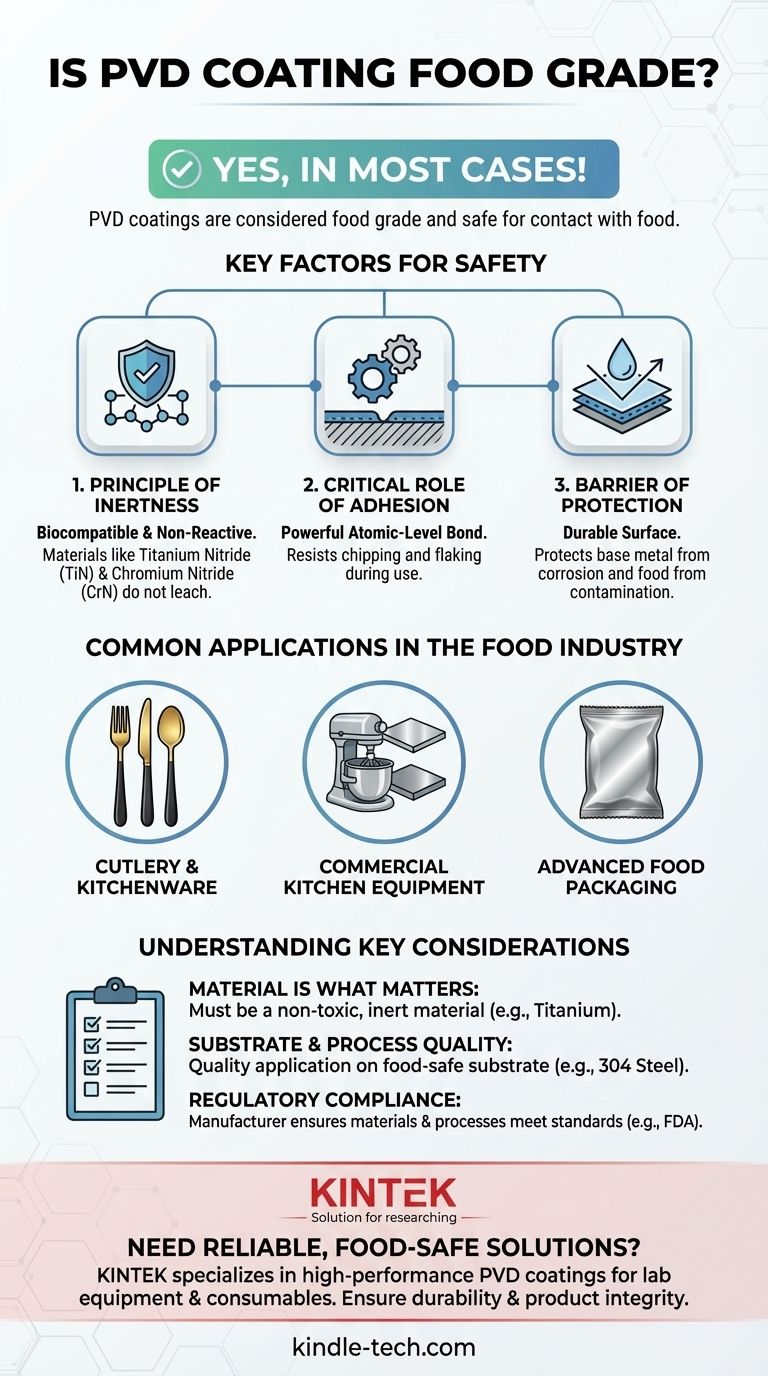
Yes, in most cases, PVD coatings are considered food grade and safe for contact with food. The safety of Physical Vapor Deposition (PVD) coatings stems from two primary factors: the materials used are typically chemically and biologically inert, and the application process creates an extremely strong bond with the underlying material, preventing the coating from flaking off.

The food safety of a PVD-coated product is not determined by the process alone, but by the specific combination of an inert coating material and a high-quality application that ensures durability and prevents any interaction with the food it touches.

Is PVD coating food grade? Ensure Safety and Durability for Food Contact Applications

What Makes a PVD Coating Food Safe?

The "food grade" status of a PVD coating is a result of its fundamental physical and chemical properties. It’s not just a label, but a functional outcome of the material and the process.

The Principle of Inertness

Most materials used for PVD coatings in food-related applications, such as titanium nitride (TiN) and chromium nitride (CrN), are biocompatible and non-reactive.

This means they do not leach chemicals or metallic ions into food, even when exposed to acidic substances like lemon juice or tomato sauce. They are chemically and biologically inert, so they pass through the body without being absorbed.

The Critical Role of Adhesion

The PVD process forms a powerful, atomic-level bond between the coating and the substrate (the base material, like stainless steel).

This bond is exceptionally strong, meaning the coating is highly resistant to chipping, peeling, or flaking off during normal use. This ensures that particles of the coating do not mix with food.

A Barrier of Protection

A PVD coating acts as a durable barrier. It protects the food from the base metal and protects the product itself from corrosion or wear.

This is especially important for commercial kitchen equipment, where constant use and cleaning could otherwise degrade the surface.

Common Applications in the Food Industry

PVD coatings are not a niche technology; they are widely used in applications where food contact is constant and safety is paramount.

Cutlery and Kitchenware

PVD is frequently used to apply decorative and durable finishes to cutlery, giving it colors like gold, black, or copper. This coating is far more resilient than traditional plating and withstands repeated washing.

Commercial Kitchen Equipment

The exceptional wear resistance of PVD coatings makes them ideal for high-contact parts in food processing machinery and commercial kitchens. This durability ensures a long service life and a consistently safe surface.

Advanced Food Packaging

Many modern food packages, like the metallic lining inside a bag of chips, use a PVD-like process called metallization. This thin layer of aluminum provides a barrier against oxygen and moisture, keeping food fresh without directly contacting it.

Understanding the Key Considerations

While PVD is generally safe, its "food grade" status is conditional. The safety depends entirely on using the right materials and a high-quality process.

The Coating Material Is What Matters

The safety hinges on the specific material being deposited. Using a non-toxic, inert material like titanium is what makes the final product safe. It is the manufacturer's responsibility to select and certify a material that is approved for food contact.

Substrate and Process Quality

A poorly applied coating could potentially fail, compromising safety. The underlying material, or substrate, must also be food-safe. A quality PVD application on a certified food-grade material like 304 stainless steel is the gold standard.

Regulatory Compliance

For any product to be commercially sold as "food safe," the manufacturer must ensure that their specific materials and processes meet regulatory standards, such as those set by the FDA in the United States. This involves rigorous testing for leaching and durability.

How to Verify Food Safety for Your Application

Choosing or specifying a PVD-coated product requires attention to its intended purpose and the supplier's qualifications.

  • If your primary focus is designing a new food product: Specify inert coating materials like titanium nitride (TiN) or chromium nitride (CrN) and partner with a PVD supplier who can provide documentation of regulatory compliance.
  • If your primary focus is purchasing for a home or business: Buy from reputable manufacturers who explicitly state that their products are food-safe and intended for culinary use.

Ultimately, PVD technology provides a proven method for creating highly durable, non-toxic, and safe surfaces for a wide range of food-related applications.

Summary Table:

Key Factor Why It Matters for Food Safety
Material Inertness Coating materials like TiN and CrN are non-reactive and do not leach chemicals into food.
Strong Adhesion The PVD process creates a durable bond, preventing the coating from chipping or flaking.
Barrier Protection The coating protects the base material from corrosion and the food from the substrate.
Regulatory Compliance High-quality applications meet FDA and other food safety standards.

Need a reliable, food-safe coating solution for your laboratory or food processing equipment?

At KINTEK, we specialize in high-performance PVD coatings for lab equipment and consumables. Our expertise ensures your products meet the highest standards of durability and food safety. Let us help you protect your investment and guarantee product integrity.

Contact our experts today to discuss your specific needs and learn how KINTEK's solutions can benefit your operation.

Visual Guide
Is PVD coating food grade? Ensure Safety and Durability for Food Contact Applications Visual Guide

Related Products

People Also Ask

Related Products

Custom CVD Diamond Coating for Lab Applications

Custom CVD Diamond Coating for Lab Applications

CVD Diamond Coating: Superior Thermal Conductivity, Crystal Quality, and Adhesion for Cutting Tools, Friction, and Acoustic Applications

RF PECVD System Radio Frequency Plasma-Enhanced Chemical Vapor Deposition RF PECVD

RF PECVD System Radio Frequency Plasma-Enhanced Chemical Vapor Deposition RF PECVD

RF-PECVD is an acronym for "Radio Frequency Plasma-Enhanced Chemical Vapor Deposition." It deposits DLC (Diamond-like carbon film) on germanium and silicon substrates. It is utilized in the 3-12um infrared wavelength range.

Vacuum Hot Press Furnace Machine for Lamination and Heating

Vacuum Hot Press Furnace Machine for Lamination and Heating

Experience clean and precise lamination with Vacuum Lamination Press. Perfect for wafer bonding, thin-film transformations, and LCP lamination. Order now!

Split Chamber CVD Tube Furnace with Vacuum Station Chemical Vapor Deposition System Equipment Machine

Split Chamber CVD Tube Furnace with Vacuum Station Chemical Vapor Deposition System Equipment Machine

Efficient split chamber CVD furnace with vacuum station for intuitive sample checking and quick cooling. Up to 1200℃ max temperature with accurate MFC mass flowmeter control.

High Pressure Laboratory Vacuum Tube Furnace Quartz Tubular Furnace

High Pressure Laboratory Vacuum Tube Furnace Quartz Tubular Furnace

KT-PTF High Pressure Tube Furnace: Compact split tube furnace with strong positive pressure resistance. Working temp up to 1100°C and pressure up to 15Mpa. Also works under controller atmosphere or high vacuum.

Vacuum Heat Treat and Molybdenum Wire Sintering Furnace for Vacuum Sintering

Vacuum Heat Treat and Molybdenum Wire Sintering Furnace for Vacuum Sintering

A vacuum molybdenum wire sintering furnace is a vertical or bedroom structure, which is suitable for withdrawal, brazing, sintering and degassing of metal materials under high vacuum and high temperature conditions. It is also suitable for dehydroxylation treatment of quartz materials.

Graphite Vacuum Continuous Graphitization Furnace

Graphite Vacuum Continuous Graphitization Furnace

High-temperature graphitization furnace is a professional equipment for graphitization treatment of carbon materials. It is a key equipment for the production of high-quality graphite products. It has high temperature, high efficiency and uniform heating. It is suitable for various high-temperature treatments and graphitization treatments. It is widely used in metallurgy, electronics, aerospace, etc. industry.

1700℃ Controlled Atmosphere Furnace Nitrogen Inert Atmosphere Furnace

1700℃ Controlled Atmosphere Furnace Nitrogen Inert Atmosphere Furnace

KT-17A Controlled atmosphere furnace: 1700℃ heating, vacuum sealing technology, PID temperature control, and versatile TFT smart touch screen controller for laboratory and industrial use.

Custom PTFE Teflon Parts Manufacturer for PTFE Tweezers

Custom PTFE Teflon Parts Manufacturer for PTFE Tweezers

PTFE tweezers inherit the excellent physical and chemical properties of PTFE, such as high temperature resistance, cold resistance, acid and alkali resistance, and corrosion resistance to most organic solvents.

Vacuum Dental Porcelain Sintering Furnace

Vacuum Dental Porcelain Sintering Furnace

Get precise and reliable results with KinTek's Vacuum Porcelain Furnace. Suitable for all porcelain powders, it features hyperbolic ceramic furnace function, voice prompt, and automatic temperature calibration.

1400℃ Controlled Atmosphere Furnace with Nitrogen and Inert Atmosphere

1400℃ Controlled Atmosphere Furnace with Nitrogen and Inert Atmosphere

Achieve precise heat treatment with KT-14A controlled atmosphere furnace. Vacuum sealed with a smart controller, it's ideal for lab and industrial use up to 1400℃.

1200℃ Controlled Atmosphere Furnace Nitrogen Inert Atmosphere Furnace

1200℃ Controlled Atmosphere Furnace Nitrogen Inert Atmosphere Furnace

Discover our KT-12A Pro Controlled atmosphere furnace - high precision, heavy duty vacuum chamber, versatile smart touch screen controller, and excellent temperature uniformity up to 1200C. Ideal for both laboratory and industrial application.

Small Vacuum Heat Treat and Tungsten Wire Sintering Furnace

Small Vacuum Heat Treat and Tungsten Wire Sintering Furnace

The small vacuum tungsten wire sintering furnace is a compact experimental vacuum furnace specially designed for universities and scientific research institutes. The furnace features a CNC welded shell and vacuum piping to ensure leak-free operation. Quick-connect electrical connections facilitate relocation and debugging, and the standard electrical control cabinet is safe and convenient to operate.

Dental Porcelain Zirconia Sintering Ceramic Vacuum Press Furnace

Dental Porcelain Zirconia Sintering Ceramic Vacuum Press Furnace

Get precise dental results with Dental Vacuum Press Furnace. Automatic temperature calibration, low noise tray, and touch screen operation. Order now!

Graphite Vacuum Furnace IGBT Experimental Graphitization Furnace

Graphite Vacuum Furnace IGBT Experimental Graphitization Furnace

IGBT experimental graphitization furnace, a tailored solution for universities and research institutions, with high heating efficiency, user-friendliness, and precise temperature control.

Vertical High Temperature Graphite Vacuum Graphitization Furnace

Vertical High Temperature Graphite Vacuum Graphitization Furnace

Vertical high temperature graphitization furnace for carbonization and graphitization of carbon materials up to 3100℃.Suitable for shaped graphitization of carbon fiber filaments and other materials sintered in a carbon environment.Applications in metallurgy, electronics, and aerospace for producing high-quality graphite products like electrodes and crucibles.

Isostatic Molding Pressing Molds for Lab

Isostatic Molding Pressing Molds for Lab

Explore high-performance isostatic pressing molds for advanced material processing. Ideal for achieving uniform density and strength in manufacturing.

Ultra-High Temperature Graphite Vacuum Graphitization Furnace

Ultra-High Temperature Graphite Vacuum Graphitization Furnace

The ultra-high temperature graphitization furnace utilizes medium frequency induction heating in a vacuum or inert gas environment. The induction coil generates an alternating magnetic field, inducing eddy currents in the graphite crucible, which heats up and radiates heat to the workpiece, bringing it to the desired temperature. This furnace is primarily used for graphitization and sintering of carbon materials, carbon fiber materials, and other composite materials.

2200 ℃ Graphite Vacuum Heat Treat Furnace

2200 ℃ Graphite Vacuum Heat Treat Furnace

Discover the power of the KT-VG Graphite Vacuum Furnace - with a maximum working temperature of 2200℃, it's perfect for vacuum sintering of various materials. Learn more now.

Vacuum Sealed Continuous Working Rotary Tube Furnace Rotating Tube Furnace

Vacuum Sealed Continuous Working Rotary Tube Furnace Rotating Tube Furnace

Experience efficient material processing with our vacuum-sealed rotary tube furnace. Perfect for experiments or industrial production, equipped with optional features for controlled feeding and optimized results. Order now.


Leave Your Message