Knowledge Vacuum Furnace Is vacuum casting expensive? Discover the Cost-Effective Solution for Low-Volume Production
Author avatar

Tech Team · Kintek Solution

Updated 2 months ago

Is vacuum casting expensive? Discover the Cost-Effective Solution for Low-Volume Production


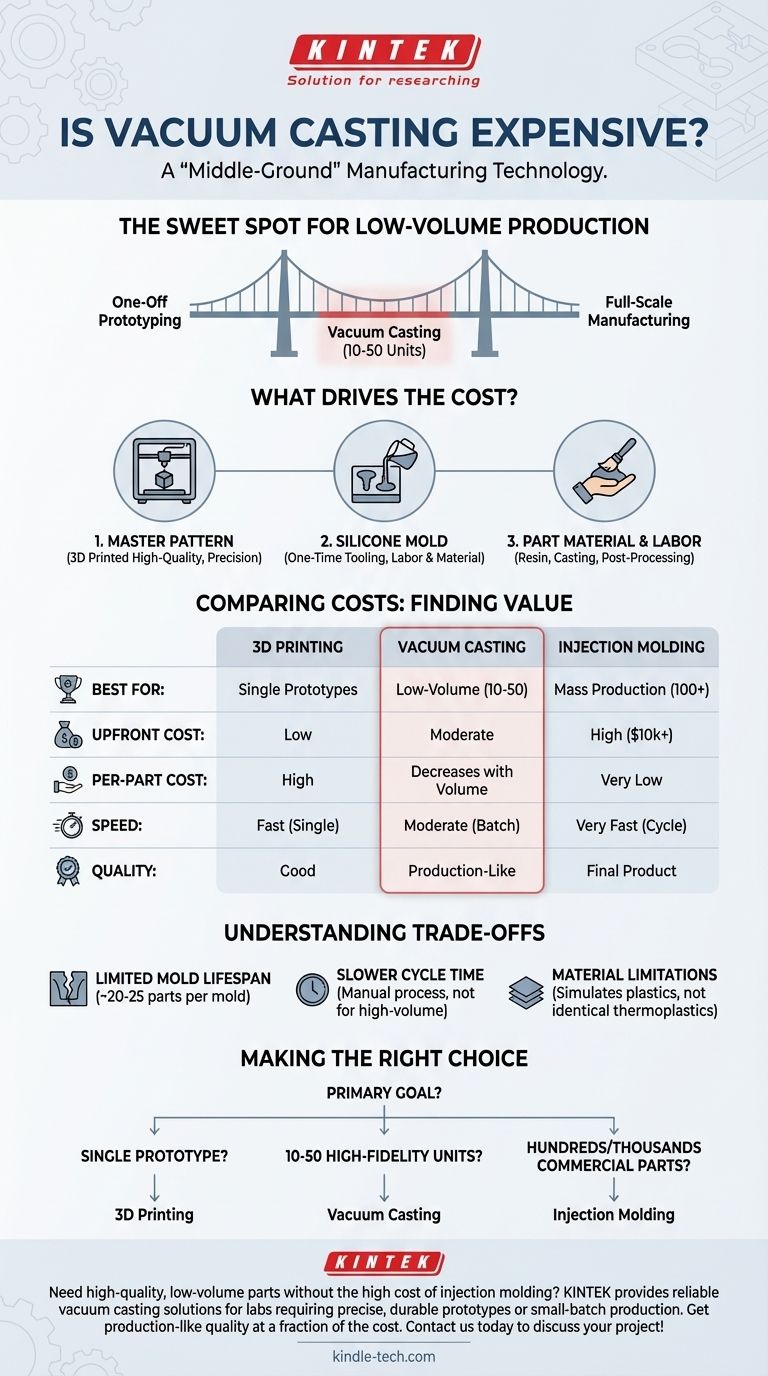
To put it directly: vacuum casting is a "middle-ground" manufacturing technology. It is more expensive per part than a single 3D print but is vastly cheaper than the steel tooling required for injection molding. Its cost-effectiveness is revealed when you need a small batch of production-quality parts, not just a single prototype.

The question isn't simply whether vacuum casting is expensive, but rather at what quantity it becomes the most economical choice. It excels in low-volume production, bridging the gap between one-off prototyping and full-scale manufacturing.
Is vacuum casting expensive? Discover the Cost-Effective Solution for Low-Volume Production

What Drives the Cost of Vacuum Casting?

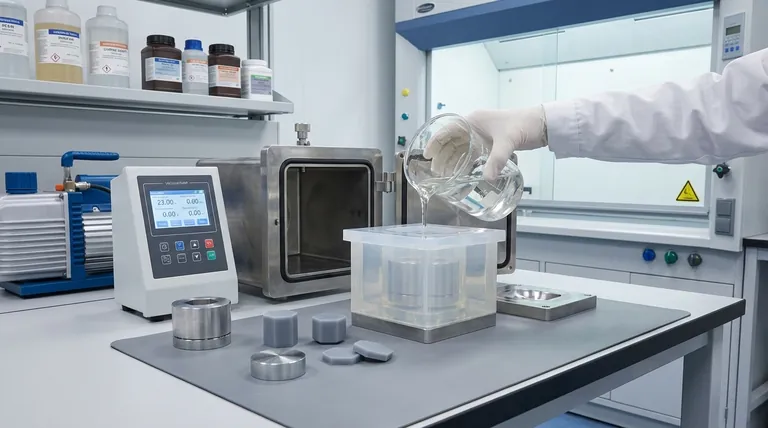
To understand its price, you must first understand the process. Vacuum casting is fundamentally a copying method. The costs are distributed across creating a master pattern, making a mold, and then casting the final parts.

The Master Pattern

The process begins with a high-quality master pattern, which is typically created using a precise 3D printing method like Stereolithography (SLA). The quality, size, and complexity of this initial part are the first cost factors.

The Silicone Mold

This master pattern is used to create a silicone mold. The amount of silicone required—determined by the part's size—and the labor to create the mold form the primary "tooling" cost. This cost is a one-time investment for each mold.

Part Material and Labor

Each part is cast by mixing and pouring a liquid polyurethane resin into the mold within a vacuum chamber. The cost of the specific resin, the skilled labor for the casting process, and any post-processing or finishing (like painting or sanding) add to the per-part price.

Comparing Costs: Vacuum Casting vs. Alternatives

The value of vacuum casting becomes clear only when compared to other methods. Its "sweet spot" is for low-volume production where other technologies are either too slow or too expensive.

Versus 3D Printing

For a single part, 3D printing is almost always cheaper and faster. However, if you need 10 identical parts, 3D printing them one-by-one can become more expensive and time-consuming than creating one mold and casting them. Vacuum casting's per-part cost drops with each copy made from a single mold.

Versus Injection Molding

Injection molding is the standard for mass production. It has an extremely low per-part cost but requires an enormous upfront investment ($10,000 to $100,000+) in a hard steel mold. Vacuum casting tooling is a fraction of this price, making it ideal for runs that don't justify a massive tooling budget.

The Breakeven Point

Vacuum casting is typically the most cost-effective option for quantities between 10 and 50 units per mold. It provides parts with material properties and surface finishes that are far superior to most 3D prints, closely simulating a final injection-molded product.

Understanding the Inherent Trade-offs

No process is perfect. Being objective means acknowledging the limitations that influence when vacuum casting is the right financial decision.

Limited Mold Lifespan

A single silicone mold has a finite life. It will begin to degrade from thermal and chemical stress after producing approximately 20-25 parts. For runs of 100 parts, you would need to budget for creating about four separate molds.

Slower Per-Part Cycle Time

Compared to the seconds-long cycle time of injection molding, vacuum casting is a manual, methodical process. Mixing resins, casting, and curing takes significantly longer per part, making it unsuitable for high-volume needs.

Material Limitations

While the available polyurethane resins can simulate a wide range of production plastics (from rigid ABS to flexible rubber), they are not the exact same thermoplastic materials used in injection molding. This can be a critical distinction for end-use parts requiring specific thermal or chemical resistance.

Making the Right Choice for Your Goal

Your production volume and quality requirements are the most critical factors in determining if vacuum casting is an "expensive" or a "cost-effective" choice for you.

  • If your primary focus is a single, early-stage prototype: Stick with 3D printing for its speed and low initial cost.
  • If your primary focus is creating 10-50 high-fidelity units for testing, marketing, or a pilot run: Vacuum casting is almost certainly your most economical option for achieving production-like quality.
  • If your primary focus is producing hundreds or thousands of parts for a commercial product: The upfront investment in injection molding tooling is the only way to achieve a viable per-part cost.

Choosing the right manufacturing process is about aligning the method's cost structure with your specific production volume and quality requirements.

Summary Table:

Factor Impact on Cost
Master Pattern Quality, size, and complexity of the 3D-printed master
Silicone Mold One-time tooling cost based on part size and labor
Part Material & Labor Per-part cost from resin, casting, and post-processing
Ideal Quantity 10-50 units per mold for optimal cost-effectiveness
Mold Lifespan ~20-25 parts per mold; multiple molds needed for larger runs

Need high-quality, low-volume parts without the high cost of injection molding? KINTEK specializes in lab equipment and consumables, providing reliable vacuum casting solutions for laboratories requiring precise, durable prototypes or small-batch production parts. Our expertise ensures you get production-like quality at a fraction of the cost—perfect for testing, pilot runs, or market validation. Contact us today to discuss your project and receive a tailored quote!

Visual Guide
Is vacuum casting expensive? Discover the Cost-Effective Solution for Low-Volume Production Visual Guide

Related Products

People Also Ask

Related Products

Vacuum Cold Mounting Machine for Sample Preparation

Vacuum Cold Mounting Machine for Sample Preparation

Vacuum Cold Mounting Machine for precise sample prep. Handles porous, fragile materials with -0.08MPa vacuum. Ideal for electronics, metallurgy, and failure analysis.

Vacuum Hot Press Furnace Machine for Lamination and Heating

Vacuum Hot Press Furnace Machine for Lamination and Heating

Experience clean and precise lamination with Vacuum Lamination Press. Perfect for wafer bonding, thin-film transformations, and LCP lamination. Order now!

Stainless Steel Quick Release Vacuum Chain Three-Section Clamp

Stainless Steel Quick Release Vacuum Chain Three-Section Clamp

Discover our stainless steel quick release clamp vacuum clamp, Ideal for high vacuum applications, Strong connections, reliable sealing, Easy installation, and durable design.

Vacuum Dental Porcelain Sintering Furnace

Vacuum Dental Porcelain Sintering Furnace

Get precise and reliable results with KinTek's Vacuum Porcelain Furnace. Suitable for all porcelain powders, it features hyperbolic ceramic furnace function, voice prompt, and automatic temperature calibration.

Vacuum Heat Treat and Molybdenum Wire Sintering Furnace for Vacuum Sintering

Vacuum Heat Treat and Molybdenum Wire Sintering Furnace for Vacuum Sintering

A vacuum molybdenum wire sintering furnace is a vertical or bedroom structure, which is suitable for withdrawal, brazing, sintering and degassing of metal materials under high vacuum and high temperature conditions. It is also suitable for dehydroxylation treatment of quartz materials.

Lab Plastic PVC Calender Stretch Film Casting Machine for Film Testing

Lab Plastic PVC Calender Stretch Film Casting Machine for Film Testing

The cast film machine is designed for the molding of polymer cast film products and has multiple processing functions such as casting, extrusion, stretching, and compounding.

Vacuum Heat Treat and Pressure Sintering Furnace for High Temperature Applications

Vacuum Heat Treat and Pressure Sintering Furnace for High Temperature Applications

Vacuum pressure sintering furnaces are designed for high temperature hot pressing applications in metal and ceramic sintering. Its advanced features ensure precise temperature control, reliable pressure maintenance, and a robust design for seamless operation.

Small Vacuum Heat Treat and Tungsten Wire Sintering Furnace

Small Vacuum Heat Treat and Tungsten Wire Sintering Furnace

The small vacuum tungsten wire sintering furnace is a compact experimental vacuum furnace specially designed for universities and scientific research institutes. The furnace features a CNC welded shell and vacuum piping to ensure leak-free operation. Quick-connect electrical connections facilitate relocation and debugging, and the standard electrical control cabinet is safe and convenient to operate.

Laboratory Sterilizer Lab Autoclave Pulsating Vacuum Desktop Steam Sterilizer

Laboratory Sterilizer Lab Autoclave Pulsating Vacuum Desktop Steam Sterilizer

The pulsating vacuum desktop steam sterilizer is a compact and reliable device used for rapid sterilization of medical, pharmaceutical, and research items.

Laboratory Sterilizer Lab Autoclave Pulse Vacuum Lifting Sterilizer

Laboratory Sterilizer Lab Autoclave Pulse Vacuum Lifting Sterilizer

The pulse vacuum lifting sterilizer is a state-of-the-art equipment for efficient and precise sterilization. It uses pulsating vacuum technology, customizable cycles, and a user-friendly design for easy operation and safety.

Vacuum Arc Induction Melting Furnace

Vacuum Arc Induction Melting Furnace

Discover the power of Vacuum Arc Furnace for melting active & refractory metals. High-speed, remarkable degassing effect, and free of contamination. Learn more now!

Vacuum Heat Treat Furnace and Levitation Induction Melting Furnace

Vacuum Heat Treat Furnace and Levitation Induction Melting Furnace

Experience precise melting with our Vacuum Levitation Melting Furnace. Ideal for high melting point metals or alloys, with advanced technology for effective smelting. Order now for high-quality results.

Vacuum Heat Treat Sintering Brazing Furnace

Vacuum Heat Treat Sintering Brazing Furnace

A vacuum brazing furnace is a type of industrial furnace used for brazing, a metalworking process that joins two pieces of metal using a filler metal that melts at a lower temperature than the base metals. Vacuum brazing furnaces are typically used for high-quality applications where a strong, clean joint is required.

Vacuum Induction Melting Spinning System Arc Melting Furnace

Vacuum Induction Melting Spinning System Arc Melting Furnace

Develop metastable materials with ease using our Vacuum Melt Spinning System. Ideal for research and experimental work with amorphous and microcrystalline materials. Order now for effective results.

Lab-Scale Vacuum Induction Melting Furnace

Lab-Scale Vacuum Induction Melting Furnace

Get precise alloy composition with our Vacuum Induction Melting Furnace. Ideal for aerospace, nuclear energy, and electronic industries. Order now for effective smelting and casting of metals and alloys.

Horizontal High Temperature Graphite Vacuum Graphitization Furnace

Horizontal High Temperature Graphite Vacuum Graphitization Furnace

Horizontal Graphitization Furnace: This type of furnace is designed with the heating elements placed horizontally, allowing for uniform heating of the sample. It's well-suited for graphitizing large or bulky samples that require precise temperature control and uniformity.

Vacuum Sealed Continuous Working Rotary Tube Furnace Rotating Tube Furnace

Vacuum Sealed Continuous Working Rotary Tube Furnace Rotating Tube Furnace

Experience efficient material processing with our vacuum-sealed rotary tube furnace. Perfect for experiments or industrial production, equipped with optional features for controlled feeding and optimized results. Order now.

Electric Heated Hydraulic Vacuum Heat Press for Lab

Electric Heated Hydraulic Vacuum Heat Press for Lab

The Electric Vacuum Heat Press is a specialized heat press equipment that operates in a vacuum environment, utilizing advanced infrared heating and precise temperature control for high quality, rugged and reliable performance.

600T Vacuum Induction Hot Press Furnace for Heat Treat and Sintering

600T Vacuum Induction Hot Press Furnace for Heat Treat and Sintering

Discover the 600T Vacuum Induction Hot Press Furnace, designed for high-temperature sintering experiments in vacuum or protected atmospheres. Its precise temperature and pressure control, adjustable working pressure, and advanced safety features make it ideal for nonmetal materials, carbon composites, ceramics, and metal powders.

Vacuum Hot Press Furnace Machine Heated Vacuum Press

Vacuum Hot Press Furnace Machine Heated Vacuum Press

Discover the advantages of Vacuum Hot Press Furnace! Manufacture dense refractory metals & compounds, ceramics, and composites under high temp and pressure.


Leave Your Message