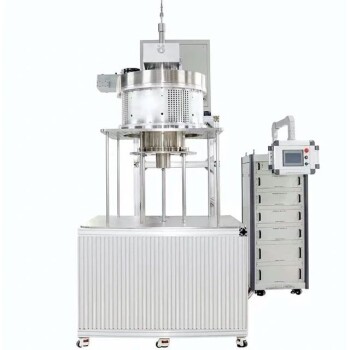
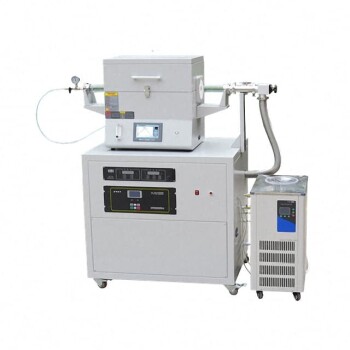
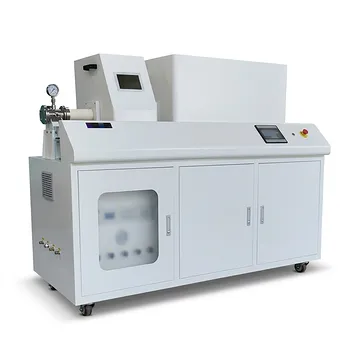
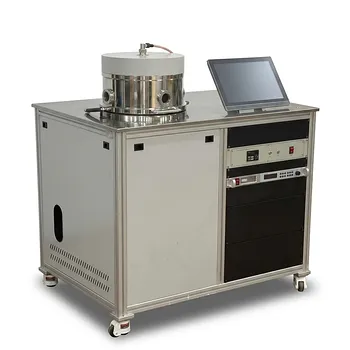
The primary advantage of a chemical vapor deposition (CVD) system is its ability to strictly control the placement and size of metal species within carbon nanotubes (CNTs). By precisely regulating the flow and concentration of volatile precursors, the system forces diffusion into the inner cavities of the nanotubes while preventing deposition on the outer walls. This "inside-only" approach leverages capillary action to create uniform, confined catalysts with superior selectivity.
The defining strength of CVD in this context is its ability to utilize the physical properties of the nanotube—specifically capillary action and internal defects—to turn the CNT into a selective nanoreactor, rather than just a passive support.
Achieving Precision Through Gas-Phase Control
Regulating Precursor Delivery
A CVD system provides granular control over the concentration and flow rate of volatile metal precursors.
This gas-phase management is the foundation of the process. It ensures that the metal source is delivered consistently to the nanotube substrate.
Thermal Activation and Diffusion
The process operates at carefully controlled temperatures.
Under these thermal conditions, the precursors are activated and diffuse effectively. This controlled environment allows the gas to penetrate the nanotube structure rather than simply coating the surface.
Mechanisms Driving Internal Deposition
Leveraging Capillary Action
CVD distinguishes itself by utilizing the natural capillary forces of the nanotubes.
These forces act as a vacuum, drawing the volatile precursors deep into the inner cavities. This physical phenomenon is critical for ensuring the catalyst enters the channel.
Targeting Electronic Defects
The interior channels of carbon nanotubes possess specific electronic defect environments.
CVD technology exploits these internal defects. The metal species anchor to these sites, facilitating uniform deposition specifically where it is required inside the channel.
Impact on Catalytic Structure
Size Control and Uniformity
Once inside the nanotube, the deposition process yields highly uniform metal species.
The confined space of the nanotube channel limits the growth of the particles. This results in intrinsic size control that is difficult to achieve with bulk deposition methods.
Preventing External Contamination
A critical advantage of this method is the ability to minimize or eliminate significant deposition on the outer walls of the CNTs.
By keeping the exterior clean, the system ensures that catalytic activity is restricted to the confined inner environment. This direct confinement is the key driver for improved catalytic selectivity.
Critical Operational Considerations
The Necessity of Strict Regulation
The benefits of CVD are entirely dependent on the precision of the system settings.
Because the process relies on diffusion and capillary action, the balance of temperature and flow rate must be exact. Inaccurate regulation can lead to poor diffusion or unintended coating of the outer walls, negating the selectivity benefits.
Making the Right Choice for Your Goal
To effectively utilize CVD for CNT-confined catalysts, align your process parameters with your specific structural requirements:
- If your primary focus is catalytic selectivity: Prioritize parameters that minimize outer wall deposition to ensure all reactions occur within the confined nanoreactor.
- If your primary focus is particle uniformity: Focus on maintaining constant precursor concentration and flow rates to ensure even distribution throughout the inner cavities.
By mastering the precise regulation of volatile precursors, you leverage the unique geometry of nanotubes to engineer high-performance, confined catalysts.
Summary Table:
| Feature | CVD Advantage for CNT Confinement | Impact on Performance |
|---|---|---|
| Deposition Control | Targets internal cavities via capillary action | Prevents external wall contamination |
| Particle Size | Confined growth within the nanotube channel | Ensures high uniformity and selectivity |
| Precursor Delivery | Granular gas-phase flow and concentration control | Consistent catalyst anchoring on defects |
| Thermal Precision | Precise activation and diffusion environments | Optimizes penetration into nano-channels |
Elevate Your Material Research with KINTEK Precision
Unlock the full potential of your carbon nanotube research with KINTEK’s advanced Chemical Vapor Deposition (CVD) systems. Whether you are developing next-generation catalysts, battery materials, or advanced electronic components, our specialized laboratory equipment provides the rigorous control over temperature and flow required for successful nano-confinement.
Why choose KINTEK for your laboratory needs?
- High-Temperature Expertise: A comprehensive range of muffle, tube, and vacuum furnaces designed for precise thermal activation.
- Advanced Synthesis Tools: Leading-edge CVD, PECVD, and MPCVD systems tailored for high-performance material growth.
- Complete Lab Solutions: From crushing and milling systems to high-pressure reactors, autoclaves, and specialized electrolytic cells.
- Quality Consumables: Premium PTFE products, ceramics, and crucibles to maintain purity in every experiment.
Ready to achieve superior catalytic selectivity and particle uniformity? Contact our technical experts today to find the perfect system for your lab!
References
- Moussa Zaarour, Javier Ruiz‐Martínez. Recent developments in the control of selectivity in hydrogenation reactions by confined metal functionalities. DOI: 10.1039/d0cy01709d
This article is also based on technical information from Kintek Solution Knowledge Base .
Related Products
- Chemical Vapor Deposition CVD Equipment System Chamber Slide PECVD Tube Furnace with Liquid Gasifier PECVD Machine
- Microwave Plasma Chemical Vapor Deposition MPCVD Machine System Reactor for Lab and Diamond Growth
- 915MHz MPCVD Diamond Machine Microwave Plasma Chemical Vapor Deposition System Reactor
- Customer Made Versatile CVD Tube Furnace Chemical Vapor Deposition Chamber System Equipment
- Split Chamber CVD Tube Furnace with Vacuum Station Chemical Vapor Deposition System Equipment Machine
People Also Ask
- What are the advantages of chemical vapor deposition? Achieve Superior Thin Films for Your Lab
- What types of substrates are used in CVD to facilitate graphene films? Optimize Graphene Growth with the Right Catalyst
- What is the chemical vapor deposition growth process? Build Superior Thin Films from the Atom Up
- How expensive is chemical vapor deposition? Understanding the True Cost of High-Performance Coating
- Why is Chemical Vapor Deposition (CVD) equipment uniquely suited for constructing hierarchical superhydrophobic structures?