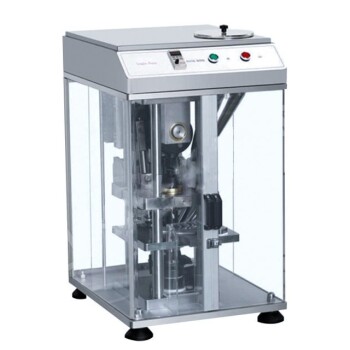
The cubic press offers distinct operational efficiencies over the belt press, particularly regarding speed and physical footprint. Its primary advantage is the ability to more rapidly achieve the high pressure and temperature required for synthetic diamond production. However, this comes at the cost of scalability, as the cubic design struggles to accommodate larger production volumes efficiently.
While the cubic press is superior for rapid cycling in a compact form factor, it is mechanically limited in scalability; increasing internal volume requires a disproportionate increase in force to maintain the necessary pressure.
The Operational Advantages
Rapid Environment Creation
The most significant performance advantage of the cubic press is its cycle time. It can rapidly achieve the extreme high pressure and temperature needed to synthesize diamond.
This speed allows for quicker turnaround times on production runs compared to the typically slower belt press.
Compact Physical Footprint
A cubic press is typically smaller than a belt press.
This reduced size allows for more efficient use of floor space in a manufacturing facility or laboratory setting.
Understanding the Trade-offs: The Scalability Barrier
The Volume vs. Force Constraint
The cubic press faces a critical limitation when manufacturers attempt to scale up production. To increase the reaction volume, you must use larger anvils.
However, because pressure is a function of force applied over an area, larger anvils drastically increase the surface area.
Difficulty in Scaling Up
To maintain the same pressure on these larger anvils, the machine must apply a significantly increased amount of force.
This relationship makes it difficult to scale the cubic press to larger volumes, as the engineering requirements for force generation become prohibitive compared to a belt press.
Making the Right Choice for Your Goal
When deciding between these two technologies, the choice comes down to the balance between cycle speed and total production volume.
- If your primary focus is rapid processing: The cubic press is the superior choice due to its ability to reach critical temperature and pressure quickly.
- If your primary focus is large-volume scalability: The cubic press is likely unsuitable, as increasing its volume requires overcoming significant mechanical force limitations.
Select the tool that aligns with your specific volume requirements, knowing that the cubic press trades scalability for speed and compactness.
Summary Table:
| Feature | Cubic Press | Belt Press |
|---|---|---|
| Cycle Speed | Rapid attainment of HPHT | Slower ramp-up times |
| Footprint | Compact and space-efficient | Larger and bulkier |
| Scalability | Limited by anvil surface area | Higher volume capacity |
| Force Req. | Increases exponentially with volume | More efficient for large scales |
| Best Use Case | Fast turnaround & lab research | Mass production of synthetics |
Elevate Your Material Synthesis with KINTEK Precision
Are you deciding between speed and scale for your high-pressure research? KINTEK specializes in advanced laboratory equipment, including high-performance hydraulic presses (pellet, hot, isostatic) and custom synthesis solutions designed to meet your exact specifications. Whether you are producing synthetic diamonds or conducting advanced material science, our team provides the technical expertise and robust equipment—from high-temperature furnaces to precision crushing systems—to optimize your workflow.
Ready to upgrade your lab's capabilities? Contact us today to find the perfect press for your application!
Related Products
- Assemble Square Lab Press Mold for Laboratory Applications
- Cylindrical Press Mold with Scale for Lab
- Cylindrical Press Mold for Lab Applications
- Square Lab Press Mold for Laboratory Applications
- Round Bidirectional Press Mold for Lab
People Also Ask
- How to use a press mold? Master the Art of Creating Consistent Ceramic Forms
- What is a laboratory press? Achieve Precise Sample Preparation for Reliable Analysis
- How does a laboratory press contribute to the initial forming of a porous copper wick? Optimize Wick Pore Architecture
- What is the press mould method? A Guide to Consistent, Detailed Ceramic Forms
- What is the process of mold press? A Step-by-Step Guide to Compression Molding