Knowledge tube furnace What are the advantages of a vertical furnace versus a horizontal furnace? Maximize Lab Efficiency & Space
Author avatar

Tech Team · Kintek Solution

Updated 2 months ago

What are the advantages of a vertical furnace versus a horizontal furnace? Maximize Lab Efficiency & Space


At its core, a vertical furnace offers three primary advantages over a horizontal furnace: superior temperature uniformity, a more compact physical footprint, and often simpler sample handling. These benefits stem directly from its vertical orientation, which leverages gravity and natural convection to create a more stable and efficient processing environment.

The decision between a vertical and horizontal furnace is not about which is universally superior, but about which geometry best serves your specific application. Vertical furnaces excel in precision-controlled batch processes and space-constrained environments, while horizontal furnaces are often better suited for high-volume or continuous production.
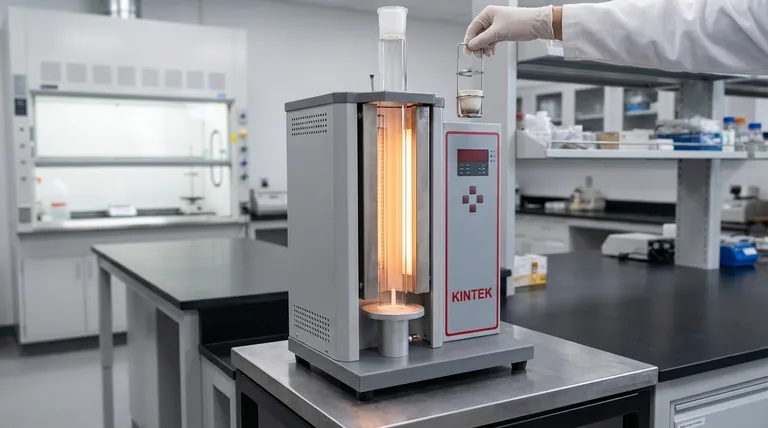
What are the advantages of a vertical furnace versus a horizontal furnace? Maximize Lab Efficiency & Space

The Core Advantage: Superior Thermal Uniformity

The most significant technical advantage of a vertical furnace is its ability to achieve highly consistent temperature distribution along the length of the sample.

The Role of Natural Convection

In a vertical furnace, the heating elements surround the process tube. This orientation allows natural convection to work in harmony with radiative heat transfer, creating a stable thermal environment that minimizes temperature variations.

Impact on Process Consistency

This excellent temperature uniformity ensures that the entire sample is exposed to the same thermal conditions. For sensitive materials processing or scientific research, this leads to more consistent, reliable, and repeatable results.

Practical Benefits in the Lab Environment

Beyond thermal performance, the physical design of a vertical furnace offers distinct practical advantages.

A Significantly Smaller Footprint

Vertical furnaces occupy less floor space than their horizontal counterparts. This makes them an ideal choice for laboratories or production facilities where space is at a premium. The area beneath the furnace can often be used for staging or storing loads.

Simplified Sample Handling

Loading and unloading samples, particularly long or delicate ones, can be much simpler in a vertical design. Gravity helps center the sample within the tube, reducing the need for complex internal supports and making batch processing more convenient.

Understanding the Trade-offs: When to Choose Horizontal

While vertical furnaces offer clear benefits, they are not the best choice for every application. Understanding the strengths of horizontal furnaces is key to making an informed decision.

Larger Working Volume and Throughput

Horizontal furnaces can often be designed with a larger working volume. This allows them to process bigger individual samples or a higher quantity of smaller samples simultaneously, making them suitable for high-throughput applications.

Suitability for Continuous Processing

The horizontal layout is often better suited for continuous production lines. Samples can be more easily fed into one end and extracted from the other, integrating smoothly into an automated manufacturing process.

Heat Distribution in Horizontal Furnaces

While vertical furnaces have an inherent advantage, a well-designed horizontal furnace can still achieve excellent heat distribution. However, this may require more careful optimization of temperature profiles to compensate for potential variations caused by a primary reliance on radiative heat.

Making the Right Choice for Your Application

Selecting the correct furnace configuration requires aligning the equipment's strengths with your primary goal.

  • If your primary focus is process consistency and repeatability: The superior thermal uniformity of a vertical furnace is the decisive factor.
  • If your primary focus is maximizing limited lab or factory space: The compact footprint of a vertical furnace provides a clear advantage.
  • If your primary focus is high-volume throughput or continuous production: A horizontal furnace's larger capacity and ease of integration into a production line is likely the better choice.

Ultimately, choosing the right furnace is about selecting the optimal tool to achieve your specific scientific or production goals.

Summary Table:

Feature Vertical Furnace Horizontal Furnace
Temperature Uniformity Superior (Natural Convection) Good (Requires Optimization)
Physical Footprint Compact, Saves Floor Space Larger
Sample Handling Simplified, Gravity-Assisted Suited for Continuous Processing
Best For Precision Batch Processes, Space-Constrained Labs High-Volume/Continuous Production

Struggling to choose the right furnace for your lab's specific needs? The experts at KINTEK can help! We specialize in providing the ideal lab equipment, including both vertical and horizontal furnaces, to match your application requirements for precision, throughput, and space. Let us help you achieve more consistent and reliable results.

Contact KINTEL today for a personalized consultation!

Visual Guide
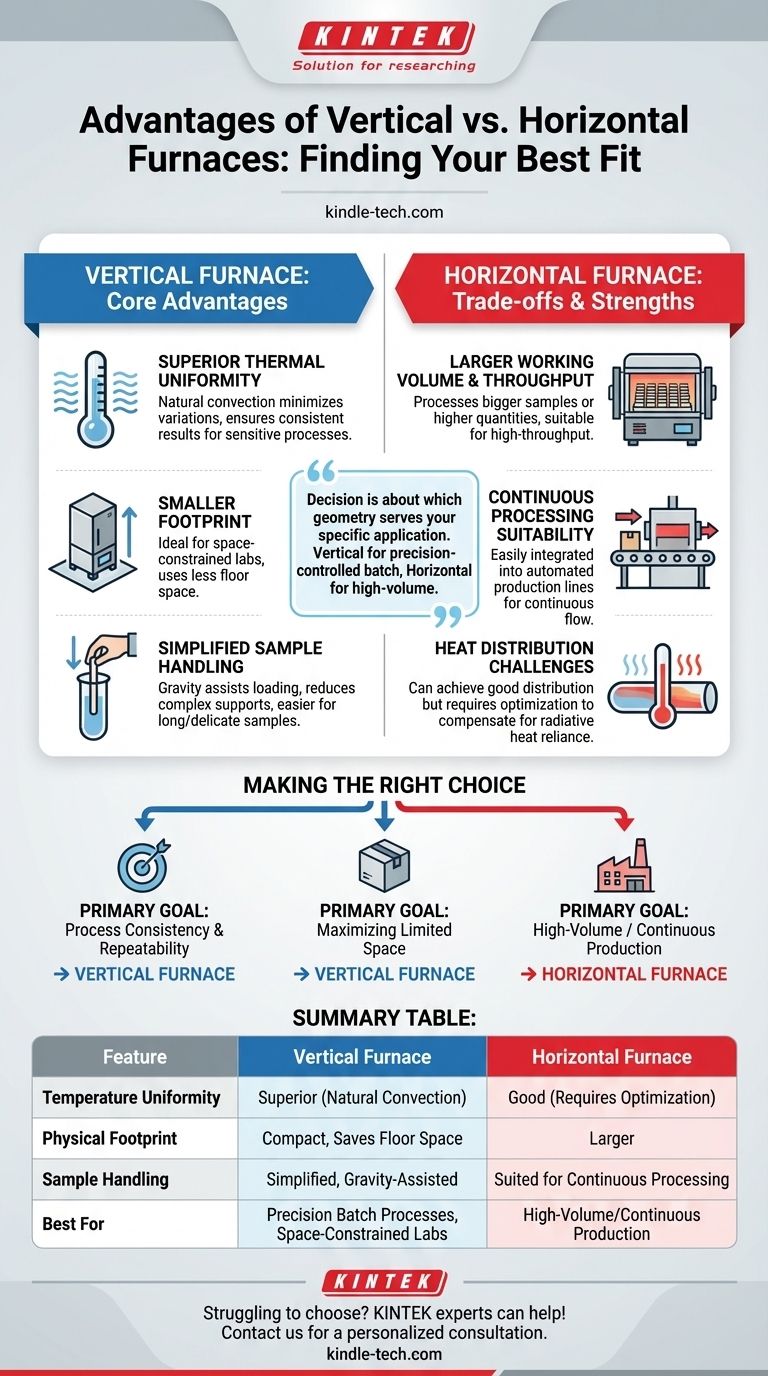
What are the advantages of a vertical furnace versus a horizontal furnace? Maximize Lab Efficiency & Space Visual Guide

Related Products

People Also Ask

Related Products

Vertical High Temperature Graphite Vacuum Graphitization Furnace

Vertical High Temperature Graphite Vacuum Graphitization Furnace

Vertical high temperature graphitization furnace for carbonization and graphitization of carbon materials up to 3100℃.Suitable for shaped graphitization of carbon fiber filaments and other materials sintered in a carbon environment.Applications in metallurgy, electronics, and aerospace for producing high-quality graphite products like electrodes and crucibles.

Large Vertical Graphite Vacuum Graphitization Furnace

Large Vertical Graphite Vacuum Graphitization Furnace

A large vertical high-temperature graphitization furnace is a type of industrial furnace used for the graphitization of carbon materials, such as carbon fiber and carbon black. It is a high-temperature furnace that can reach temperatures of up to 3100°C.

Vertical Laboratory Tube Furnace

Vertical Laboratory Tube Furnace

Elevate your experiments with our Vertical Tube Furnace. Versatile design allows for operation under various environments and heat treatment applications. Order now for precise results!

Graphite Vacuum Furnace Bottom Discharge Graphitization Furnace for Carbon Materials

Graphite Vacuum Furnace Bottom Discharge Graphitization Furnace for Carbon Materials

Bottom-out graphitization furnace for carbon materials, ultra-high temperature furnace up to 3100°C, suitable for graphitization and sintering of carbon rods and carbon blocks. Vertical design, bottom discharging, convenient feeding and discharging, high temperature uniformity, low energy consumption, good stability, hydraulic lifting system, convenient loading and unloading.

Horizontal High Temperature Graphite Vacuum Graphitization Furnace

Horizontal High Temperature Graphite Vacuum Graphitization Furnace

Horizontal Graphitization Furnace: This type of furnace is designed with the heating elements placed horizontally, allowing for uniform heating of the sample. It's well-suited for graphitizing large or bulky samples that require precise temperature control and uniformity.

Multi Heating Zones CVD Tube Furnace Machine Chemical Vapor Deposition Chamber System Equipment

Multi Heating Zones CVD Tube Furnace Machine Chemical Vapor Deposition Chamber System Equipment

KT-CTF14 Multi Heating Zones CVD Furnace - Precise Temperature Control and Gas Flow for Advanced Applications. Max temp up to 1200℃, 4 channels MFC mass flow meter, and 7" TFT touch screen controller.

Rotary Tube Furnace Split Multi Heating Zone Rotating Tube Furnace

Rotary Tube Furnace Split Multi Heating Zone Rotating Tube Furnace

Multi zone rotary furnace for high-precision temperature control with 2-8 independent heating zones. Ideal for lithium ion battery electrode materials and high-temperature reactions. Can work under vacuum and controlled atmosphere.

Customer Made Versatile CVD Tube Furnace Chemical Vapor Deposition Chamber System Equipment

Customer Made Versatile CVD Tube Furnace Chemical Vapor Deposition Chamber System Equipment

Get your exclusive CVD furnace with KT-CTF16 Customer Made Versatile Furnace. Customizable sliding, rotating, and tilting functions for precise reactions. Order now!

High Temperature Muffle Oven Furnace for Laboratory Debinding and Pre Sintering

High Temperature Muffle Oven Furnace for Laboratory Debinding and Pre Sintering

KT-MD High temperature debinding and pre-sintering furnace for ceramic materials with various molding processes. Ideal for electronic components such as MLCC and NFC.

1200℃ Split Tube Furnace with Quartz Tube Laboratory Tubular Furnace

1200℃ Split Tube Furnace with Quartz Tube Laboratory Tubular Furnace

KT-TF12 split tube furnace: high-purity insulation, embedded heating wire coils, and max. 1200C. Widely used for new materials and chemical vapour deposition.

Laboratory Muffle Oven Furnace Bottom Lifting Muffle Furnace

Laboratory Muffle Oven Furnace Bottom Lifting Muffle Furnace

Efficiently produce batches with excellent temperature uniformity using our Bottom Lifting Furnace. Features two electric lifting stages and advanced temperature control up to 1600℃.

1200℃ Controlled Atmosphere Furnace Nitrogen Inert Atmosphere Furnace

1200℃ Controlled Atmosphere Furnace Nitrogen Inert Atmosphere Furnace

Discover our KT-12A Pro Controlled atmosphere furnace - high precision, heavy duty vacuum chamber, versatile smart touch screen controller, and excellent temperature uniformity up to 1200C. Ideal for both laboratory and industrial application.

Mesh belt controlled atmosphere furnace

Mesh belt controlled atmosphere furnace

Discover our KT-MB mesh belt sintering furnace - perfect for high-temperature sintering of electronic components & glass insulators. Available for open air or controlled atmosphere environments.

Ultra-High Temperature Graphite Vacuum Graphitization Furnace

Ultra-High Temperature Graphite Vacuum Graphitization Furnace

The ultra-high temperature graphitization furnace utilizes medium frequency induction heating in a vacuum or inert gas environment. The induction coil generates an alternating magnetic field, inducing eddy currents in the graphite crucible, which heats up and radiates heat to the workpiece, bringing it to the desired temperature. This furnace is primarily used for graphitization and sintering of carbon materials, carbon fiber materials, and other composite materials.

Vacuum Sealed Continuous Working Rotary Tube Furnace Rotating Tube Furnace

Vacuum Sealed Continuous Working Rotary Tube Furnace Rotating Tube Furnace

Experience efficient material processing with our vacuum-sealed rotary tube furnace. Perfect for experiments or industrial production, equipped with optional features for controlled feeding and optimized results. Order now.

1700℃ Controlled Atmosphere Furnace Nitrogen Inert Atmosphere Furnace

1700℃ Controlled Atmosphere Furnace Nitrogen Inert Atmosphere Furnace

KT-17A Controlled atmosphere furnace: 1700℃ heating, vacuum sealing technology, PID temperature control, and versatile TFT smart touch screen controller for laboratory and industrial use.

1400℃ Controlled Atmosphere Furnace with Nitrogen and Inert Atmosphere

1400℃ Controlled Atmosphere Furnace with Nitrogen and Inert Atmosphere

Achieve precise heat treatment with KT-14A controlled atmosphere furnace. Vacuum sealed with a smart controller, it's ideal for lab and industrial use up to 1400℃.

Multi-zone Laboratory Tube Furnace

Multi-zone Laboratory Tube Furnace

Experience precise, efficient thermal testing with our Multi Zone Tube Furnace. Independent heating zones and temperature sensors allow for controlled high-temperature gradient heating fields. Order now for advanced thermal analysis!

Vacuum Heat Treat and Pressure Sintering Furnace for High Temperature Applications

Vacuum Heat Treat and Pressure Sintering Furnace for High Temperature Applications

Vacuum pressure sintering furnaces are designed for high temperature hot pressing applications in metal and ceramic sintering. Its advanced features ensure precise temperature control, reliable pressure maintenance, and a robust design for seamless operation.

Controlled Nitrogen Inert Hydrogen Atmosphere Furnace

Controlled Nitrogen Inert Hydrogen Atmosphere Furnace

KT-AH Hydrogen atmosphere furnace - induction gas furnace for sintering/annealing with built-in safety features, dual housing design, and energy-saving efficiency. Ideal for lab and industrial use.


Leave Your Message



















