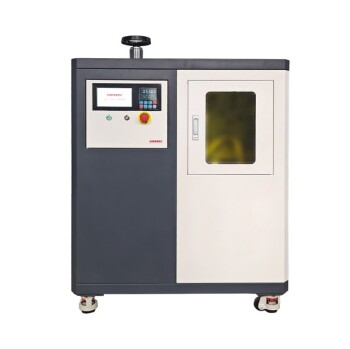
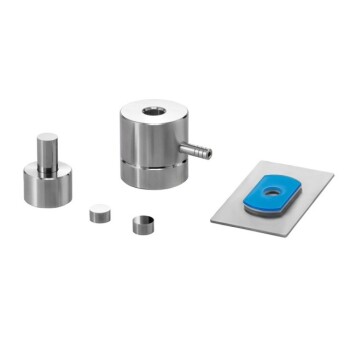
The primary advantage of using a hot press over a cold press for LiMOCl4 composite cathodes lies in the ability to simultaneously apply heat and pressure to leverage the material's physical properties. By utilizing the low softening point of LiMOCl4, hot pressing facilitates material deformation, ensuring a tight integration between the electrolyte and cathode particles that significantly lowers interfacial impedance.
Core Takeaway Cold pressing relies solely on mechanical force, often leaving microscopic voids that hinder performance. Hot pressing activates the deformability of LiMOCl4, creating a seamless, dense interface that maximizes conductivity while adhering to strict thermal limits to prevent degradation.
Mechanisms of Improved Performance
Leveraging Material Deformability
Standard cold pressing treats the cathode materials as rigid solids, often resulting in point-to-point contacts.
Hot pressing, however, exploits the relatively low softening point of LiMOCl4.
By applying heat, the material becomes pliable, allowing it to "flow" and conform around the cathode active material particles more effectively than mechanical pressure alone could achieve.
Reducing Interfacial Impedance
The greatest challenge in all-solid-state batteries is the resistance to ion flow at the boundaries between materials.
Because hot pressing creates a more intimate, continuous contact area, it drastically reduces this interfacial impedance.
This tighter integration mimics the benefits of isostatic pressing—eliminating pores and voids—but achieves it through thermal assistance specific to the material's chemistry.
Precision Process Control
Staying Within Thermal Limits
While heat is beneficial, LiMOCl4 is sensitive to excessive temperatures.
A hot press provides precise temperature control, allowing fabricators to heat the material enough to soften it without crossing the threshold into damage.
Preventing Chemical Decomposition
It is critical to maintain processing temperatures below the material's decomposition point, which is typically below 150°C.
Using a controlled hot press ensures the material remains chemically stable, preventing undesirable side reactions that would degrade the battery's lifespan and safety.
Understanding the Trade-offs
The Risk of Thermal Overrun
While hot pressing is superior for performance, it introduces the variable of thermal sensitivity.
If the temperature control fails or exceeds the decomposition limit (150°C) even briefly, the LiMOCl4 can degrade, rendering the cathode unusable.
Complexity vs. Simplicity
Cold pressing is a simpler, strictly mechanical process that carries less risk of chemical decomposition.
However, choosing cold pressing to avoid thermal risks results in a "trade-down" in performance, accepting higher internal resistance and lower energy density due to poorer particle contact.
Making the Right Choice for Your Goal
To maximize the potential of your LiMOCl4 composite cathodes, align your fabrication method with your specific performance targets.
- If your primary focus is maximizing conductivity: Prioritize hot pressing to exploit the material's softening point, ensuring the lowest possible interfacial impedance.
- If your primary focus is material stability: strict adherence to the <150°C temperature limit is required during the press cycle to avoid irreversible decomposition.
Ultimately, the thermal plasticity of LiMOCl4 makes hot pressing the definitive choice for high-performance fabrication, provided thermal limits are strictly respected.
Summary Table:
| Feature | Cold Pressing | Hot Pressing (LiMOCl4) |
|---|---|---|
| Mechanism | Mechanical force only | Combined heat and pressure |
| Material State | Rigid solid particles | Softened/Pliable state |
| Particle Contact | Point-to-point contacts | Seamless, dense interface |
| Interfacial Impedance | High due to microscopic voids | Significantly lowered |
| Risk Factor | Low (Mechanical only) | High (Requires <150°C control) |
| Conductivity | Sub-optimal | Maximized via material flow |
Revolutionize Your Solid-State Battery Research with KINTEK
To achieve the perfect balance of thermal stability and high conductivity for your LiMOCl4 composite cathodes, you need equipment engineered for precision. KINTEK specializes in advanced laboratory solutions, including high-performance hot presses, isostatic presses, and pellet presses designed to handle sensitive battery materials.
Whether you are refining cathode fabrication or exploring new electrolyte interfaces, our comprehensive range of crushing systems, milling tools, and high-temperature furnaces ensures your research remains at the cutting edge. Don't compromise on interfacial impedance—leverage our expertise to optimize your manufacturing process.
Ready to enhance your lab's performance? Contact our experts today to find the ideal pressing solution for your specific battery research needs!
Related Products
- Automatic Heated Hydraulic Press Machine with Heated Plates for Laboratory Hot Press 25T 30T 50T
- Manual High Temperature Heated Hydraulic Press Machine with Heated Plates for Lab
- Touchscreen Automatic Vacuum Heat Press
- 30T 40T Split Automatic Heated Hydraulic Press Machine with Heated Plates for Laboratory Hot Press
- Vacuum Hot Press Furnace Machine Heated Vacuum Press
People Also Ask
- Why is the heating function of a laboratory hydraulic press essential for MEA assembly in DEFC? Optimize Cell Bonding
- What technical conditions does a heated hydraulic press provide for PEO batteries? Optimize Solid-State Interfaces
- How is a heated hydraulic press used for Li-LLZO batteries? Optimize Interfacial Bonding with Thermal-Pressure
- What role does a heated hydraulic press play in Cold Sintering (CSP)? Enhancing LATP-Halide Densification
- What are heated hydraulic presses used for? Molding Composites, Vulcanizing Rubber, and More