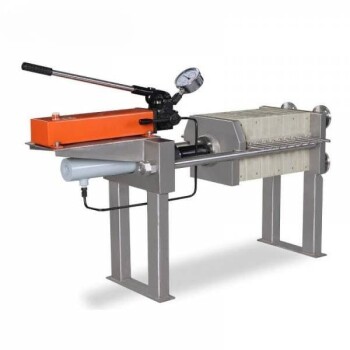
Precise pressure control in hydraulic presses offers the critical advantage of regulating exact loading rates and dwell times during the cold-press molding process. Unlike standard presses, this precision eliminates density gradients and stress concentrations, resulting in a mechanically superior LPSCl0.3F0.7 electrolyte pellet capable of suppressing lithium dendrite growth.
Core Takeaway: The transition from standard to precise pressure control is not just about applying force; it is about achieving structural uniformity. By ensuring a consistent density profile, you maximize the electrolyte's mechanical modulus, which is the primary defense against battery failure caused by dendrite penetration.
Enhancing Electrolyte Performance
The primary value of precision control lies in its ability to manipulate the microstructure of the green pellet.
Uniformity Through Loading Control
Standard presses often apply force unevenly or too rapidly, which can trap air or create uneven compaction. Precise control regulates the loading rate, ensuring the powder compresses uniformly throughout the mold rather than compacting rapidly at the surface while remaining loose in the center.
The Role of Dwell Times
Holding pressure for a specific, repeatable duration—known as the dwell time—allows the material to settle and bond. This relaxation phase is essential for reducing internal stress concentrations that could otherwise lead to cracking or structural weakness during battery operation.
The Critical Link to Battery Safety
For LPSCl0.3F0.7 electrolytes, the physical properties of the pellet are directly tied to the safety of the final battery cell.
Improving Mechanical Modulus
A pellet with uniform density inherently possesses a higher mechanical modulus (stiffness). A standard press that creates density gradients will leave "soft spots" in the electrolyte layer, significantly reducing its overall effective modulus.
Blocking Dendrite Growth
High mechanical modulus is the key factor in preventing lithium dendrites from puncturing the electrolyte. By using precise control to eliminate weak points, you create a robust physical barrier that effectively blocks dendrite propagation and prevents short circuits.
Operational and Process Efficiency
While the primary benefit is performance, utilizing hydraulic compression molding also offers distinct process advantages.
Reducing Material Waste
Precision reduces the likelihood of producing cracked, warped, or defective pellets. This minimizes the waste of expensive electrolyte materials, as fewer parts are rejected due to structural inconsistencies.
Speed and Scalability
Hydraulic compression molding remains a fast and efficient process. Even with added precision controls, it allows for high-throughput shaping of materials, contributing to lower labor costs compared to more manual or slower fabrication methods.
Understanding the Trade-offs
While precise pressure control is superior for performance, it introduces specific considerations that must be managed.
Complexity vs. Simplicity
Equipment capable of micro-adjusting pressure and loading rates is inherently more complex than standard "pump-and-press" hydraulic systems. This generally requires a higher initial capital investment and may demand more specialized operator training to program effective pressure curves.
Cycle Time Optimization
Achieving perfect uniformity through controlled loading rates and extended dwell times may slightly increase the cycle time per part. You are trading raw speed for higher fidelity and yield; however, in the context of solid-state batteries, this is usually a necessary exchange to ensure safety.
Making the Right Choice for Your Goal
To decide if the investment in precise pressure control is necessary for your specific application, consider the following:
- If your primary focus is Maximum Dendrite Suppression: You must use precise control to achieve the high mechanical modulus required to physically block lithium growth.
- If your primary focus is Process Yield: Precision control is recommended to eliminate density gradients that lead to parts cracking during ejection or handling.
- If your primary focus is Cost Efficiency: While initial equipment costs are higher, the reduction in material waste and labor associated with rejected parts often offsets the investment.
For LPSCl0.3F0.7 electrolytes, uniformity is not a luxury—it is the prerequisite for a safe, functioning battery.
Summary Table:
| Feature | Standard Hydraulic Press | Precise Pressure Control Press |
|---|---|---|
| Loading Rate | Often uneven or too rapid | Regulated and consistent |
| Density Profile | Prone to gradients/soft spots | Uniform throughout the pellet |
| Internal Stress | High (risk of cracking) | Minimized via dwell time control |
| Mechanical Modulus | Lower/Inconsistent | Maximized for dendrite defense |
| Material Waste | Higher due to rejects | Minimized through high yield |
| Key Outcome | Basic compaction | Structural uniformity & safety |
Elevate Your Solid-State Battery Research with KINTEK
Precision is the foundation of high-performance electrolyte development. At KINTEK, we specialize in advanced laboratory equipment designed to meet the rigorous demands of material science. Our comprehensive range of hydraulic presses, including pellet, hot, and isostatic systems, provides the micro-adjustable pressure curves and dwell-time precision necessary to eliminate density gradients and maximize mechanical modulus in LPSCl0.3F0.7 electrolytes.
From high-temperature furnaces and crushing systems to specialized high-pressure reactors and battery research consumables, KINTEK provides the end-to-end solutions you need to suppress dendrite growth and ensure battery safety.
Ready to optimize your cold-press molding process and reduce material waste? Contact us today to consult with our experts on the perfect pressing solution for your lab.
Related Products
- Automatic High Temperature Heated Hydraulic Press Machine with Heated Plates for Lab
- Heated Hydraulic Press Machine with Heated Plates for Vacuum Box Laboratory Hot Press
- Manual High Temperature Heated Hydraulic Press Machine with Heated Plates for Lab
- 24T 30T 60T Heated Hydraulic Press Machine with Heated Plates for Laboratory Hot Press
- Laboratory Hydraulic Press Split Electric Lab Pellet Press
People Also Ask
- Why is a heated hydraulic press used for warm pressing NASICON green tapes? Optimize Your Solid Electrolyte Density
- What is a heated hydraulic press used for? Essential Tool for Curing, Molding, and Laminating
- Why is a heated laboratory hydraulic press necessary for composite laminates? Achieve Void-Free Structural Integrity
- What is a hot hydraulic press? Harness Heat and Pressure for Advanced Manufacturing
- Why is the heating function of a laboratory hydraulic press essential for MEA assembly in DEFC? Optimize Cell Bonding