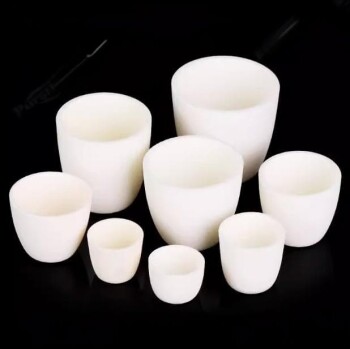
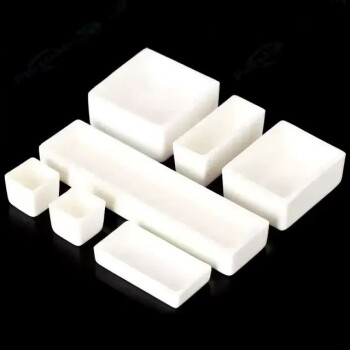
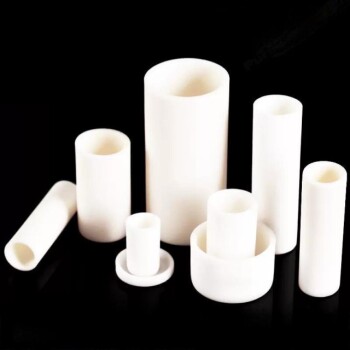
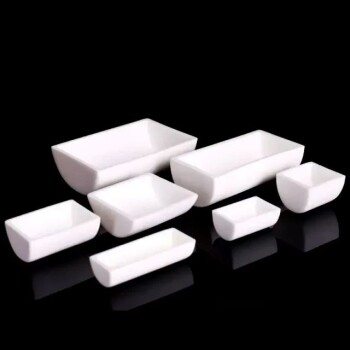
High-purity alumina crucibles provide essential protection for functional materials during extended sintering processes. Their primary advantages are exceptional high-temperature resistance and superior chemical inertness, which collectively prevent the containment vessel from contaminating or reacting with your sample in high-energy environments.
The core value of high-purity alumina lies in its ability to act as a strictly inert barrier. By preventing thermal diffusion and solid-phase reactions, it ensures the final material retains its intrinsic physical properties and crystalline structure without interference from external impurities.
The Critical Role of Chemical Inertness
Preventing Thermal Diffusion
During long-duration sintering, the environment inside the furnace becomes highly energetic. This heat promotes the migration of atoms, creating a risk that components from the crucible itself will migrate into your sample.
High-purity alumina effectively blocks this thermal diffusion. This isolation is vital for ensuring that the chemical composition of your functional material remains exactly as intended.
Avoiding Solid-Phase Reactions
Elevated temperatures often trigger unintended chemistry between the vessel and its contents. This is particularly problematic for reactive substances, such as high-voltage spinel cathode materials or lithium-based coatings.
Alumina’s inert nature prevents these high-temperature solid-phase reactions. By stopping the crucible from chemically interacting with the sample, you eliminate the introduction of foreign impurities that could degrade performance.
Preserving Material Integrity
Maintaining Intrinsic Properties
The presence of even trace impurities can alter the fundamental physics of a material. To measure properties accurately, the sample must remain pristine.
Using high-purity crucibles ensures that intrinsic physical properties and strain-induced effects are preserved. The data you gather reflects the material itself, not the influence of the container.
Protecting Crystalline Structure
Functional materials often rely on a precise crystal lattice to perform correctly. Contaminants from a degrading crucible can infiltrate and disrupt this structure.
Alumina crucibles maintain the crystalline structural integrity of modified materials. This is essential for applications where structural defects would lead to material failure.
Understanding the Risks of Compromise
The Impact of Impurities on Data
While standard crucibles may suffice for short, low-temperature runs, they become a liability during long-duration sintering. The longer the heat exposure, the higher the probability of diffusion.
Using lower-purity vessels introduces a variable that is difficult to control. If the crucible contributes impurities, you cannot distinguish between the material's actual behavior and artifacts caused by contamination.
Material Compatibility
Not all materials require high-purity alumina, but reactive materials demand it. If you are working with sensitive compounds like lithium, failing to use a chemically inert crucible will almost certainly result in a degraded product due to reaction at the interface.
Making the Right Choice for Your Goal
To ensure the success of your sintering process, align your crucible choice with your specific technical requirements:
- If your primary focus is Fundamental Research: Use high-purity alumina to isolate intrinsic physical properties and strain effects without the noise of contamination.
- If your primary focus is Battery Material Synthesis: This is critical for spinel cathodes or lithium coatings to prevent solid-phase reactions that ruin electrochemical performance.
High-purity alumina is not just a container; it is a critical process control variable for high-fidelity materials science.
Summary Table:
| Feature | Benefit for Functional Materials | Why It Matters for Sintering |
|---|---|---|
| Chemical Inertness | Prevents solid-phase reactions | Essential for reactive materials like lithium coatings |
| Thermal Diffusion Barrier | Blocks atom migration into samples | Maintains exact chemical composition during long runs |
| High Purity (Al2O3) | Minimizes foreign impurities | Preserves intrinsic physical properties and crystal structure |
| Temperature Resistance | Maintains structural stability | Ensures the vessel does not fail or deform under extreme heat |
Elevate Your Material Research with KINTEK Precision
At KINTEK, we understand that high-fidelity results depend on the quality of your consumables. Our high-purity alumina crucibles and ceramics are engineered to provide the ultimate inert environment for your most sensitive sintering processes, from battery research tools to high-temperature furnaces.
Whether you are synthesizing spinel cathodes or exploring fundamental materials science, our comprehensive range of laboratory equipment—including vacuum furnaces, crushing systems, and specialized crucibles—is designed to help you maintain strict process control and sample integrity.
Ready to eliminate contamination risks? Contact KINTEK today to find the perfect high-temperature solutions for your laboratory needs!
References
- Hasmik Kirakosyan, Sofiya Aydinyan. The preparation of high-entropy refractory alloys by aluminothermic reduction process. DOI: 10.1063/5.0189206
This article is also based on technical information from Kintek Solution Knowledge Base .
Related Products
- Arc-Shaped Alumina Ceramic Crucible High Temperature Resistant for Engineering Advanced Fine Ceramics
- Engineering Advanced Fine Alumina Al2O3 Ceramic Crucible for Laboratory Muffle Furnace
- Engineering Advanced Fine Ceramics Alumina Al2O3 Crucible With Lid Cylindrical Laboratory Crucible
- Engineering Advanced Fine Ceramics Alumina Crucibles (Al2O3) for Thermal Analysis TGA DTA
- Alumina Al2O3 Ceramic Crucible Semicircle Boat with Lid for Engineering Advanced Fine Ceramics
People Also Ask
- Why Use Alumina Crucibles & Powder Burial for NaSICON? Ensure Phase Purity and Prevent Elemental Volatilization
- What is the primary purpose of using alumina crucibles for LLTO ceramics? Optimize Your High-Temperature Sintering
- Why are alumina crucibles and mother powder essential for LATP sintering? Optimize Your Solid Electrolyte Performance
- Why are high-purity alumina crucibles used for liquid lead corrosion experiments? Ensure Data Accuracy at 550°C
- Primary considerations for choosing alumina crucibles and quartz tubes in indium intercalation: Ensure Material Purity