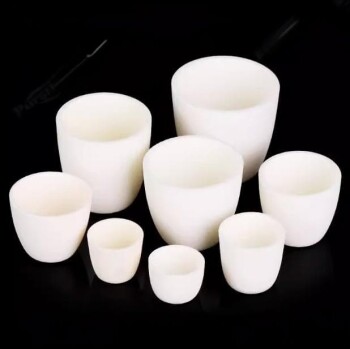
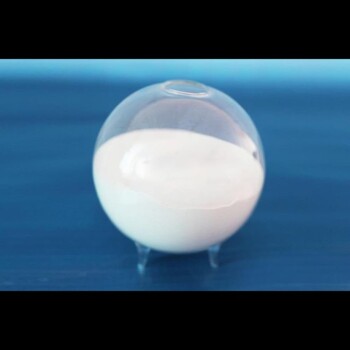
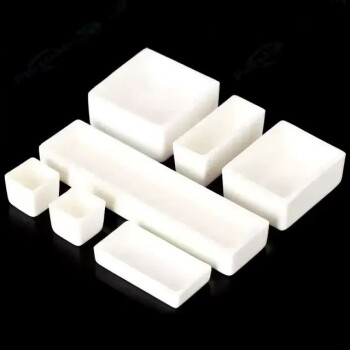
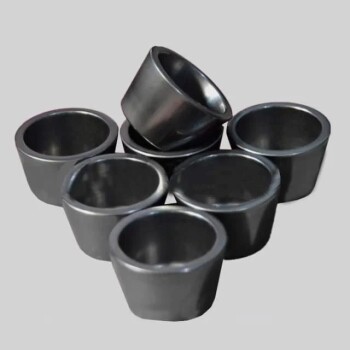
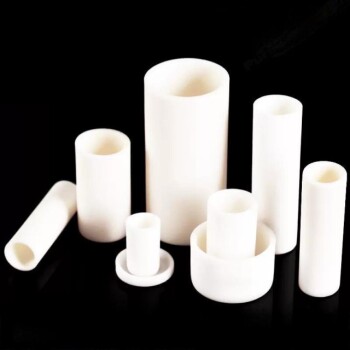
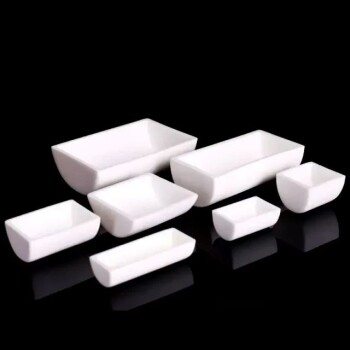
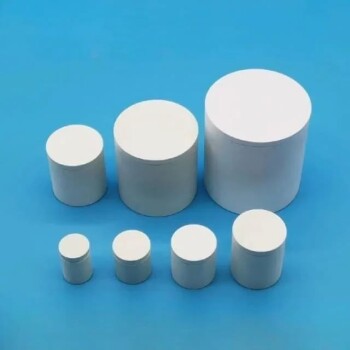
High-purity alumina crucibles provide the critical chemical inertness required for annealing sensitive battery materials. When processing LLZTO-coated cathodes, specifically in oxygen atmospheres between 300°C and 500°C, these vessels effectively contain highly reactive elements like Lithium (Li) and Lanthanum (La). By resisting interaction with these precursors, the crucible prevents cross-contamination and ensures the final material retains the exact chemical composition intended.
The core value of high-purity alumina is its ability to act as a neutral barrier during heat treatment. It prevents high-temperature solid-phase reactions that would otherwise introduce impurities, thereby preserving the crystalline structural integrity of the modified cathode.
Preserving Material Purity
The primary challenge in annealing LLZTO-coated materials is the high reactivity of the components involved. High-purity alumina addresses this by offering superior resistance to chemical attack.
Resisting Reactive Elements
LLZTO coatings contain Lithium and Lanthanum, both of which are highly reactive elements.
Standard containment vessels often degrade or react when in contact with these elements under heat. High-purity alumina remains inert, ensuring no chemical reaction occurs between the vessel walls and the cathode precursors.
Eliminating External Impurities
Any reaction between the crucible and the powder introduces foreign impurities into the cathode material.
By preventing these reactions, high-purity alumina ensures that the final product is free of external contamination. This is vital for maintaining the strict purity standards required for high-performance battery applications.
Thermal Stability in Oxidizing Atmospheres
The annealing process requires sustained heating in an oxygen-rich environment. The crucible must maintain its structural and chemical stability throughout this thermal cycle.
Performance in the Annealing Window
The specific annealing process for LLZTO-coated cathodes typically occurs between 300°C and 500°C.
High-purity alumina demonstrates excellent thermal stability within this specific temperature range. It withstands the oxidizing atmosphere without degrading or releasing particulate matter into the sample.
Preventing Solid-Phase Reactions
At elevated temperatures, materials are more prone to solid-phase reactions, where the vessel material migrates into the sample.
Alumina’s superior thermal resistance creates a stable boundary. This prevents the crucible material from engaging in these phase reactions with high-voltage spinel cathodes or the lithium-based coating.
Common Pitfalls to Avoid
While high-purity alumina is the superior choice, failing to adhere to specific process parameters can still lead to issues.
The Necessity of "High Purity"
Not all alumina is created equal. Using standard-grade alumina with lower purity levels can reintroduce the very risks you are trying to avoid.
Lower-grade vessels may contain binders or impurities that can leach out at 300°C–500°C, compromising the LLZTO coating despite the base material being alumina.
Temperature Limitations
While stable at the prescribed annealing temperatures (300°C–500°C), thermal stability is not infinite.
Operators must ensure the furnace temperature does not inadvertently exceed the rated limits of the specific crucible grade being used, although alumina generally handles much higher temperatures than this specific annealing process requires.
Making the Right Choice for Your Goal
Selecting the correct containment vessel is a decision that directly impacts the electrochemical performance of your final battery cell.
- If your primary focus is Chemical Composition: Prioritize high-purity alumina to prevent Lithium and Lanthanum loss or contamination during the heating phase.
- If your primary focus is Structural Integrity: Use these crucibles to ensure no solid-phase reactions alter the crystalline structure of the cathode material.
By isolating your reactive precursors from the containment vessel, you guarantee that the only chemistry happening in your furnace is the chemistry you intended.
Summary Table:
| Feature | High-Purity Alumina Benefit |
|---|---|
| Chemical Inertness | Resists reactive Lithium (Li) and Lanthanum (La) elements |
| Thermal Stability | Maintains integrity in oxygen-rich environments (300°C–500°C) |
| Purity Control | Eliminates external impurities and solid-phase migration |
| Material Integrity | Preserves crystalline structural integrity of the cathode |
| Application | Ideal for high-voltage spinel cathodes and LLZTO coatings |
Elevate Your Battery Research with KINTEK Precision
Precise chemical composition is the foundation of high-performance battery technology. At KINTEK, we understand that even minor impurities can compromise your LLZTO-coated cathode materials. Our premium high-purity alumina crucibles and ceramics provide the neutral barrier necessary to prevent unwanted reactions during critical annealing processes.
Beyond specialized containment, KINTEK offers a comprehensive suite of laboratory solutions tailored for advanced material science, including:
- Thermal Processing: High-temperature muffle, tube, and vacuum furnaces.
- Sample Preparation: Crushing, milling, and hydraulic pellet presses.
- Advanced Synthesis: CVD/PECVD systems and high-pressure reactors.
- Battery Analysis: Dedicated research tools, electrolytic cells, and consumables.
Ensure the integrity of your electrochemical research—contact KINTEK today for expert guidance and high-quality lab equipment.
Related Products
- Arc-Shaped Alumina Ceramic Crucible High Temperature Resistant for Engineering Advanced Fine Ceramics
- High Purity Alumina Granulated Powder for Engineering Advanced Fine Ceramics
- High Purity Pure Graphite Crucible for Evaporation
- Engineering Advanced Fine Alumina Al2O3 Ceramic Crucible for Laboratory Muffle Furnace
- High Purity Pure Graphite Crucible for Electron Beam Evaporation
People Also Ask
- Why Use Alumina Crucibles & Powder Burial for NaSICON? Ensure Phase Purity and Prevent Elemental Volatilization
- What is the primary purpose of using alumina crucibles for LLTO ceramics? Optimize Your High-Temperature Sintering
- Why are alumina crucibles and mother powder essential for LATP sintering? Optimize Your Solid Electrolyte Performance
- Why are high-purity alumina crucibles used for liquid lead corrosion experiments? Ensure Data Accuracy at 550°C
- Primary considerations for choosing alumina crucibles and quartz tubes in indium intercalation: Ensure Material Purity