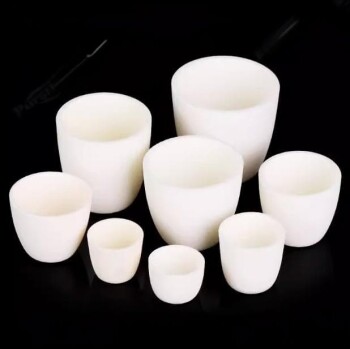
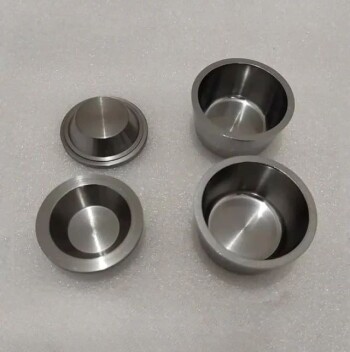
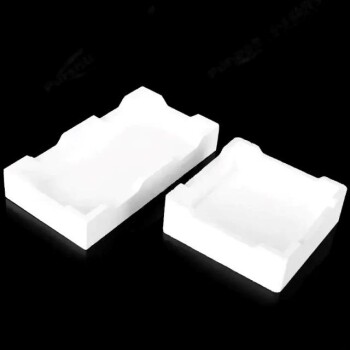
The primary function of a high-purity alumina crucible in the pack cementation process is to act as a chemically inert, thermally stable containment vessel. It holds the reactive "pack" mixture—typically comprising aluminum powder, alumina filler, and a sodium fluoride (NaF) activator—and withstands prolonged heating cycles between 1023K and 1223K without contaminating the reaction.
In pack cementation, the integrity of the coating depends on a pure reaction environment. The high-purity alumina crucible provides the necessary isolation, ensuring the vessel itself does not become a variable in the chemical equation.
Establishing a Stable Reaction Environment
Unwavering Thermal Resistance
The aluminizing process requires sustained high temperatures, specifically falling within the range of 1023K to 1223K.
The crucible must maintain its structural integrity throughout this thermal cycle. High-purity alumina is selected because it remains rigid and stable at these temperatures, ensuring the containment of the pack mixture does not fail during the process.
Chemical Inertness
The pack mixture contains reactive agents, such as sodium fluoride (NaF) and aluminum, which are designed to generate volatile halide gases.
A standard ceramic vessel might react with these aggressive chemicals, leading to vessel degradation. High-purity alumina possesses high chemical stability, ensuring it remains neutral and does not react with the aluminizing filler, even under prolonged exposure to heat.
Protecting the Diffusion Layer
Preventing Impurity Contamination
The goal of pack cementation is to create a specific diffusion layer on the target component.
If the crucible material were to degrade or release particles, it would introduce foreign elements into the pack. By using high-purity alumina, you ensure that the only elements participating in the diffusion process are those intentionally placed in the mixture, thereby maintaining the purity of the final coating.
Containment of the Pack Matrix
The crucible physically holds the three critical components of the pack: the source material (aluminum), the activator (NaF), and the inert filler.
It keeps these powders in close contact with the substrate while allowing the necessary internal reactions to occur. The crucible essentially acts as the "furnace within a furnace," defining the boundaries of the local reaction zone.
Distinguishing the Crucible from the Filler
The Vessel vs. The Matrix
It is important to distinguish between the alumina crucible and the alumina powder often used inside the crucible.
While the crucible acts as the external container, the high-purity alumina powder serves as an inert filler within the mix. This internal powder prevents the metallic aluminum from sintering (clumping) and maintains porosity so halide gases can circulate.
Shared Material Properties
Both the vessel and the filler utilize alumina for the same reason: its refusal to participate in the reaction.
Whether in solid form (crucible) or powder form (filler), the material is chosen for its ability to withstand reducing environments and high vacuum conditions without altering the chemistry of the coating.
Operational Considerations and Limitations
Thermal Shock Sensitivity
While alumina handles steady high heat exceptionally well, it can be brittle.
Operators must be cautious of rapid temperature changes. Drastic heating or cooling rates can cause the crucible to crack due to thermal shock, potentially spilling the pack mixture or ruining the batch.
The Cost of Purity
High-purity alumina products are generally more expensive than lower-grade refractories.
However, in processes like aluminizing where surface chemistry is critical, this cost is a necessary trade-off. Using lower-purity vessels introduces a high risk of cross-contamination that can compromise the mechanical properties of the treated part.
Ensuring Process Integrity
To maximize the effectiveness of your aluminizing process, consider the following regarding your choice of crucible:
- If your primary focus is coating purity: Prioritize crucibles with the highest available alumina content to eliminate any risk of silica or iron contamination from the vessel walls.
- If your primary focus is process consistency: Inspect crucibles strictly for micro-cracks before every run, as the halide gases generated can escape through fractures, leading to uneven coating deposition.
By selecting high-purity alumina, you convert the variable of "containment" into a constant, allowing you to focus entirely on the chemistry of the coating.
Summary Table:
| Feature | Benefit in Pack Cementation |
|---|---|
| High Alumina Purity | Prevents contamination from silica or iron, ensuring coating integrity. |
| Thermal Stability | Withstands prolonged heating (1023K–1223K) without structural failure. |
| Chemical Inertness | Resists aggressive reaction with NaF activators and volatile halide gases. |
| Physical Containment | Maintains the precise density and proximity of the pack matrix around the substrate. |
| Reduced Sintering | Works in tandem with alumina filler to prevent metallic powder clumping. |
Elevate Your Material Research with KINTEK Precision
Maximize the integrity of your diffusion coatings with KINTEK’s high-purity alumina crucibles. Specifically engineered for rigorous pack cementation and aluminizing processes, our crucibles ensure a contamination-free environment for your most critical thermal treatments.
Why Choose KINTEK?
- Comprehensive Laboratory Solutions: From high-temperature muffle and vacuum furnaces to advanced crushing, milling, and sieving equipment.
- Specialized Material Tools: We offer a full range of high-performance ceramics, crucibles, and PTFE products designed for chemical stability.
- Total Lab Support: Our portfolio includes everything from high-pressure reactors and electrolytic cells to cooling solutions and hydraulic presses.
Don't let vessel impurities compromise your results. Contact KINTEK today to find the perfect high-temperature solution for your lab!
References
- Liu Zhu, Yucheng Wu. Design and properties of FeAl/Al2O3/TiO2 composite tritium-resistant coating prepared through pack cementation and sol–gel method. DOI: 10.1016/j.mtcomm.2020.101848
This article is also based on technical information from Kintek Solution Knowledge Base .
Related Products
- Arc-Shaped Alumina Ceramic Crucible High Temperature Resistant for Engineering Advanced Fine Ceramics
- Engineering Advanced Fine Alumina Al2O3 Ceramic Crucible for Laboratory Muffle Furnace
- Engineering Advanced Fine Ceramics Alumina Al2O3 Crucible With Lid Cylindrical Laboratory Crucible
- High Purity Pure Graphite Crucible for Evaporation
- High Purity Alumina Granulated Powder for Engineering Advanced Fine Ceramics
People Also Ask
- Why Use Alumina Crucibles & Powder Burial for NaSICON? Ensure Phase Purity and Prevent Elemental Volatilization
- What is the primary purpose of using alumina crucibles for LLTO ceramics? Optimize Your High-Temperature Sintering
- Why are alumina crucibles and mother powder essential for LATP sintering? Optimize Your Solid Electrolyte Performance
- Why are high-purity alumina crucibles used for liquid lead corrosion experiments? Ensure Data Accuracy at 550°C
- Primary considerations for choosing alumina crucibles and quartz tubes in indium intercalation: Ensure Material Purity