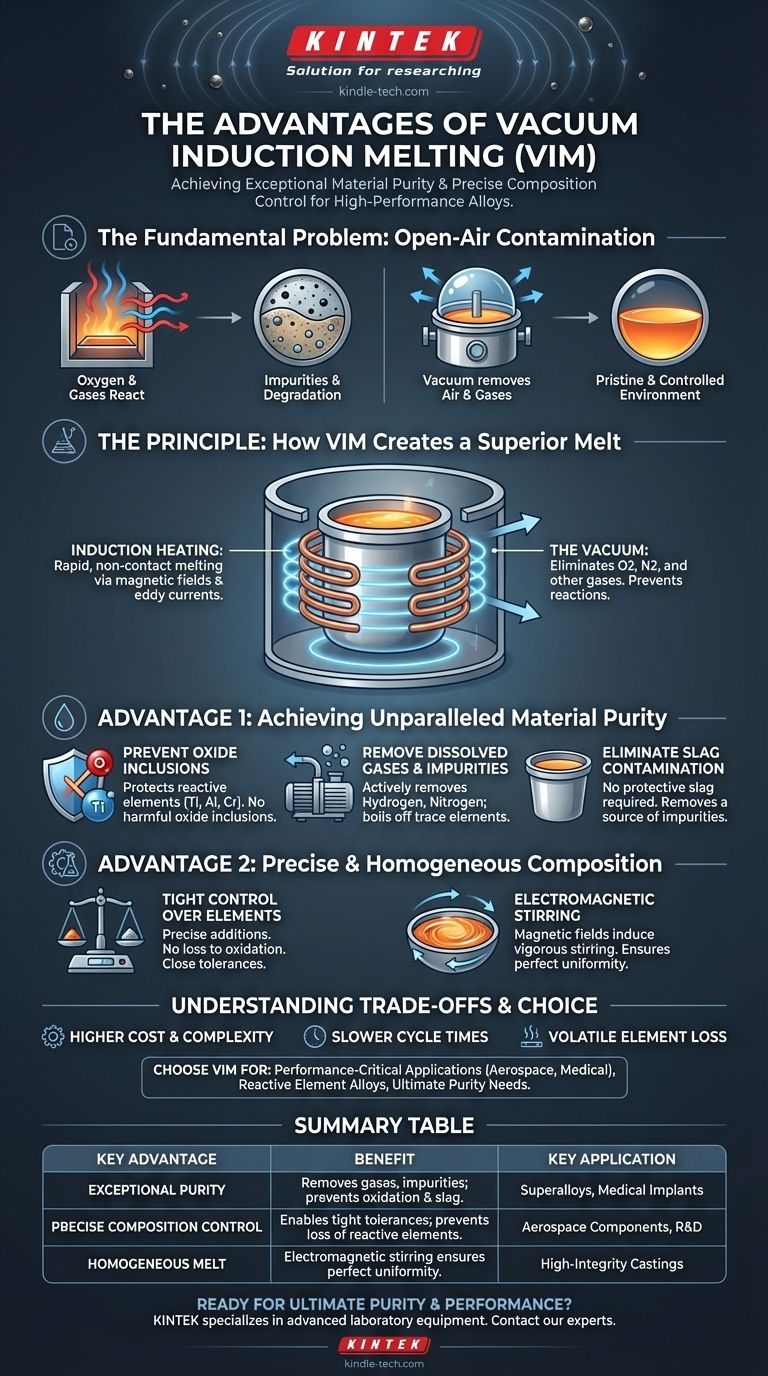
At its core, vacuum induction melting (VIM) offers two primary advantages: achieving exceptional material purity and enabling precise control over alloy composition. By melting metals inside a vacuum, the process eliminates contamination from atmospheric gases, removes dissolved impurities, and uses electromagnetic forces to ensure the final product is both chemically clean and perfectly uniform.
The fundamental problem with melting metal in open air is contamination—oxygen and other gases react with the melt, creating impurities that degrade performance. Vacuum induction melting solves this by creating a pristine, controlled environment, making it the definitive process for producing high-performance alloys where purity and consistency are non-negotiable.
The Principle: How VIM Creates a Superior Melt
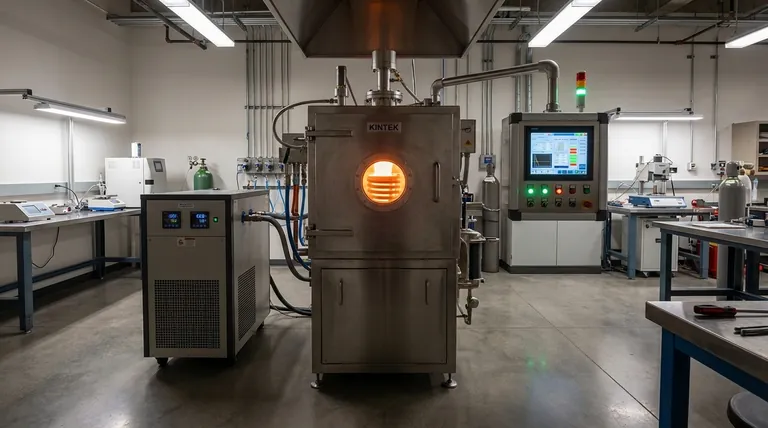
Vacuum induction melting is a sophisticated process that combines two key technologies: induction heating and a high-vacuum environment. Understanding how they work together reveals why the resulting metal is superior.
The Role of Induction Heating
An alternating electric current is passed through a copper coil, which generates a powerful, fluctuating magnetic field around the metal charge held within a crucible.
This magnetic field induces strong electrical eddy currents within the metal itself. The metal's natural electrical resistance causes it to heat up rapidly and melt, all without any direct contact from a heat source.
The Power of the Vacuum
Performing this process in a vacuum is the critical advantage. By removing the air, the system eliminates oxygen, nitrogen, and other gases that would otherwise react with the hot, liquid metal.
This prevents the formation of undesirable compounds and ensures the integrity of the final alloy. For some processes, the chamber can be backfilled with a pure, inert gas like argon to provide a controlled, non-reactive atmosphere.
Advantage 1: Achieving Unparalleled Material Purity
The primary driver for using VIM is to produce the cleanest possible metal. This is not just about looks; it is about eliminating microscopic flaws that can lead to catastrophic material failure in demanding applications.
Preventing Oxide Inclusions
Many high-performance alloys rely on reactive elements like titanium, aluminum, and chromium. When melted in air, these valuable elements rapidly oxidize and are lost, forming harmful oxide inclusions that weaken the material.
VIM's oxygen-free environment completely prevents this reaction, ensuring these elements remain in the alloy to deliver their intended properties.
Removing Dissolved Gases and Impurities
The vacuum actively pulls unwanted dissolved gases, such as hydrogen and nitrogen, out of the liquid metal. These gases can cause porosity and embrittlement in the final product.
Furthermore, the process can boil off and remove undesired trace elements that have high vapor pressures, further refining the metal beyond what is possible in an atmospheric melt.
Eliminating Slag Contamination
Traditional furnaces often require a layer of slag to protect the melt from the air. This slag can itself become a source of contamination.
VIM completely eliminates the need for a protective slag cover, removing another potential source of impurities and simplifying the process.
Advantage 2: Precise and Homogeneous Composition
For advanced alloys, getting the chemical recipe exactly right is critical. VIM provides an unmatched level of control over the final composition and its consistency.
Tight Control Over Alloying Elements
Because the vacuum prevents the loss of elements to oxidation, metallurgists can make precise additions to the melt with confidence. This allows for extremely close compositional tolerances, ensuring the alloy meets exacting specifications every time.
The Benefit of Electromagnetic Stirring
A unique side effect of induction heating is that the magnetic fields generate a natural, vigorous stirring action within the liquid metal.
This electromagnetic stirring ensures all alloying elements are distributed perfectly evenly throughout the melt. The result is a completely homogeneous material, free from variations that could create weak points.
Understanding the Trade-offs
While powerful, VIM is not the universal solution for all metal melting. Its precision and purity come with specific considerations.
Higher Cost and Complexity
Vacuum furnaces are significantly more complex and expensive to build, operate, and maintain than standard air-melt furnaces. The process requires specialized knowledge to manage the vacuum systems and controls.
Slower Cycle Times for Some Operations
The need to pump down the chamber to a high vacuum before each melt can increase the total cycle time compared to continuous atmospheric melting. However, modern semi-continuous VIM systems help mitigate this for higher throughput.
Unsuitability for Retaining Volatile Elements
The same mechanism that removes undesirable trace elements can also remove desirable alloying elements if they have a high vapor pressure. The process must be carefully controlled to prevent the loss of key ingredients like manganese or zinc if they are part of the target specification.
Making the Right Choice for Your Goal
Selecting a melting process depends entirely on the required performance and cost constraints of your final product.
- If your primary focus is performance-critical applications: Choose VIM for superalloys, medical implants, or aerospace components where ultimate purity and reliability are essential.
- If your primary focus is producing alloys with reactive elements: VIM is the only viable choice to prevent the loss of elements like titanium and aluminum to oxidation.
- If your primary focus is high-volume, standard-grade metals: A conventional air-melt furnace is often more cost-effective when the extreme purity and compositional control of VIM are not required.
Ultimately, investing in vacuum induction melting is a decision to prioritize material integrity above all else.
Summary Table:
| Key Advantage | Benefit | Key Application |
|---|---|---|
| Exceptional Purity | Removes gases & impurities; prevents oxidation and slag contamination. | Superalloys, Medical Implants |
| Precise Composition Control | Enables tight alloying tolerances; prevents loss of reactive elements. | Aerospace Components, R&D |
| Homogeneous Melt | Electromagnetic stirring ensures perfect uniformity. | High-Integrity Castings |
Ready to achieve ultimate material purity and performance?
For demanding applications in aerospace, medical, or advanced research, the integrity of your materials is paramount. KINTEK specializes in advanced laboratory equipment, including solutions for high-purity melting processes. Our expertise can help you select the right technology to meet your stringent quality and performance goals.
Contact our experts today to discuss how we can support your critical material production needs.
Visual Guide
Related Products
- Lab-Scale Vacuum Induction Melting Furnace
- Vacuum Induction Melting Spinning System Arc Melting Furnace
- Non Consumable Vacuum Arc Induction Melting Furnace
- Vacuum Heat Treat Furnace and Levitation Induction Melting Furnace
- Vacuum Arc Induction Melting Furnace
People Also Ask
- How do vacuum induction or arc melting furnaces facilitate the synthesis of U-Al-C MAX phases? Precision Heat & Purity
- What is the function of a vacuum induction melting furnace? Essential Guide for High-Purity FeCrAl Alloy Production
- What are the key components inside the vacuum chamber of a vacuum induction melting furnace? A Guide to the Core Melting Assembly
- What core role does a Vacuum Induction Melting furnace play in nickel-free steel production? Achieve High-Purity Alloys
- How do specialized industrial-grade small melting furnaces address challenges in precision jewelry casting? Expert Guide