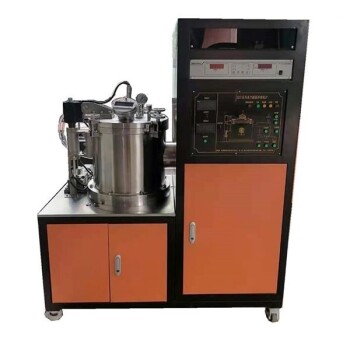
The vacuum system serves a dual purpose: it eliminates oxygen to prevent chemical degradation and actively removes trapped gases to ensure physical density. By maintaining a low oxygen partial pressure, the system protects the copper matrix and carbon reinforcements from oxidation while extracting interstitial gases that would otherwise create structural defects.
The success of sintering Cu/Ti3SiC2/C/MWCNTs composites relies on maintaining a pristine processing environment. The vacuum system is not merely a passive container; it is an active processing tool that safeguards the material's conductivity and strength by preventing the formation of insulating oxides and internal voids.
Preventing Material Degradation
The primary function of the vacuum system is to control the chemical environment within the furnace, specifically addressing the sensitivities of the composite materials.
Protecting the Copper Matrix
Copper is highly susceptible to oxidation at the elevated temperatures required for sintering (often around 950°C).
Without a vacuum, oxygen reacts with the metal to form copper oxides. These oxides disrupt the continuity of the matrix, significantly reducing electrical conductivity and weakening the final mechanical structure.
Preserving Carbon Reinforcements
The composite relies on carbon phases, such as graphite and Multi-Walled Carbon Nanotubes (MWCNTs), for reinforcement.
In the presence of oxygen, these carbon materials are prone to ablation—essentially burning away. The vacuum environment shields these reinforcements, ensuring they remain intact to provide the intended mechanical strengthening and electrical pathways.
Optimizing Physical Density
Beyond chemical protection, the vacuum system plays a mechanical role by managing the gases inherent in the powder metallurgy process.
Desorbing Surface Impurities
Powder particles, particularly those with high specific surface areas like MWCNTs, naturally adsorb water vapor and oxygen.
The vacuum system is critical for reducing the pressure to pull these adsorbed gases off the particle surfaces. This desorption process is especially vital to clear the "interstices" (spaces between particles) before the material begins to fuse.
Eliminating Micro-Porosity
If trapped gases are not evacuated, they become enclosed within the material as the metal densifies.
This results in "closed pores" or micro-porosity within the sintered body. By removing these gases, the vacuum system enables higher relative density (potentially reaching >93%), which directly correlates to superior mechanical properties and thermal stability.
Critical Operational Considerations
While the vacuum is essential, its effectiveness depends on how it is applied during specific stages of the thermal cycle.
The Importance of Low-Temperature Degassing
A critical function often overlooked is the application of vacuum during the low-temperature phase, typically below 400°C.
It is during this stage that the bulk of adsorbed water vapor and oxygen must be discharged. If the vacuum does not effectively remove these volatiles before high-temperature densification begins, the reduction reactions may be inhibited, and pores will be permanently locked into the structure.
Making the Right Choice for Your Goal
When configuring your sintering process for these composites, consider the specific outcomes you need to prioritize.
- If your primary focus is Electrical Conductivity: Ensure the vacuum level is sufficient to prevent any copper oxidation, as even minor oxide layers act as insulators.
- If your primary focus is Mechanical Strength: Prioritize the "degassing" phase at lower temperatures to maximize density and eliminate the micro-pores that act as fracture initiation points.
The vacuum system is the deciding factor between a porous, brittle ceramic-metal mix and a high-performance, conductive composite.
Summary Table:
| Function | Primary Mechanism | Impact on Composite Quality |
|---|---|---|
| Oxidation Prevention | Removes oxygen & low partial pressure | Preserves copper conductivity & carbon reinforcements |
| Gas Desorption | Pulls adsorbed H2O & O2 from surfaces | Clears particle interstices for better fusion |
| Densification | Eliminates trapped gas pockets | Reduces micro-porosity and increases relative density |
| Degassing | Low-temp (<400°C) volatile discharge | Prevents internal voids and improves thermal stability |
Elevate Your Material Research with KINTEK Precision
Achieving the perfect density and conductivity in Cu/Ti3SiC2/C/MWCNTs composites requires more than just heat—it requires a controlled environment. KINTEK specializes in advanced laboratory equipment designed for the most demanding powder metallurgy applications.
Our comprehensive range of high-temperature vacuum and atmosphere furnaces provides the precise pressure control and thermal uniformity needed to prevent material degradation and eliminate micro-porosity. Whether you are developing next-generation conductors or high-strength composites, KINTEK offers the tools you need:
- Advanced Sintering Solutions: Vacuum, tube, and rotary furnaces tailored for composite processing.
- Material Preparation: High-performance crushing, milling, and hydraulic pellet presses.
- Specialized Labware: High-purity ceramics, crucibles, and PTFE products to maintain sample integrity.
Don't let oxidation or porosity compromise your results. Partner with KINTEK for reliable, high-performance equipment and expert support.
Contact us today to optimize your sintering process!
Related Products
- Vacuum Heat Treat and Molybdenum Wire Sintering Furnace for Vacuum Sintering
- Vacuum Heat Treat and Pressure Sintering Furnace for High Temperature Applications
- Vacuum Heat Treat and Sintering Furnace with 9MPa Air Pressure
- 2200 ℃ Tungsten Vacuum Heat Treat and Sintering Furnace
- Small Vacuum Heat Treat and Tungsten Wire Sintering Furnace
People Also Ask
- What is the pressure for vacuum sintering? Achieve Optimal Material Purity and Density
- What is vacuum hardness? Unlock Superior Material Performance with Vacuum Processing
- What critical process conditions does a vacuum sintering furnace provide for titanium? Expert Diffusion Bonding Guide
- How does a vacuum environment benefit the purification of matrix powders? Optimize Diamond Tool Sintering Efficiency
- What are the advantages of vacuum sintering? Achieve Superior Purity, Strength, and Performance