Knowledge Vacuum Furnace What are the different types of furnace used in heat treatment? Find the Perfect Match for Your Process
Author avatar

Tech Team · Kintek Solution

Updated 2 months ago

What are the different types of furnace used in heat treatment? Find the Perfect Match for Your Process


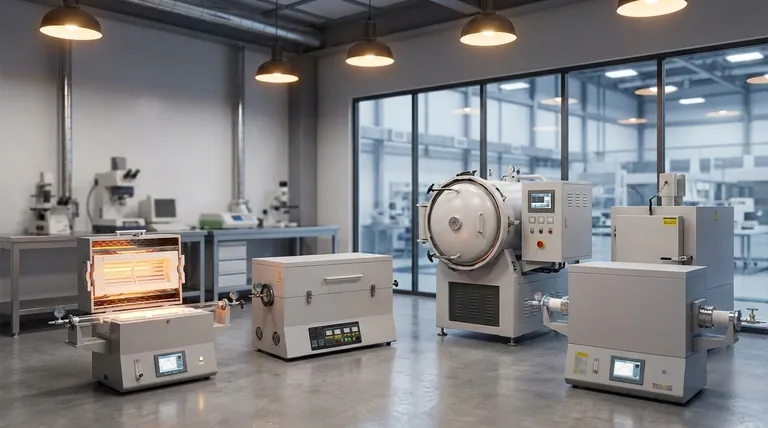
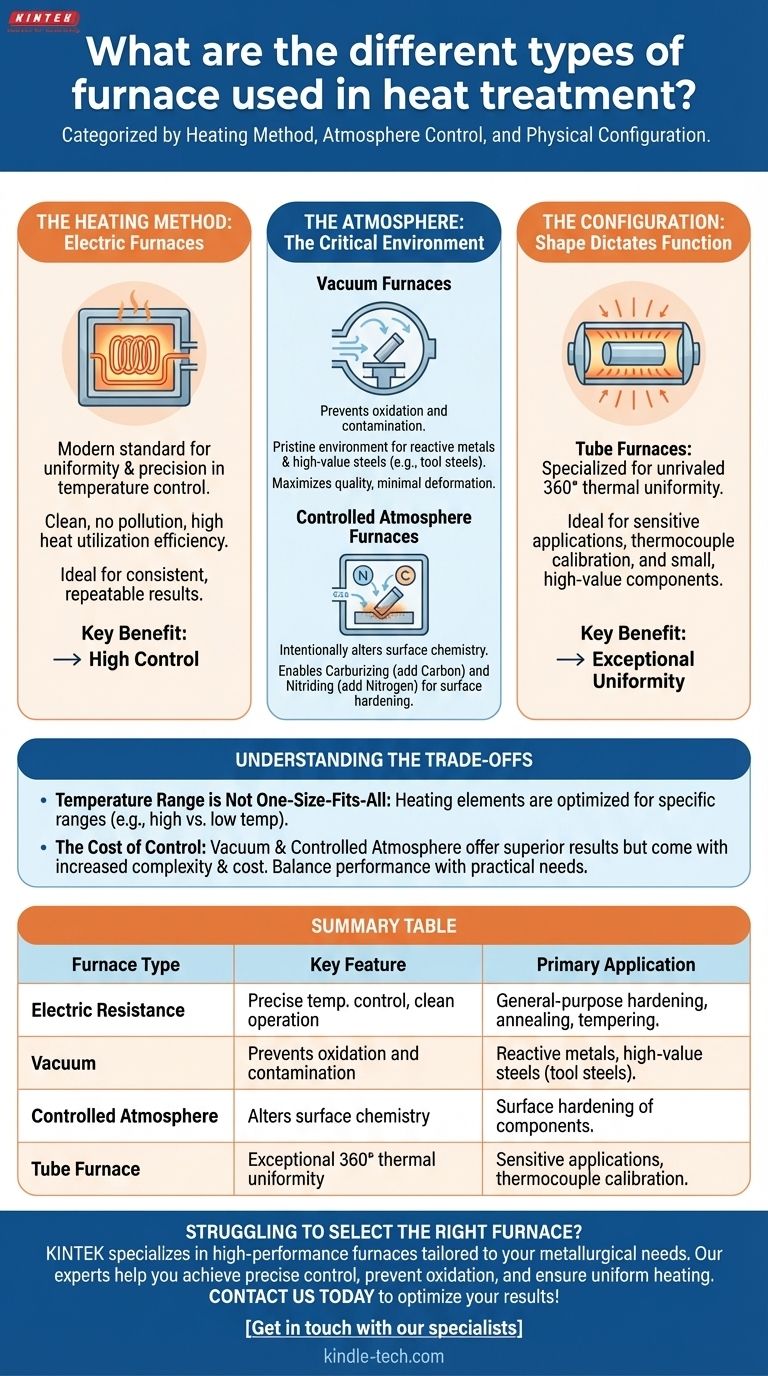
In heat treatment, furnaces are primarily categorized by their heating method, atmosphere control, and physical configuration. The most common types include versatile electric resistance furnaces, highly controlled vacuum furnaces for preventing oxidation, and specialized designs like tube furnaces that offer exceptional thermal uniformity for sensitive applications.

The selection of a heat treatment furnace is not about finding a single "best type," but about matching the furnace's capabilities—specifically its temperature precision and atmospheric environment—to the exact metallurgical requirements of the material and the desired outcome of the process.
What are the different types of furnace used in heat treatment? Find the Perfect Match for Your Process

The Core Elements of Furnace Design

Understanding the fundamental components that differentiate furnaces is key to selecting the right tool. The design is driven by the specific treatment required for a given material stock and temperature.

The Heating Method: Electric Furnaces

Most modern heat treatment furnaces are electrically powered due to their significant advantages over fuel-fired alternatives.

Electric furnaces provide outstanding uniformity and precision in temperature control. This high degree of control ensures consistent, repeatable results across the entire workpiece.

They also offer high heat utilization efficiency, a clean working environment with no pollution, and the ability to reach very high temperatures using specialized heating elements.

The Atmosphere: The Critical Environment

The atmosphere inside the furnace has a profound impact on the material's surface. The choice between an inert or active atmosphere depends on the material and the process goals.

Vacuum Furnaces A vacuum furnace is used when the primary goal is to prevent any surface reaction, such as oxidation or contamination.

By removing the atmosphere, these furnaces create a pristine environment ideal for treating reactive metals and high-value steels, including tool steels and martensitic stainless steels. This maximizes quality with minimal deformation.

Controlled Atmosphere Furnaces In other cases, the goal is to use the atmosphere to intentionally alter the material's surface. An active, or controlled, atmosphere is used for this purpose.

These atmospheres can prevent undesirable reactions like decarburization (carbon loss) or introduce new elements. Common applications include carburizing (adding carbon) and nitriding (adding nitrogen) to harden the surface of a part.

The Configuration: Shape Dictates Function

The physical design of the furnace is tailored to the type of part being treated and the specific thermal process.

Tube Furnaces A tube furnace is a prime example of a specialized configuration. Its cylindrical design provides unrivaled thermal uniformity around the entire 360° axis of a part.

This makes it ideal for sensitive applications requiring precise and even heating, such as the calibration of thermocouples or the processing of small, high-value components.

Understanding the Trade-offs in Selection

Choosing a furnace involves balancing performance requirements with practical limitations. A furnace optimized for one task may be inefficient or unsuitable for another.

Temperature Range is Not One-Size-Fits-All

A furnace designed for very high temperatures (e.g., 1300°C) may not provide the necessary control or efficiency for a low-temperature process (e.g., 300°C).

The heating elements—such as resistance wires, silicon carbide rods, or molybdenum bands—are optimized for specific temperature ranges. Using a furnace far outside its ideal operating window can lead to poor results and inefficiency.

The Cost of Control

While vacuum and controlled atmosphere furnaces offer superior metallurgical results for sensitive materials, they come with increased complexity and cost.

For processes where minor surface oxidation is acceptable or can be removed later, a simpler electric furnace operating in ambient air may be a more cost-effective solution. The cost must be justified by the service demands of the final product.

Making the Right Choice for Your Process

Your selection should be guided by the primary objective of your heat treatment cycle.

  • If your primary focus is preventing oxidation on reactive or high-carbon steels: A vacuum furnace is the essential choice to ensure a clean, uncompromised surface.
  • If your primary focus is hardening a part's surface by altering its chemistry: A controlled atmosphere furnace capable of carburizing or nitriding is required.
  • If your primary focus is achieving the highest possible thermal uniformity for sensitive or cylindrical parts: A tube furnace configuration offers the most consistent heating.
  • If your primary focus is general-purpose hardening, annealing, or tempering with precise temperature control: A standard electric resistance furnace provides the best combination of performance and versatility.

Ultimately, understanding these core principles of heating, atmosphere, and configuration empowers you to select the ideal furnace for your specific metallurgical task.

Summary Table:

Furnace Type Key Feature Primary Application
Electric Resistance Precise temperature control, clean operation General-purpose hardening, annealing, tempering
Vacuum Prevents oxidation and contamination Reactive metals, high-value steels (tool steels)
Controlled Atmosphere Alters surface chemistry (e.g., carburizing, nitriding) Surface hardening of components
Tube Furnace Exceptional 360° thermal uniformity Sensitive applications, thermocouple calibration

Struggling to select the right furnace for your heat treatment process? KINTEK specializes in providing laboratory equipment and consumables, including a wide range of high-performance furnaces tailored to your specific metallurgical needs. Our experts can help you achieve precise temperature control, prevent oxidation, and ensure uniform heating for your most critical applications. Contact us today to discuss your requirements and let us help you optimize your heat treatment results! Get in touch with our specialists

Visual Guide
What are the different types of furnace used in heat treatment? Find the Perfect Match for Your Process Visual Guide

Related Products

People Also Ask

Related Products

Vacuum Heat Treat Furnace with Ceramic Fiber Liner

Vacuum Heat Treat Furnace with Ceramic Fiber Liner

Vacuum furnace with polycrystalline ceramic fiber insulation liner for excellent heat insulation and uniform temperature field. Choose from 1200℃ or 1700℃ max. working temperature with high vacuum performance and precise temperature control.

2200 ℃ Graphite Vacuum Heat Treat Furnace

2200 ℃ Graphite Vacuum Heat Treat Furnace

Discover the power of the KT-VG Graphite Vacuum Furnace - with a maximum working temperature of 2200℃, it's perfect for vacuum sintering of various materials. Learn more now.

Molybdenum Vacuum Heat Treat Furnace

Molybdenum Vacuum Heat Treat Furnace

Discover the benefits of a high-configuration molybdenum vacuum furnace with heat shield insulation. Ideal for high-purity, vacuum environments like sapphire crystal growth and heat treatment.

600T Vacuum Induction Hot Press Furnace for Heat Treat and Sintering

600T Vacuum Induction Hot Press Furnace for Heat Treat and Sintering

Discover the 600T Vacuum Induction Hot Press Furnace, designed for high-temperature sintering experiments in vacuum or protected atmospheres. Its precise temperature and pressure control, adjustable working pressure, and advanced safety features make it ideal for nonmetal materials, carbon composites, ceramics, and metal powders.

Vacuum Heat Treat and Pressure Sintering Furnace for High Temperature Applications

Vacuum Heat Treat and Pressure Sintering Furnace for High Temperature Applications

Vacuum pressure sintering furnaces are designed for high temperature hot pressing applications in metal and ceramic sintering. Its advanced features ensure precise temperature control, reliable pressure maintenance, and a robust design for seamless operation.

1400℃ Controlled Atmosphere Furnace with Nitrogen and Inert Atmosphere

1400℃ Controlled Atmosphere Furnace with Nitrogen and Inert Atmosphere

Achieve precise heat treatment with KT-14A controlled atmosphere furnace. Vacuum sealed with a smart controller, it's ideal for lab and industrial use up to 1400℃.

1200℃ Controlled Atmosphere Furnace Nitrogen Inert Atmosphere Furnace

1200℃ Controlled Atmosphere Furnace Nitrogen Inert Atmosphere Furnace

Discover our KT-12A Pro Controlled atmosphere furnace - high precision, heavy duty vacuum chamber, versatile smart touch screen controller, and excellent temperature uniformity up to 1200C. Ideal for both laboratory and industrial application.

1700℃ Controlled Atmosphere Furnace Nitrogen Inert Atmosphere Furnace

1700℃ Controlled Atmosphere Furnace Nitrogen Inert Atmosphere Furnace

KT-17A Controlled atmosphere furnace: 1700℃ heating, vacuum sealing technology, PID temperature control, and versatile TFT smart touch screen controller for laboratory and industrial use.

2200 ℃ Tungsten Vacuum Heat Treat and Sintering Furnace

2200 ℃ Tungsten Vacuum Heat Treat and Sintering Furnace

Experience the ultimate refractory metal furnace with our Tungsten vacuum furnace. Capable of reaching 2200℃, perfect for sintering advanced ceramics and refractory metals. Order now for high-quality results.

Laboratory Rapid Thermal Processing (RTP) Quartz Tube Furnace

Laboratory Rapid Thermal Processing (RTP) Quartz Tube Furnace

Get lightning-fast heating with our RTP Rapid Heating Tube Furnace. Designed for precise, high-speed heating and cooling with convenient sliding rail and TFT touch screen controller. Order now for ideal thermal processing!

Multi-zone Laboratory Tube Furnace

Multi-zone Laboratory Tube Furnace

Experience precise, efficient thermal testing with our Multi Zone Tube Furnace. Independent heating zones and temperature sensors allow for controlled high-temperature gradient heating fields. Order now for advanced thermal analysis!

Electric Rotary Kiln Continuous Working Small Rotary Furnace Heating Pyrolysis Plant

Electric Rotary Kiln Continuous Working Small Rotary Furnace Heating Pyrolysis Plant

Efficiently calcine and dry bulk powder and lump fluid materials with an electric heating rotary furnace. Ideal for processing lithium ion battery materials and more.

Vertical High Temperature Graphite Vacuum Graphitization Furnace

Vertical High Temperature Graphite Vacuum Graphitization Furnace

Vertical high temperature graphitization furnace for carbonization and graphitization of carbon materials up to 3100℃.Suitable for shaped graphitization of carbon fiber filaments and other materials sintered in a carbon environment.Applications in metallurgy, electronics, and aerospace for producing high-quality graphite products like electrodes and crucibles.

Ultra-High Temperature Graphite Vacuum Graphitization Furnace

Ultra-High Temperature Graphite Vacuum Graphitization Furnace

The ultra-high temperature graphitization furnace utilizes medium frequency induction heating in a vacuum or inert gas environment. The induction coil generates an alternating magnetic field, inducing eddy currents in the graphite crucible, which heats up and radiates heat to the workpiece, bringing it to the desired temperature. This furnace is primarily used for graphitization and sintering of carbon materials, carbon fiber materials, and other composite materials.

1700℃ Laboratory High Temperature Tube Furnace with Alumina Tube

1700℃ Laboratory High Temperature Tube Furnace with Alumina Tube

Looking for a high-temperature tube furnace? Check out our 1700℃ Tube Furnace with Alumina Tube. Perfect for research and industrial applications up to 1700C.

High Temperature Muffle Oven Furnace for Laboratory Debinding and Pre Sintering

High Temperature Muffle Oven Furnace for Laboratory Debinding and Pre Sintering

KT-MD High temperature debinding and pre-sintering furnace for ceramic materials with various molding processes. Ideal for electronic components such as MLCC and NFC.

Laboratory Muffle Oven Furnace Bottom Lifting Muffle Furnace

Laboratory Muffle Oven Furnace Bottom Lifting Muffle Furnace

Efficiently produce batches with excellent temperature uniformity using our Bottom Lifting Furnace. Features two electric lifting stages and advanced temperature control up to 1600℃.

Horizontal High Temperature Graphite Vacuum Graphitization Furnace

Horizontal High Temperature Graphite Vacuum Graphitization Furnace

Horizontal Graphitization Furnace: This type of furnace is designed with the heating elements placed horizontally, allowing for uniform heating of the sample. It's well-suited for graphitizing large or bulky samples that require precise temperature control and uniformity.

1700℃ Muffle Oven Furnace for Laboratory

1700℃ Muffle Oven Furnace for Laboratory

Get superior heat control with our 1700℃ Muffle Furnace. Equipped with intelligent temperature microprocessor, TFT touch screen controller & advanced insulation materials for precise heating up to 1700C. Order now!

Controlled Nitrogen Inert Hydrogen Atmosphere Furnace

Controlled Nitrogen Inert Hydrogen Atmosphere Furnace

KT-AH Hydrogen atmosphere furnace - induction gas furnace for sintering/annealing with built-in safety features, dual housing design, and energy-saving efficiency. Ideal for lab and industrial use.


Leave Your Message



















