Knowledge What are the equipment requirements for loading platinum (Pt) onto composite supports? Precise Stirring for High Dispersion
Author avatar

Tech Team · Kintek Solution

Updated 23 hours ago

What are the equipment requirements for loading platinum (Pt) onto composite supports? Precise Stirring for High Dispersion


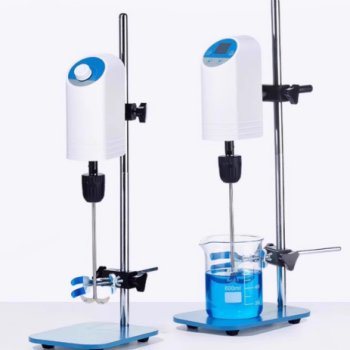
To successfully load platinum (Pt) onto composite supports using the sodium borohydride reduction precipitation method, the fundamental equipment requirement is a chemical reaction vessel integrated with high-precision stirring capabilities. This hardware setup is strictly necessary to manage the liquid-phase environment where sodium borohydride (NaBH4) acts as a reducing agent within a solvent such as ethylene glycol.

The core objective of this equipment is not just to mix reagents, but to maintain precise liquid-phase control. This ensures platinum deposits as highly dispersed nanoparticles, maximizing the electrochemical active surface area rather than forming large, ineffective clusters.

The Core Hardware Architecture

To achieve the optimal interaction between the metal and the support, your equipment must address two specific mechanical needs: containment and agitation.

The Chemical Reaction Vessel

The foundation of the process is the reaction vessel itself. It must be chemically compatible with organic solvents like ethylene glycol, which is commonly used as the medium for this reduction process.

The vessel acts as the controlled environment where the platinum precursors meet the composite supports. It must be robust enough to handle the introduction of sodium borohydride (NaBH4), a strong reducing agent, without degrading or contaminating the mixture.

Precision Stirring Functions

The reference explicitly highlights the need for precision stirring functions. Standard mixing is often insufficient for this specific method.

You need a mechanism that provides consistent, vigorous agitation throughout the entire liquid volume. This prevents the platinum from settling or agglomerating unevenly on the support structure.

The Impact of Equipment on Material Quality

The hardware you select directly dictates the microscopic structure of the final product. The equipment is the enabler of the chemical principles at play.

Achieving High Dispersion

The primary goal of the stirring mechanism is to ensure highly dispersed nanoparticles.

If the equipment allows for "dead zones" or inconsistent mixing speeds, the reduction of platinum precursors will be uneven. This leads to particle clumping, which significantly reduces the quality of the catalyst.

Maximizing Active Surface Area

The reference notes that the process is designed to maximize the electrochemical active surface area.

This property is strictly dependent on the equipment's ability to maintain a homogeneous suspension. Proper equipment ensures that the platinum nanoparticles deposit uniformly onto the oxide components of the support.

Understanding the Trade-offs

While the method is effective, relying on precision equipment introduces specific operational considerations.

Precision vs. Simplicity

The requirement for "precision stirring" implies that simple magnetic stir bars or manual mixing may be inadequate for high-performance applications.

You likely need mechanical overhead stirrers or varying-speed impellers to achieve the necessary shear and flow. This increases the complexity of the setup compared to simpler impregnation methods.

Sensitivity to Liquid-Phase Control

The process is sensitive. The reference emphasizes "precise liquid-phase control."

If your equipment cannot maintain stable agitation over the duration of the reduction, you sacrifice the interaction strength between the metal and the support. The equipment must be reliable enough to run continuously without fluctuation.

Making the Right Choice for Your Goal

When selecting or configuring your equipment for this precipitation method, prioritize the following based on your specific catalytic targets:

  • If your primary focus is Maximum Surface Area: Prioritize a stirring system with variable speed control to ensure the highest possible dispersion of nanoparticles without agglomeration.
  • If your primary focus is Support Interaction: Ensure your reaction vessel geometry allows for uniform flow, guaranteeing that the oxide components of the support are constantly exposed to the reducing agent.

Your equipment is not merely a container; it is the primary control variable that determines whether your platinum becomes a highly active catalyst or wasted material.

Summary Table:

Equipment Component Functional Requirement Impact on Pt Loading
Reaction Vessel Chemical resistance to ethylene glycol & NaBH4 Prevents contamination; ensures a stable environment.
Stirring System High-precision, variable-speed agitation Prevents particle agglomeration; ensures uniform dispersion.
Temperature Control Stable liquid-phase thermal management Regulates reduction kinetics for optimal nanoparticle size.
Flow Geometry Elimination of "dead zones" within the vessel Maximizes electrochemical active surface area (ECSA).

Elevate Your Catalyst Synthesis with KINTEK Precision

Achieving highly dispersed platinum nanoparticles requires more than just basic mixing; it demands professional-grade precision. KINTEK specializes in advanced laboratory equipment designed for rigorous chemical synthesis. From high-performance crushing and milling systems for support preparation to precision stirring solutions and high-temperature reactors, we provide the tools necessary to maximize your electrochemical active surface area.

Our value to you:

  • Precision Control: Optimized hardware for stable liquid-phase reduction.
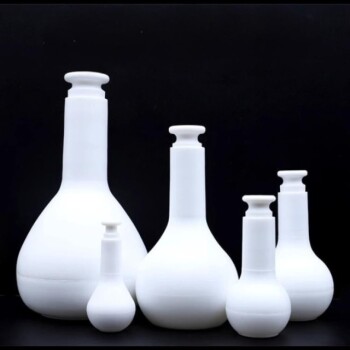
  • Comprehensive Range: Supporting your workflow from PTFE consumables and ceramics to ULT freezers for sample preservation.
  • Expertise: Tailored solutions for battery research, material science, and high-pressure applications.

Don't let inadequate equipment compromise your catalyst quality. Contact our technical team today to find the perfect setup for your lab!

Related Products

People Also Ask

Related Products

Vacuum Sealed Continuous Working Rotary Tube Furnace Rotating Tube Furnace

Vacuum Sealed Continuous Working Rotary Tube Furnace Rotating Tube Furnace

Experience efficient material processing with our vacuum-sealed rotary tube furnace. Perfect for experiments or industrial production, equipped with optional features for controlled feeding and optimized results. Order now.

Electric Rotary Kiln Continuous Working Small Rotary Furnace Heating Pyrolysis Plant

Electric Rotary Kiln Continuous Working Small Rotary Furnace Heating Pyrolysis Plant

Efficiently calcine and dry bulk powder and lump fluid materials with an electric heating rotary furnace. Ideal for processing lithium ion battery materials and more.

Horizontal High Temperature Graphite Vacuum Graphitization Furnace

Horizontal High Temperature Graphite Vacuum Graphitization Furnace

Horizontal Graphitization Furnace: This type of furnace is designed with the heating elements placed horizontally, allowing for uniform heating of the sample. It's well-suited for graphitizing large or bulky samples that require precise temperature control and uniformity.

Laboratory Vacuum Tilt Rotary Tube Furnace Rotating Tube Furnace

Laboratory Vacuum Tilt Rotary Tube Furnace Rotating Tube Furnace

Discover the versatility of Laboratory Rotary Furnace: Ideal for calcination, drying, sintering, and high-temperature reactions. Adjustable rotating and tilting functions for optimal heating. Suitable for vacuum and controlled atmosphere environments. Learn more now!

Vacuum Hot Press Furnace Machine Heated Vacuum Press

Vacuum Hot Press Furnace Machine Heated Vacuum Press

Discover the advantages of Vacuum Hot Press Furnace! Manufacture dense refractory metals & compounds, ceramics, and composites under high temp and pressure.

600T Vacuum Induction Hot Press Furnace for Heat Treat and Sintering

600T Vacuum Induction Hot Press Furnace for Heat Treat and Sintering

Discover the 600T Vacuum Induction Hot Press Furnace, designed for high-temperature sintering experiments in vacuum or protected atmospheres. Its precise temperature and pressure control, adjustable working pressure, and advanced safety features make it ideal for nonmetal materials, carbon composites, ceramics, and metal powders.

Ultra-High Temperature Graphite Vacuum Graphitization Furnace

Ultra-High Temperature Graphite Vacuum Graphitization Furnace

The ultra-high temperature graphitization furnace utilizes medium frequency induction heating in a vacuum or inert gas environment. The induction coil generates an alternating magnetic field, inducing eddy currents in the graphite crucible, which heats up and radiates heat to the workpiece, bringing it to the desired temperature. This furnace is primarily used for graphitization and sintering of carbon materials, carbon fiber materials, and other composite materials.

1200℃ Split Tube Furnace with Quartz Tube Laboratory Tubular Furnace

1200℃ Split Tube Furnace with Quartz Tube Laboratory Tubular Furnace

KT-TF12 split tube furnace: high-purity insulation, embedded heating wire coils, and max. 1200C. Widely used for new materials and chemical vapour deposition.

Large Vertical Graphite Vacuum Graphitization Furnace

Large Vertical Graphite Vacuum Graphitization Furnace

A large vertical high-temperature graphitization furnace is a type of industrial furnace used for the graphitization of carbon materials, such as carbon fiber and carbon black. It is a high-temperature furnace that can reach temperatures of up to 3100°C.

Laboratory Rapid Thermal Processing (RTP) Quartz Tube Furnace

Laboratory Rapid Thermal Processing (RTP) Quartz Tube Furnace

Get lightning-fast heating with our RTP Rapid Heating Tube Furnace. Designed for precise, high-speed heating and cooling with convenient sliding rail and TFT touch screen controller. Order now for ideal thermal processing!

Graphite Vacuum Furnace High Thermal Conductivity Film Graphitization Furnace

Graphite Vacuum Furnace High Thermal Conductivity Film Graphitization Furnace

The high thermal conductivity film graphitization furnace has uniform temperature, low energy consumption and can operate continuously.

Graphite Vacuum Furnace Bottom Discharge Graphitization Furnace for Carbon Materials

Graphite Vacuum Furnace Bottom Discharge Graphitization Furnace for Carbon Materials

Bottom-out graphitization furnace for carbon materials, ultra-high temperature furnace up to 3100°C, suitable for graphitization and sintering of carbon rods and carbon blocks. Vertical design, bottom discharging, convenient feeding and discharging, high temperature uniformity, low energy consumption, good stability, hydraulic lifting system, convenient loading and unloading.

Vacuum Dental Porcelain Sintering Furnace

Vacuum Dental Porcelain Sintering Furnace

Get precise and reliable results with KinTek's Vacuum Porcelain Furnace. Suitable for all porcelain powders, it features hyperbolic ceramic furnace function, voice prompt, and automatic temperature calibration.

Vacuum Heat Treat and Sintering Furnace with 9MPa Air Pressure

Vacuum Heat Treat and Sintering Furnace with 9MPa Air Pressure

The air pressure sintering furnace is a high-tech equipment commonly used for the sintering of advanced ceramic materials. It combines vacuum sintering and pressure sintering techniques to achieve high-density and high-strength ceramics.

Multi Heating Zones CVD Tube Furnace Machine Chemical Vapor Deposition Chamber System Equipment

Multi Heating Zones CVD Tube Furnace Machine Chemical Vapor Deposition Chamber System Equipment

KT-CTF14 Multi Heating Zones CVD Furnace - Precise Temperature Control and Gas Flow for Advanced Applications. Max temp up to 1200℃, 4 channels MFC mass flow meter, and 7" TFT touch screen controller.

1400℃ Controlled Atmosphere Furnace with Nitrogen and Inert Atmosphere

1400℃ Controlled Atmosphere Furnace with Nitrogen and Inert Atmosphere

Achieve precise heat treatment with KT-14A controlled atmosphere furnace. Vacuum sealed with a smart controller, it's ideal for lab and industrial use up to 1400℃.

1200℃ Controlled Atmosphere Furnace Nitrogen Inert Atmosphere Furnace

1200℃ Controlled Atmosphere Furnace Nitrogen Inert Atmosphere Furnace

Discover our KT-12A Pro Controlled atmosphere furnace - high precision, heavy duty vacuum chamber, versatile smart touch screen controller, and excellent temperature uniformity up to 1200C. Ideal for both laboratory and industrial application.

Dental Porcelain Zirconia Sintering Ceramic Vacuum Press Furnace

Dental Porcelain Zirconia Sintering Ceramic Vacuum Press Furnace

Get precise dental results with Dental Vacuum Press Furnace. Automatic temperature calibration, low noise tray, and touch screen operation. Order now!

Vertical High Temperature Graphite Vacuum Graphitization Furnace

Vertical High Temperature Graphite Vacuum Graphitization Furnace

Vertical high temperature graphitization furnace for carbonization and graphitization of carbon materials up to 3100℃.Suitable for shaped graphitization of carbon fiber filaments and other materials sintered in a carbon environment.Applications in metallurgy, electronics, and aerospace for producing high-quality graphite products like electrodes and crucibles.

Small Vacuum Heat Treat and Tungsten Wire Sintering Furnace

Small Vacuum Heat Treat and Tungsten Wire Sintering Furnace

The small vacuum tungsten wire sintering furnace is a compact experimental vacuum furnace specially designed for universities and scientific research institutes. The furnace features a CNC welded shell and vacuum piping to ensure leak-free operation. Quick-connect electrical connections facilitate relocation and debugging, and the standard electrical control cabinet is safe and convenient to operate.


Leave Your Message